
Science
Researchers Develop Innovative Dry-Process for Battery Electrodes

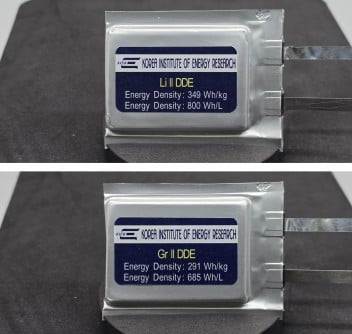
A collaborative research team led by Dr. Gyujin Song from the Korea Institute of Energy Research, along with Dr. Kwon-Hyung Lee from the University of Cambridge and Professor Tae-Hee Kim from the University of Ulsan, has developed a groundbreaking dry-process technology for manufacturing secondary battery electrodes. This innovation addresses critical limitations associated with traditional electrode fabrication methods.
The new dry-process technology creates a dual-fibrous structure within the electrode, producing both thin “thread-like” fibers and thicker “rope-like” fibers. This dual-fiber architecture effectively mitigates the common issues of low mixing strength and performance degradation found in conventional dry processes. Traditional battery manufacturing methods are categorized into wet and dry processes, with the wet process currently dominating due to its reliability and performance benefits.
In the wet process, an adhesive binder is dissolved in a solvent, facilitating uniform mixing of electrode materials. However, this method relies heavily on toxic organic solvents, which pose environmental challenges and increase production costs due to lengthy drying and solvent recovery times. The new dry process eliminates the use of solvents, thereby reducing environmental impact and energy consumption while enabling faster processing times.
Despite the advantages of solvent-free production, conventional dry processes have been hindered by limited binder material options, primarily relying on polytetrafluoroethylene (PTFE). PTFE, known for its heat and chemical resistance, has been used in everyday products like Teflon cookware. Yet, using PTFE in a dry process has led to difficulties in achieving uniform mixing of electrode materials, which can compromise battery performance and durability.
To overcome these challenges, the research team focused on enhancing the structural properties of PTFE rather than changing the binder material. They devised a multi-step process that divides the binder addition into two stages. Initially, a small amount of binder is introduced, creating a fine, thread-like fibrous network that connects the active material and conductive additives. In the second stage, the remaining binder is added, maintaining the fibrous network while forming additional robust, rope-like fibers.
This innovative approach results in a uniform distribution of materials within the electrode, which enhances reaction consistency and overall battery performance. The thick, rope-like fibers provide significant mechanical stability and strength, ensuring the electrode’s durability in mass production settings. Analysis through electrochemical reaction-resistance mapping has shown that the electrode exhibits fast, uniform reaction kinetics, minimizing energy loss during operation and extending the battery’s lifespan.
Performance evaluations indicate that the newly developed dry electrode achieves a commendable areal capacity of 10.1 mAh/cm2. A pouch-type lithium metal anode cell utilizing this electrode reached an energy density of 349 Wh/kg, approximately 40% higher than the typical commercial electrodes, which average around 250 Wh/kg. Additionally, a pouch cell using a graphite anode achieved an energy density of 291 Wh/kg, about 20% more than that of wet-process cells under similar conditions.
Dr. Gyujin Song highlighted the significance of this research, stating, “This study is highly significant in that we have established an original process technology capable of simultaneously resolving the two core challenges of dry electrodes: electrochemical uniformity and mechanical durability.” He further emphasized its potential impact on the cost competitiveness of the secondary battery industry, with applications anticipated in electric vehicles and energy storage systems, which require high energy densities.
This research was conducted with support from the Ministry of Science and ICT’s “Global TOP Research Program” and “Creative Allied Project.” The findings were published in the September 2023 issue of Energy & Environmental Science, a prestigious journal in the energy and environmental field.

Discover the Top 10 White Elephant Gifts Under $30 Right Now

Alexander Skarsgård Stars in Gothic Horror Film ‘The Wolf Will Tear Your Immaculate Hands’

James Cameron Praises Netflix’s K-Pop Demon Hunters Amid Cinema Concerns

Dallas Greyhound Terminal Closure Sparks New Development Opportunities

Vigil Held for Stabbed Social Worker at San Francisco Hospital

Parents Seek Creative Ways to Celebrate Son’s 40th Birthday

Researchers Develop Innovative Dry-Process for Battery Electrodes

Vanderbilt Football Prepares for ReliaQuest Bowl Showdown

Firefighter Dies as Wildfires Devastate Australia’s Landscape

Urgent Update: Tom Aspinall’s Vision Deteriorates After UFC 321

University of Hawaiʻi Joins $25.6M AI Project to Enhance Disaster Monitoring

MIT Scientists Uncover Surprising Genomic Loops During Cell Division

AI Disruption: AWS Faces Threat as Startups Shift Cloud Focus

Time Crystals Revolutionize Quantum Computing Potential

Discover the Full Map of Pokémon Legends: Z-A’s Lumiose City

Parenthood Set to Depart Hulu: What Fans Need to Know

GOP Faces Backlash as Protests Surge Against Trump Policies

Honeywell Forecasts Record Business Jet Deliveries Over Next Decade
-
 Top Stories1 month ago
Urgent Update: Tom Aspinall’s Vision Deteriorates After UFC 321
-
Science1 month ago
University of Hawaiʻi Joins $25.6M AI Project to Enhance Disaster Monitoring
-
 Health2 months ago
MIT Scientists Uncover Surprising Genomic Loops During Cell Division
-
 Top Stories2 months ago
AI Disruption: AWS Faces Threat as Startups Shift Cloud Focus
-
 Science2 months ago
Time Crystals Revolutionize Quantum Computing Potential
-
 Entertainment2 months ago
Discover the Full Map of Pokémon Legends: Z-A’s Lumiose City
-
 Entertainment2 months ago
Parenthood Set to Depart Hulu: What Fans Need to Know
-
 Top Stories2 months ago
GOP Faces Backlash as Protests Surge Against Trump Policies
-
 World2 months ago
Honeywell Forecasts Record Business Jet Deliveries Over Next Decade
-

 Politics2 months ago
Judge Signals Dismissal of Chelsea Housing Case Citing AI Flaws
-

 Health2 months ago
Maine Insurers Cut Medicare Advantage Plans Amid Cost Pressures
-

 Sports2 months ago
Yoshinobu Yamamoto Shines in Game 2, Leading Dodgers to Victory