
Top Stories
CEOs Embrace AI Daily: Transforming Workflows Now!

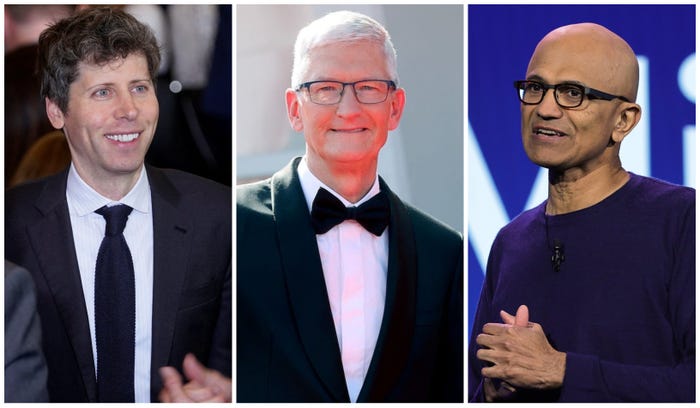
UPDATE: Top CEOs are revolutionizing their work and personal lives through the rapid adoption of artificial intelligence (AI), integrating it into daily tasks. This trend is not just a tech fad; it’s reshaping how leaders operate in an increasingly digital world.
As the AI market is projected to reach $4.8 trillion by 2033, these CEOs are leveraging AI for efficiency, creativity, and even parenting. From Satya Nadella at Microsoft to Tim Cook at Apple, here’s how these industry giants are making AI a daily necessity.
Satya Nadella, Microsoft’s CEO since 2014, utilizes AI tools to streamline his workflow. He uploads podcast transcripts to Microsoft’s Copilot app for discussion during his commute. Once at headquarters in Redmond, Washington, Nadella relies on Copilot to summarize emails and meetings, stating, “I’m an email typist.” His use of at least 10 custom agents showcases how crucial AI has become for his productivity.
Meanwhile, Sam Altman, CEO of OpenAI, famously known for ChatGPT, reveals that he employs AI for mundane tasks, including email management and parenting. “I don’t know how I would have done that,” Altman said about using AI to navigate fatherhood with his newborn. His insights highlight AI’s capability to enhance everyday life, proving invaluable to busy executives.
Over at Nvidia, Jensen Huang harnesses AI as a personal tutor, saying, “I use it as a tutor every day.” He emphasizes AI’s role in learning complex subjects, demonstrating how it can democratize knowledge. Huang’s company, valued at over $3 trillion, is at the forefront of AI research and applications, pushing the boundaries of technology.
At Apple, Tim Cook has introduced Apple Intelligence, which helps him summarize lengthy emails. “It’s changed my life,” Cook noted, showcasing how even small time savings can accumulate into significant productivity gains over time. This innovation positions Apple as a key player in the AI landscape.
Real estate tech is also getting in on the action. Jeremy Wacksman, CEO of Zillow, reported using AI to summarize documentation and meetings, allowing a personalized approach to information management. He encourages his staff to innovate with AI, holding “AI days” to celebrate advancements.
In the cryptocurrency world, Brian Armstrong, CEO of Coinbase, is pushing boundaries with AI by employing it in decision-making processes. He mentioned a recent instance of “AI to AI crypto transactions,” illustrating the innovative uses of AI in financial technology. Armstrong’s approach emphasizes the urgency for teams to integrate AI, even leading to firings for non-compliance.
LinkedIn’s Ryan Roslansky likened AI to “having a second brain,” particularly for drafting critical communications to other executives. His use of Microsoft’s Copilot reflects a broader trend among leaders relying on AI to enhance communication effectiveness.
In healthcare, David Ricks of Eli Lilly is pioneering AI-powered platforms for drug discovery, stating, “I have at least one or two AIs running every minute of every meeting.” This approach underscores the potential of AI to revolutionize the pharmaceutical industry by accelerating research and development.
As AI continues to permeate various sectors, the implications for productivity and innovation are profound. The rapid integration of AI by these CEOs serves as a powerful testament to its transformative potential.
WHAT’S NEXT: As AI technology evolves, keep an eye on how these leaders adapt their strategies. The ongoing integration of AI into daily operations could set new standards across industries. AI’s role will likely expand even further, reshaping not just workflows but entire business models in the coming years.
Stay tuned for more updates on how AI is influencing the highest levels of corporate leadership and beyond.

Church Members Rally Together After Thanksgiving Fire Devastation

U.S. Investment in Canadian Energy Firms Surges Despite Low Oil Prices

Nick Jonas Unveils New Solo Album ‘Sunday Best’ Set for February Release

Researchers Urge Label Changes for Low-Alcohol Drinks to Aid Pregnant Women

Wedding Cookie Table Community Aims for World’s Largest Cookie Exchange

Mayor Appoints Alan Wong as New Supervisor for District 4

UK Report Reveals Growing Role of AI in University Research Assessments

Mayor Lurie Appoints Alan Wong as New District 4 Supervisor

South Korea Strengthens FX Oversight in Urgent Market Stabilization

Urgent Update: Tom Aspinall’s Vision Deteriorates After UFC 321

MIT Scientists Uncover Surprising Genomic Loops During Cell Division

University of Hawaiʻi Joins $25.6M AI Project to Enhance Disaster Monitoring

AI Disruption: AWS Faces Threat as Startups Shift Cloud Focus

Time Crystals Revolutionize Quantum Computing Potential

Honeywell Forecasts Record Business Jet Deliveries Over Next Decade

Discover the Full Map of Pokémon Legends: Z-A’s Lumiose City

Parenthood Set to Depart Hulu: What Fans Need to Know

GOP Faces Backlash as Protests Surge Against Trump Policies
-
 Top Stories1 month ago
Urgent Update: Tom Aspinall’s Vision Deteriorates After UFC 321
-
 Health1 month ago
MIT Scientists Uncover Surprising Genomic Loops During Cell Division
-
Science4 weeks ago
University of Hawaiʻi Joins $25.6M AI Project to Enhance Disaster Monitoring
-
 Top Stories1 month ago
AI Disruption: AWS Faces Threat as Startups Shift Cloud Focus
-
 Science2 months ago
Time Crystals Revolutionize Quantum Computing Potential
-
 World2 months ago
Honeywell Forecasts Record Business Jet Deliveries Over Next Decade
-
 Entertainment1 month ago
Discover the Full Map of Pokémon Legends: Z-A’s Lumiose City
-
 Entertainment2 months ago
Parenthood Set to Depart Hulu: What Fans Need to Know
-
 Top Stories2 months ago
GOP Faces Backlash as Protests Surge Against Trump Policies
-

 Politics2 months ago
Judge Signals Dismissal of Chelsea Housing Case Citing AI Flaws
-

 Sports2 months ago
Yoshinobu Yamamoto Shines in Game 2, Leading Dodgers to Victory
-

 Health2 months ago
Maine Insurers Cut Medicare Advantage Plans Amid Cost Pressures