
Top Stories
Tesla’s New Budget Models Fail to Compete with Chinese Rivals

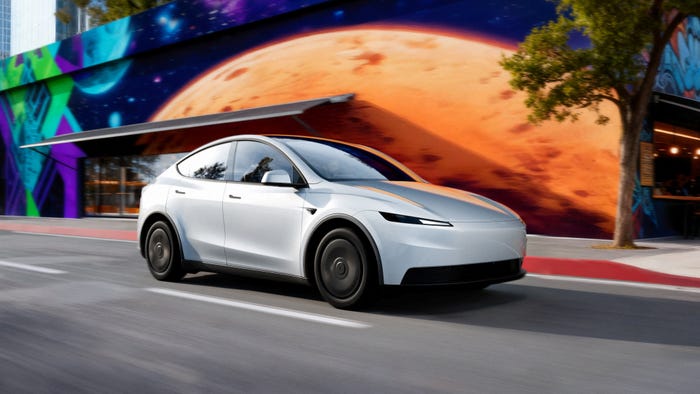
URGENT UPDATE: Tesla has just unveiled its long-anticipated “affordable” versions of the Model Y and Model 3, priced at $40,000 and $37,000, respectively. However, industry experts warn these new models may not be enough to fend off fierce competition from Chinese electric vehicle (EV) manufacturers.
Ex-Nissan COO Andy Palmer, known as the “godfather of EVs,” expressed skepticism in an interview with Business Insider. He claims that while Tesla’s new Standard models aim to capture a more budget-conscious segment, they lack essential features that make them competitive against China’s rapidly advancing EV market.
“If you take out the features — and Tesla has taken out an awful lot of features — then that creates a new price point, but that new price point doesn’t make it competitive with the Chinese competition,” Palmer stated. He emphasized that Tesla’s stripped-down models do not meet the demand for truly affordable EVs in the U.S.
The new Model 3 and Model Y standard versions, launched last week, come without key features like Autosteer, rear screens, and radios, leaving investors and fans underwhelmed. Following the announcement, Tesla’s share price experienced a notable decline. Palmer stresses that the U.S. market needs electric vehicles priced below $30,000 with full specifications to truly compete.
Despite Tesla’s efforts to provide more budget-friendly options, the company faces increasing pressure from Chinese manufacturers like BYD and Geely. Although these brands do not currently sell their cars in the U.S. due to tariffs, they are gaining significant market share in Europe and other regions such as Brazil and Mexico. BYD, for instance, has seen a surge in sales of its affordable electric and hybrid vehicles, even as Tesla’s sales have dropped.
“It isn’t such a big problem in the U.S., but elsewhere you have Chinese models that are coming in with lots of features at a very good price point,” Palmer noted, highlighting the competitive edge of Chinese automakers. He added, “Stripping back a car doesn’t help you.”
Chinese manufacturers have prioritized high-tech features, including autonomous driving and AI assistants, to attract customers. BYD revealed plans in February to integrate advanced self-driving tech into all its vehicles, including its budget model, the $8,000 Seagull. Meanwhile, Xiaomi’s $30,000 SU7 sedan allows drivers to control home appliances directly from the car.
Palmer, speaking from China, warned Western brands to wake up to the rising dominance of Chinese automakers. He urged them to develop strategies to compete rather than relying solely on tariffs for protection. “You have to address the issue rather than standing behind regulatory or tariff rules,” he said. “They’ll insulate you for a while, but don’t make the problem go away.”
As Tesla rolls out these new models, all eyes are on how the market will respond and what steps the company will take to strengthen its position against an increasingly aggressive Chinese EV sector. The heightened competition raises questions about the future of electric vehicles and affordability in the U.S. market.
Stay tuned for more updates as this story develops.

Tottenville Falls Short in PSAL 4A Title Game Against Erasmus

Shark Teeth Study Reveals Urgent Clues to Prevent Extinction

Church Members Rally Together After Thanksgiving Fire Devastation

U.S. Investment in Canadian Energy Firms Surges Despite Low Oil Prices

Nick Jonas Unveils New Solo Album ‘Sunday Best’ Set for February Release

Researchers Urge Label Changes for Low-Alcohol Drinks to Aid Pregnant Women

Wedding Cookie Table Community Aims for World’s Largest Cookie Exchange

Mayor Appoints Alan Wong as New Supervisor for District 4

UK Report Reveals Growing Role of AI in University Research Assessments

Urgent Update: Tom Aspinall’s Vision Deteriorates After UFC 321

MIT Scientists Uncover Surprising Genomic Loops During Cell Division

University of Hawaiʻi Joins $25.6M AI Project to Enhance Disaster Monitoring

AI Disruption: AWS Faces Threat as Startups Shift Cloud Focus

Time Crystals Revolutionize Quantum Computing Potential

Honeywell Forecasts Record Business Jet Deliveries Over Next Decade

Discover the Full Map of Pokémon Legends: Z-A’s Lumiose City

GOP Faces Backlash as Protests Surge Against Trump Policies

Parenthood Set to Depart Hulu: What Fans Need to Know
-
 Top Stories1 month ago
Urgent Update: Tom Aspinall’s Vision Deteriorates After UFC 321
-
 Health1 month ago
MIT Scientists Uncover Surprising Genomic Loops During Cell Division
-
Science4 weeks ago
University of Hawaiʻi Joins $25.6M AI Project to Enhance Disaster Monitoring
-
 Top Stories1 month ago
AI Disruption: AWS Faces Threat as Startups Shift Cloud Focus
-
 Science2 months ago
Time Crystals Revolutionize Quantum Computing Potential
-
 World2 months ago
Honeywell Forecasts Record Business Jet Deliveries Over Next Decade
-
 Entertainment1 month ago
Discover the Full Map of Pokémon Legends: Z-A’s Lumiose City
-
 Top Stories2 months ago
GOP Faces Backlash as Protests Surge Against Trump Policies
-
 Entertainment2 months ago
Parenthood Set to Depart Hulu: What Fans Need to Know
-

 Politics2 months ago
Judge Signals Dismissal of Chelsea Housing Case Citing AI Flaws
-

 Sports2 months ago
Yoshinobu Yamamoto Shines in Game 2, Leading Dodgers to Victory
-

 Health2 months ago
Maine Insurers Cut Medicare Advantage Plans Amid Cost Pressures