
Science
Researchers Uncover Ice Records in Mars’ Craters, Revealing Planet’s History

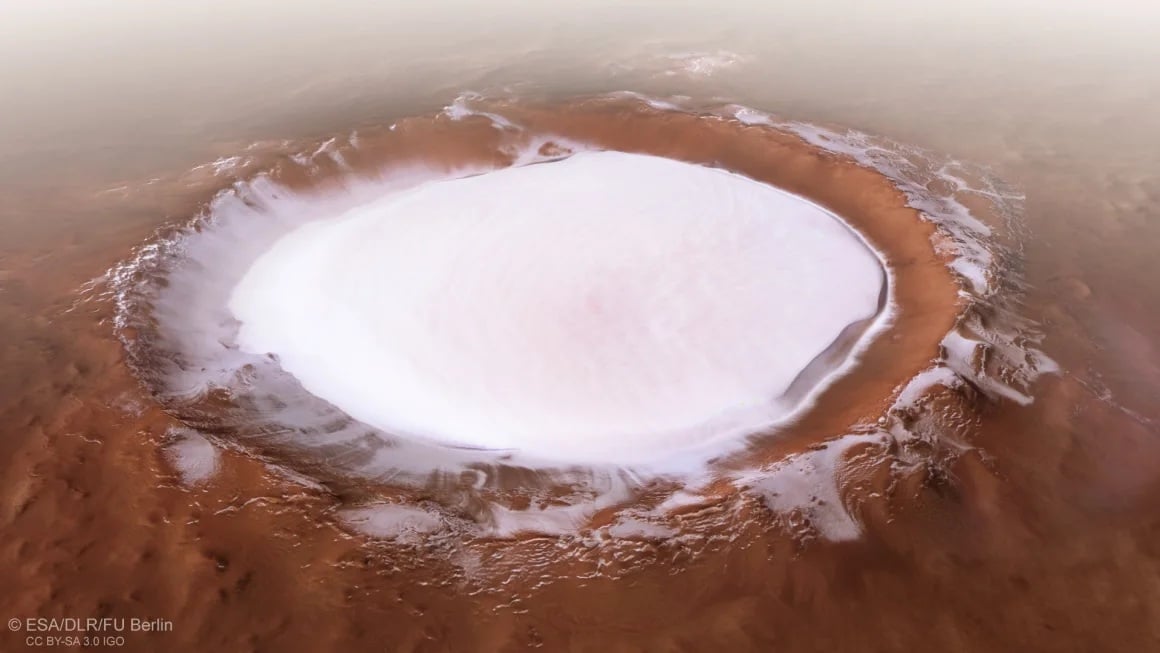
Recent research has unveiled significant findings about Mars, indicating that ice deposits within its craters hold critical clues to the planet’s climatic history. A team of researchers from Japan, led by Trishit Ruj, an associate professor at the Institute for Planetary Materials at Okayama University, has published their study in the journal Geology. Their work suggests that the ice layers in these craters chronicle numerous ice ages that have shaped Mars over hundreds of millions of years.
The Martian landscape is marked by features that point to a time when the planet was significantly warmer and wetter. This includes evidence of river channels, delta fans, and sedimentary deposits that suggest the existence of rivers, lakes, and even an ocean in its northern hemisphere. As scientists continue to explore these features, pressing questions arise regarding the volume of water that once flowed on Mars and the factors that led to its transformation into a cold, arid world.
The research team focused on glacial landforms found in craters located between 20°N and 45°N latitude on Mars. Utilizing high-resolution images captured by the Mars Reconnaissance Orbiter (MRO), specifically the Context Camera (CTX) and the High-Resolution Imaging Science Experiment (HiRISE), they identified craters exhibiting signs of glaciation. These included ridges, debris left by ancient ice sheets, and maze-like pit formations.
As the study progressed, researchers noted that the ice deposits consistently formed in shaded areas, particularly on the southwestern walls of these craters. This pattern persisted over multiple glacial periods during the Amazonian period, which lasted from approximately 640 to 98 million years ago.
Dr. Ruj explained in a press release that climate shifts on Mars, similar to those on Earth, are influenced by changes in the planet’s axial tilt, or obliquity. Mars’ axial tilt, which can change significantly over time, leads to cycles of glaciation followed by thawing periods. The findings indicate that Mars has gradually dried out during the Amazonian Era, the most recent and longest geological period in its history.
The implications of this research extend beyond understanding Mars’ past. The insights gained could be vital for future crewed missions to the planet, which will need to utilize local resources for sustaining life. The presence of water ice could facilitate the production of drinking water, oxygen, and even fuel, all essential for long-duration missions.
Given the lengthy travel time between Earth and Mars—typically six to nine months using conventional propulsion—relying on in-situ resource utilization (ISRU) becomes critical for the success of human exploration.
Moreover, the techniques employed to study Martian ice deposits may also offer valuable applications on Earth. As climate change accelerates the melting of glaciers and ice caps, the methodologies used in Mars research could assist scientists in monitoring changes in ice and water reserves globally.
Dr. Hasegawa from Kochi University noted, “Mars serves as a natural laboratory for understanding how ice behaves over vast timescales. The insights we gain here can sharpen our understanding of climate processes on Earth as well.”
This research not only contributes to our understanding of Mars but also highlights the interconnectedness of planetary science and climate studies, emphasizing the importance of utilizing findings from other worlds to address challenges on our own. As we continue to explore the cosmos, the lessons learned from Mars may prove invaluable for both future exploration and for combating climate issues here on Earth.

Bitcoin Plummets Below $88K Amid Tether Concerns and Warnings

Tottenville Falls Short in PSAL 4A Title Game Against Erasmus

Shark Teeth Study Reveals Urgent Clues to Prevent Extinction

Church Members Rally Together After Thanksgiving Fire Devastation

U.S. Investment in Canadian Energy Firms Surges Despite Low Oil Prices

Nick Jonas Unveils New Solo Album ‘Sunday Best’ Set for February Release

Researchers Urge Label Changes for Low-Alcohol Drinks to Aid Pregnant Women

Wedding Cookie Table Community Aims for World’s Largest Cookie Exchange

Mayor Appoints Alan Wong as New Supervisor for District 4

Urgent Update: Tom Aspinall’s Vision Deteriorates After UFC 321

MIT Scientists Uncover Surprising Genomic Loops During Cell Division

University of Hawaiʻi Joins $25.6M AI Project to Enhance Disaster Monitoring

AI Disruption: AWS Faces Threat as Startups Shift Cloud Focus

Time Crystals Revolutionize Quantum Computing Potential

Honeywell Forecasts Record Business Jet Deliveries Over Next Decade

Discover the Full Map of Pokémon Legends: Z-A’s Lumiose City

GOP Faces Backlash as Protests Surge Against Trump Policies

Parenthood Set to Depart Hulu: What Fans Need to Know
-
 Top Stories1 month ago
Urgent Update: Tom Aspinall’s Vision Deteriorates After UFC 321
-
 Health1 month ago
MIT Scientists Uncover Surprising Genomic Loops During Cell Division
-
Science4 weeks ago
University of Hawaiʻi Joins $25.6M AI Project to Enhance Disaster Monitoring
-
 Top Stories1 month ago
AI Disruption: AWS Faces Threat as Startups Shift Cloud Focus
-
 Science2 months ago
Time Crystals Revolutionize Quantum Computing Potential
-
 World2 months ago
Honeywell Forecasts Record Business Jet Deliveries Over Next Decade
-
 Entertainment1 month ago
Discover the Full Map of Pokémon Legends: Z-A’s Lumiose City
-
 Top Stories2 months ago
GOP Faces Backlash as Protests Surge Against Trump Policies
-
 Entertainment2 months ago
Parenthood Set to Depart Hulu: What Fans Need to Know
-

 Politics2 months ago
Judge Signals Dismissal of Chelsea Housing Case Citing AI Flaws
-

 Sports2 months ago
Yoshinobu Yamamoto Shines in Game 2, Leading Dodgers to Victory
-

 Health2 months ago
Maine Insurers Cut Medicare Advantage Plans Amid Cost Pressures