
Science
Scientists Discover Life’s Building Blocks in Ice Outside Milky Way

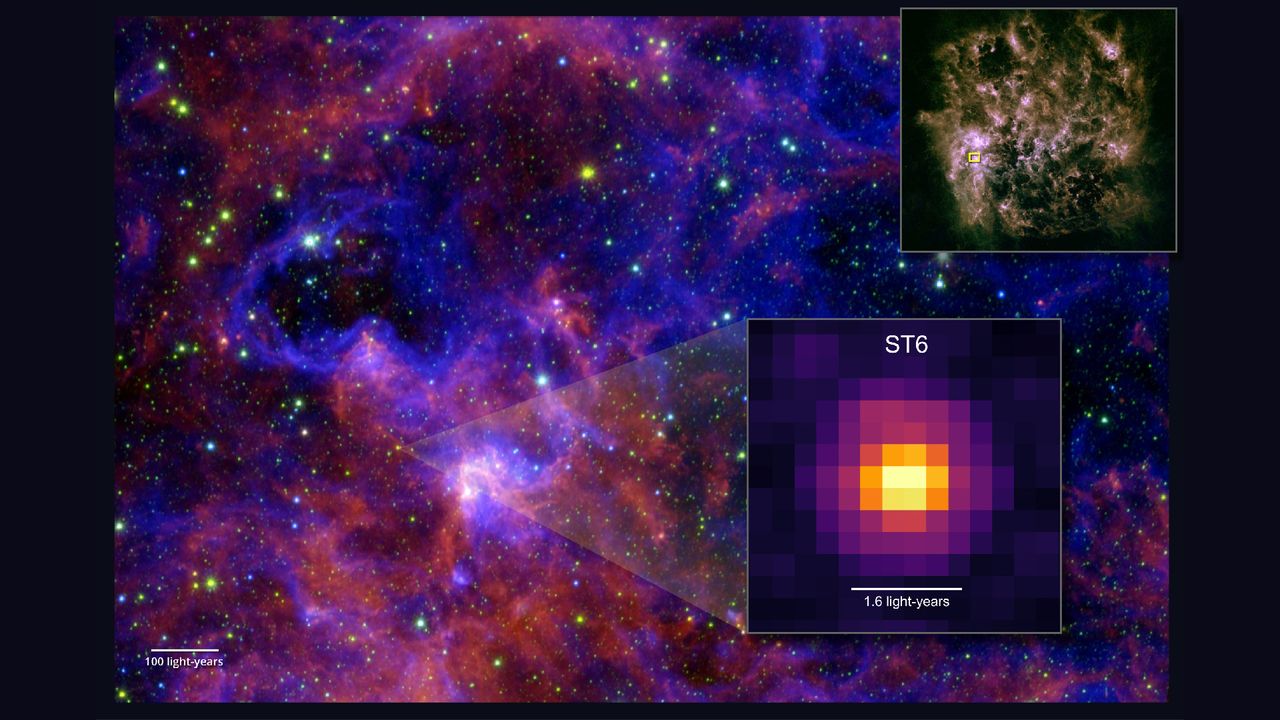
For the first time, scientists have detected multiple complex building blocks of life in the ice surrounding a star outside the Milky Way. Utilizing the James Webb Space Telescope (JWST), researchers identified five significant carbon-based compounds around a protostar known as ST6 in the Large Magellanic Cloud (LMC), a nearby dwarf galaxy approximately 160,000 light-years from Earth. This groundbreaking discovery, detailed in a study published on October 20 in the Astrophysical Journal Letters, offers new insights into the formation of complex molecules in the early universe.
The LMC, which orbits closely to the Milky Way, is characterized by its hot, luminous stars that emit copious amounts of ultraviolet radiation. Unlike the Milky Way, it contains fewer elements heavier than helium, creating conditions that resemble those expected in galaxies from the universe’s infancy. According to Marta Sewilo, an astronomer at the University of Maryland and NASA’s Goddard Space Flight Center, “What we learn in the Large Magellanic Cloud, we can apply to understanding these more distant galaxies from when the universe was much younger.”
During their observations in March 2024, the researchers focused on the developing star ST6 and discovered five complex carbon-based molecules in the icy environment surrounding the star: methanol, acetaldehyde, ethanol, methyl formate, and acetic acid. Notably, only methanol had previously been detected in protostars outside the Milky Way, while acetic acid, a primary component of vinegar, had never been conclusively identified in space ice before this study.
Sewilo noted, “Before Webb, methanol had been the only complex organic molecule conclusively detected in ice around protostars, even in our own galaxy. The exceptional quality of our new observations helped us gather an immense amount of information from a single spectrum, more than we’ve ever had before.”
The researchers also detected potential signals indicative of glycolaldehyde, a molecule that can react with others to form ribose, a crucial component of ribonucleic acid (RNA), which is essential for life. This discovery is significant, as it suggests that complex molecules can form through chemical reactions on dust grain surfaces, even under harsh conditions.
The implications of finding such complex molecules in the LMC are profound. It indicates that the building blocks of life may be more widespread in the universe than previously thought. The research team plans to conduct further studies to search for these and similar molecules around other protostars in both the Milky Way and nearby galaxies.
With this groundbreaking discovery, Sewilo remarked, “We’ve made significant advancements in understanding how complex chemistry emerges in the universe and opened new possibilities for research into how life came to be.” The findings not only advance our understanding of organic chemistry in primitive environments but also pave the way for future explorations into the origins of life beyond our planet.

Woman Arrested for Threatening U-Haul Worker with Baton

Japan’s PM Takaichi Vows Urgent Fiscal Management Amid Rate Trends

Bitcoin Plummets Below $88K Amid Tether Concerns and Warnings

Tottenville Falls Short in PSAL 4A Title Game Against Erasmus

Shark Teeth Study Reveals Urgent Clues to Prevent Extinction

Church Members Rally Together After Thanksgiving Fire Devastation

U.S. Investment in Canadian Energy Firms Surges Despite Low Oil Prices

Nick Jonas Unveils New Solo Album ‘Sunday Best’ Set for February Release

Researchers Urge Label Changes for Low-Alcohol Drinks to Aid Pregnant Women

Urgent Update: Tom Aspinall’s Vision Deteriorates After UFC 321

MIT Scientists Uncover Surprising Genomic Loops During Cell Division

University of Hawaiʻi Joins $25.6M AI Project to Enhance Disaster Monitoring

AI Disruption: AWS Faces Threat as Startups Shift Cloud Focus

Time Crystals Revolutionize Quantum Computing Potential

Honeywell Forecasts Record Business Jet Deliveries Over Next Decade

Discover the Full Map of Pokémon Legends: Z-A’s Lumiose City

GOP Faces Backlash as Protests Surge Against Trump Policies

Parenthood Set to Depart Hulu: What Fans Need to Know
-
 Top Stories1 month ago
Urgent Update: Tom Aspinall’s Vision Deteriorates After UFC 321
-
 Health1 month ago
MIT Scientists Uncover Surprising Genomic Loops During Cell Division
-
Science4 weeks ago
University of Hawaiʻi Joins $25.6M AI Project to Enhance Disaster Monitoring
-
 Top Stories1 month ago
AI Disruption: AWS Faces Threat as Startups Shift Cloud Focus
-
 Science2 months ago
Time Crystals Revolutionize Quantum Computing Potential
-
 World2 months ago
Honeywell Forecasts Record Business Jet Deliveries Over Next Decade
-
 Entertainment1 month ago
Discover the Full Map of Pokémon Legends: Z-A’s Lumiose City
-
 Top Stories2 months ago
GOP Faces Backlash as Protests Surge Against Trump Policies
-
 Entertainment2 months ago
Parenthood Set to Depart Hulu: What Fans Need to Know
-

 Politics2 months ago
Judge Signals Dismissal of Chelsea Housing Case Citing AI Flaws
-

 Sports2 months ago
Yoshinobu Yamamoto Shines in Game 2, Leading Dodgers to Victory
-

 Health2 months ago
Maine Insurers Cut Medicare Advantage Plans Amid Cost Pressures