
Business
Bank of Canada Cuts Interest Rates to 2.25% Amid Weak Growth

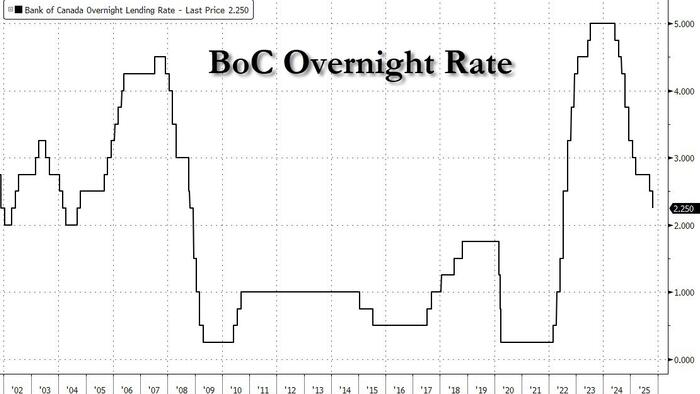
The Bank of Canada has reduced its benchmark interest rate by 25 basis points to 2.25% in response to sluggish economic growth. This decision aligns with market expectations and aims to maintain inflation near the target of 2% while supporting the economy during a period of structural adjustment. The central bank’s announcement comes amid reports that the Canadian economy contracted by 1.6% in the second quarter of 2023, reflecting increased uncertainty largely attributed to ongoing trade tensions with the United States.
In its statement, the Bank of Canada emphasized that the current policy rate is “about the right level” to foster economic stability. Despite the anticipated cut, the governing body acknowledged that the labor market remains weak, particularly in trade-sensitive sectors, where job losses have persisted. The unemployment rate stood at 7.1% in September, following two months of significant employment declines.
Impact of US Trade Policy
The central bank highlighted the unpredictable nature of US trade policy as a significant factor impacting Canada’s economic outlook. Trade tensions have dampened investment across various sectors, including autos, steel, aluminum, and lumber. The Bank projects that GDP growth will remain weak throughout the latter half of the year, although a modest recovery is expected in 2026 as consumer and government spending increases, alongside a rebound in exports and business investment.
Governor Tiff Macklem noted that the structural damage caused by the trade conflict has reduced the country’s productive capacity, which in turn complicates the role of monetary policy in stimulating demand while keeping inflation in check. He remarked, “The weakness we’re seeing in the Canadian economy is more than a cyclical downturn. It is also a structural transition.”
Future Projections and Market Reactions
The Bank of Canada’s latest Monetary Policy Report indicated that global economic growth is set to decrease from approximately 2% in 2025 to around 3% in 2026 and 2027. These projections underscore the potential long-term consequences of trade uncertainties. Despite recent cuts, the Bank remains prepared to adjust its policies should the economic outlook change.
Market reactions to the rate cut were subdued, as the decision was anticipated. The Canadian dollar initially dipped slightly against the US dollar, moving from 1.3929 to 1.3916, before stabilizing around 1.3925. This muted response reflects the consensus that the Bank of Canada is likely to maintain its current stance while observing the effects of its recent easing measures.
Overall, the Bank of Canada’s actions signify a cautious approach to navigating a complex economic landscape shaped by external pressures and internal adjustments.

Philadelphia Parks Launch Free Earth Month Events Starting April 1

Bradford’s Fish Fry Fridays Serve Community with Delicious Dinners

Trump Faces Growing Challenges Amid Rising Tensions with Iran

Scientists Probe the Universe’s Missing Topological Defects

Samsung Galaxy Watch 9 to Feature Larger 435mAh Battery

UConn Huskies Aim to Defend Title in 2026 NCAA Women’s Tournament

U.S. Littoral Combat Ships Dock in Malaysia Amid Regional Tensions

Healthy Choice Wellness Reports Quarterly Earnings, Shares Rise

Urgent News: Charles M. Payment Passes Away at 78 in Duluth

University of Hawaiʻi Joins $25.6M AI Project to Enhance Disaster Monitoring

Major Grant Enhances Cancer Care and Research in Hawaiʻi

Joleen Chaney, Beloved Journalist, Passes Leaving Lasting Legacy

San Francisco’s SFO to Welcome 16 Airlines with Nonstop Flights to Europe in 2026

Goldman Sachs Unveils 2026 Catalyst Playbook for Biotech Investors

Discover Top Business Smartphones for Professionals in 2026

Urgent Update: Tom Aspinall’s Vision Deteriorates After UFC 321

Texas Roadhouse Honors Veterans with Free Meal Vouchers

CD Projekt Red Confirms No Release for The Witcher 4 in 2026
-
Science9 months ago
University of Hawaiʻi Joins $25.6M AI Project to Enhance Disaster Monitoring
-
 Health8 months ago
Major Grant Enhances Cancer Care and Research in Hawaiʻi
-
 Top Stories9 months ago
Joleen Chaney, Beloved Journalist, Passes Leaving Lasting Legacy
-
 World7 months ago
San Francisco’s SFO to Welcome 16 Airlines with Nonstop Flights to Europe in 2026
-
 Business8 months ago
Goldman Sachs Unveils 2026 Catalyst Playbook for Biotech Investors
-
 Business8 months ago
Discover Top Business Smartphones for Professionals in 2026
-
 Top Stories9 months ago
Urgent Update: Tom Aspinall’s Vision Deteriorates After UFC 321
-
 Lifestyle9 months ago
Texas Roadhouse Honors Veterans with Free Meal Vouchers
-
 Entertainment8 months ago
CD Projekt Red Confirms No Release for The Witcher 4 in 2026
-

 Top Stories10 months ago
AI Disruption: AWS Faces Threat as Startups Shift Cloud Focus
-

 Health10 months ago
MIT Scientists Uncover Surprising Genomic Loops During Cell Division
-

 Entertainment10 months ago
Discover the Full Map of Pokémon Legends: Z-A’s Lumiose City