
Science
Researchers Gather at BU to Explore Future of Self-Driving Labs

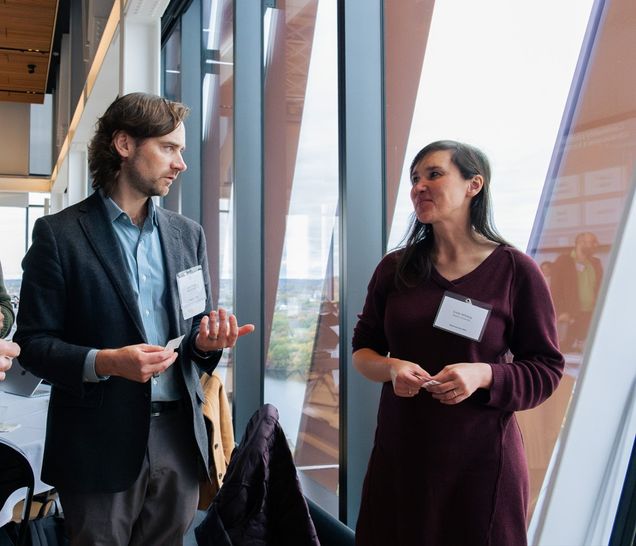
Last week, approximately 130 researchers convened on the 17th floor of Boston University’s Duan Family Center for Computing & Data Sciences for the tenth annual Materials Day. The event, titled “From Automation to Collaboration: The Future of Self-Driving Labs,” focused on advancements in automation for materials discovery. Sponsored by the Materials Science & Engineering (MSE) division of the Boston University College of Engineering and the Rafik B. Hariri Institute for Computing and Computational Science & Engineering, the workshop featured presentations from nine faculty speakers along with lightning talks from graduate students.
In her opening remarks, Elise Morgan, Dean of the College of Engineering, highlighted the integration of various disciplines in materials research at BU. She stated, “We think that convergent approach really helps address the complex challenges that aren’t solvable by single-discipline thinking alone.” Morgan emphasized the transformative potential of self-driving labs (SDLs) in democratizing research and enhancing its societal impact, particularly in the context of dwindling research funding.
Innovations in Self-Driving Labs
A self-driving lab utilizes robotic devices and machine learning to conduct numerous experiments, directed by human scientists. Keith Brown (ME, MSE, physics), who organized the event, showcased his lab’s innovative approach. His KABLab employs a system called the Bayesian experimental autonomous researcher (BEAR), which combines additive manufacturing and robotics. This lab has successfully identified the most efficient energy-absorbing material, suitable for applications in crash helmets and packaging.
Brown referenced the historical methods of Thomas Edison, stating, “The term ‘Edisonian’ has in some ways come to mean a brute-force approach that doesn’t leave room for thought.” He advocated for a balance between thoughtful inquiry and extensive experimentation, noting that automation can significantly enhance this process. Machine learning, he explained, allows software to select experiments, enabling researchers to conduct smarter and more efficient trials.
Another key speaker, Douglas Densmore (ECE, BME, MSE), emphasized the importance of reproducibility in scientific experiments. Densmore’s Design, Automation, Manufacturing and Processes (DAMP) Lab demonstrated its capabilities during the pandemic by processing up to 6,000 COVID-19 tests daily. He likened the lab’s operational efficiency to that of a fast-food franchise, where standardized processes ensure consistent results regardless of staff changes.
Applications in Polymer Research
Assistant Professor Joerg Werner (ME, MSE) discussed the applicability of SDLs in polymer materials research. He noted that polymers, used in packaging, coatings, and electronics, require careful processing to optimize their properties. Werner’s collaboration with Brown’s BEAR DEN aims to accelerate the development of innovative polymer films using advanced techniques such as electrodeposition.
During the event, various other speakers from institutions including MIT and Cornell University shared insights on topics ranging from Bayesian optimization to workforce development. Nadya Peek from the University of Washington explored how DIY approaches can lower barriers to automation, while Tonio Buonnassisi from MIT shared findings on reducing bottlenecks in material characterization.
The student lightning talks provided an opportunity for emerging researchers to present their work. Doctoral student Jiashuo Wang remarked on the value of community engagement, stating that discussions following the presentations fostered collaboration and knowledge sharing.
Community Engagement and Future Directions
A new feature of this year’s Materials Day was a community ideation exercise, where participants contributed open questions and challenges on sticky notes. This interactive element encouraged dialogue on various topics including hardware, software, and human-machine collaboration. Attendees moved through the room, engaging with each other’s ideas, which sparked discussions that could lead to future partnerships.
Yannis Paschalidis, Director of the Hariri Institute, underscored the significance of in-person gatherings, stating, “You need to hear from other people. Our oral history, this way of sharing is the best we’ve got right now.” The collaborative environment fostered at Materials Day exemplifies the importance of community in advancing research and innovation in the rapidly evolving field of materials science.

Knicks Dominate Raptors 116-94, Extend Home Winning Streak

Hallmark’s ‘Christmas at the Catnip Café’ Premieres Tonight

Woman Arrested for Threatening U-Haul Worker with Baton

Japan’s PM Takaichi Vows Urgent Fiscal Management Amid Rate Trends

Bitcoin Plummets Below $88K Amid Tether Concerns and Warnings

Tottenville Falls Short in PSAL 4A Title Game Against Erasmus

Shark Teeth Study Reveals Urgent Clues to Prevent Extinction

Church Members Rally Together After Thanksgiving Fire Devastation

U.S. Investment in Canadian Energy Firms Surges Despite Low Oil Prices

Urgent Update: Tom Aspinall’s Vision Deteriorates After UFC 321

MIT Scientists Uncover Surprising Genomic Loops During Cell Division

University of Hawaiʻi Joins $25.6M AI Project to Enhance Disaster Monitoring

AI Disruption: AWS Faces Threat as Startups Shift Cloud Focus

Time Crystals Revolutionize Quantum Computing Potential

Honeywell Forecasts Record Business Jet Deliveries Over Next Decade

Discover the Full Map of Pokémon Legends: Z-A’s Lumiose City

GOP Faces Backlash as Protests Surge Against Trump Policies

Parenthood Set to Depart Hulu: What Fans Need to Know
-
 Top Stories1 month ago
Urgent Update: Tom Aspinall’s Vision Deteriorates After UFC 321
-
 Health1 month ago
MIT Scientists Uncover Surprising Genomic Loops During Cell Division
-
Science4 weeks ago
University of Hawaiʻi Joins $25.6M AI Project to Enhance Disaster Monitoring
-
 Top Stories1 month ago
AI Disruption: AWS Faces Threat as Startups Shift Cloud Focus
-
 Science2 months ago
Time Crystals Revolutionize Quantum Computing Potential
-
 World2 months ago
Honeywell Forecasts Record Business Jet Deliveries Over Next Decade
-
 Entertainment1 month ago
Discover the Full Map of Pokémon Legends: Z-A’s Lumiose City
-
 Top Stories2 months ago
GOP Faces Backlash as Protests Surge Against Trump Policies
-
 Entertainment2 months ago
Parenthood Set to Depart Hulu: What Fans Need to Know
-

 Politics2 months ago
Judge Signals Dismissal of Chelsea Housing Case Citing AI Flaws
-

 Sports2 months ago
Yoshinobu Yamamoto Shines in Game 2, Leading Dodgers to Victory
-

 Health2 months ago
Maine Insurers Cut Medicare Advantage Plans Amid Cost Pressures