
Science
Physicists Converge at Brown University to Explore Higgs Boson Mysteries

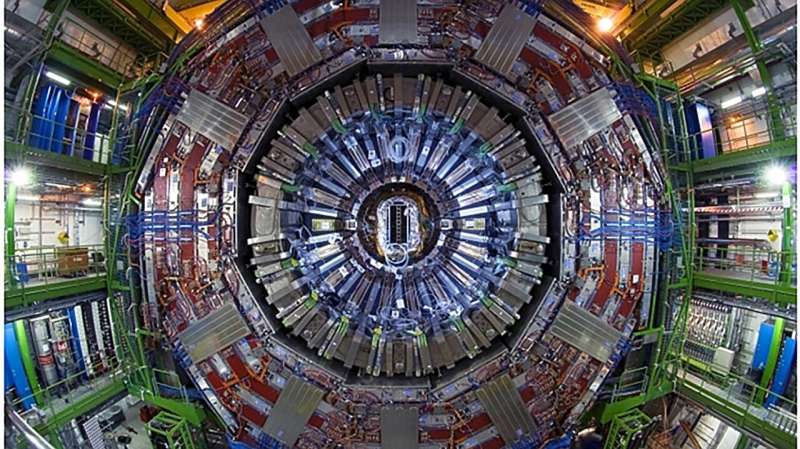
Researchers from around the globe gathered at Brown University in late October 2025 for the annual Higgs Conference, marking the first time the prestigious event was hosted at the university. This gathering focused on the complexities surrounding the Higgs boson, a particle whose discovery in July 2012 was hailed as a landmark achievement in particle physics. The findings were announced by scientists at the Large Hadron Collider (LHC) in Switzerland and earned the 2013 Nobel Prize in Physics.
The Higgs boson is integral to understanding how some elementary particles acquire mass. Key contributors to this discovery from Brown University include experimentalists David Cutts, Ulrich Heintz, Greg Landsberg, and the late Meenakshi Narain. Theoretical predictions about the Higgs were formulated earlier by Gerald Guralnik, whose work laid the groundwork for the particle’s identification.
Despite the pivotal discovery, fundamental questions about the Higgs remain unanswered. During the conference, researchers discussed ongoing investigations into the Higgs boson’s interactions with other particles and its implications for the universe’s structure.
Exploring Open Questions Surrounding the Higgs Boson
In an interview, physicist Loukas Gouskos explained the Higgs boson’s significance. “It’s a particle that we discovered over a decade ago, and it was very elusive. We were looking for it exhaustively for about 50 years,” he said. The particle interacts with the Higgs field, which permeates the universe, helping to determine the masses of quarks and charged leptons, the fundamental components of matter.
While the discovery was celebrated, Gouskos emphasized that it opened a new chapter in research. Scientists are keen to understand how the Higgs interacts not only with known particles but also with potential particles beyond the established Standard Model of particle physics. Current knowledge of some Higgs couplings remains limited, with uncertainties of 10% or less for certain interactions.
Gouskos highlighted that understanding these interactions could address profound questions, including why matter dominates over antimatter and the enigmatic nature of dark matter. Moreover, researchers are investigating the Higgs potential, which refers to the energy landscape from which the Higgs particle arises. Although scientists have identified the minimum of this potential, uncertainty remains about whether it is the lowest possible state or if it could transition to a lower energy state, potentially altering the universe’s fate.
Insights from the Conference and Future Directions
The Higgs Conference is recognized as the most significant gathering focused on this particle, attracting around 130 attendees this year. The agenda included plenary sessions outlining the current understanding of the Higgs boson, followed by specialized discussions aimed at identifying future research directions. A key theme was “tools for precision,” focusing on advancements in detection technologies and innovative analytical methods, including artificial intelligence, which aid in transforming data into meaningful measurements.
Looking ahead, participants discussed plans for the next phase of the LHC, which aims to enhance its intensity, as well as the development of a potential multi-billion-dollar collider project. These initiatives could significantly extend knowledge of the Higgs boson and its role in the universe.
Hosting this conference is a notable achievement for Brown University, according to Gouskos. He expressed hope that the event would solidify the university’s position as a central hub for Higgs and particle physics research. Furthermore, he noted that the conference could stimulate interdisciplinary interests, particularly in areas like engineering and computer science, where techniques used in particle physics have relevant applications.
“It’s a great opportunity for our students,” Gouskos added. “They get to meet a lot of people and realize how important what we are doing here is, and also what it takes to become a successful scientist.”
The conference not only highlights the ongoing exploration of fundamental questions in physics but also emphasizes the collaborative spirit essential for advancing scientific understanding. As researchers continue to unravel the mysteries of the Higgs boson, their findings could reshape our comprehension of the universe and its underlying principles.

Philadelphia Parks Launch Free Earth Month Events Starting April 1

Bradford’s Fish Fry Fridays Serve Community with Delicious Dinners

Trump Faces Growing Challenges Amid Rising Tensions with Iran

Scientists Probe the Universe’s Missing Topological Defects

Samsung Galaxy Watch 9 to Feature Larger 435mAh Battery

UConn Huskies Aim to Defend Title in 2026 NCAA Women’s Tournament

U.S. Littoral Combat Ships Dock in Malaysia Amid Regional Tensions

Healthy Choice Wellness Reports Quarterly Earnings, Shares Rise

Urgent News: Charles M. Payment Passes Away at 78 in Duluth

University of Hawaiʻi Joins $25.6M AI Project to Enhance Disaster Monitoring

Major Grant Enhances Cancer Care and Research in Hawaiʻi

Joleen Chaney, Beloved Journalist, Passes Leaving Lasting Legacy

San Francisco’s SFO to Welcome 16 Airlines with Nonstop Flights to Europe in 2026

Goldman Sachs Unveils 2026 Catalyst Playbook for Biotech Investors

Discover Top Business Smartphones for Professionals in 2026

Urgent Update: Tom Aspinall’s Vision Deteriorates After UFC 321

Texas Roadhouse Honors Veterans with Free Meal Vouchers

CD Projekt Red Confirms No Release for The Witcher 4 in 2026
-
Science9 months ago
University of Hawaiʻi Joins $25.6M AI Project to Enhance Disaster Monitoring
-
 Health8 months ago
Major Grant Enhances Cancer Care and Research in Hawaiʻi
-
 Top Stories9 months ago
Joleen Chaney, Beloved Journalist, Passes Leaving Lasting Legacy
-
 World7 months ago
San Francisco’s SFO to Welcome 16 Airlines with Nonstop Flights to Europe in 2026
-
 Business8 months ago
Goldman Sachs Unveils 2026 Catalyst Playbook for Biotech Investors
-
 Business7 months ago
Discover Top Business Smartphones for Professionals in 2026
-
 Top Stories9 months ago
Urgent Update: Tom Aspinall’s Vision Deteriorates After UFC 321
-
 Lifestyle9 months ago
Texas Roadhouse Honors Veterans with Free Meal Vouchers
-
 Entertainment8 months ago
CD Projekt Red Confirms No Release for The Witcher 4 in 2026
-

 Top Stories10 months ago
AI Disruption: AWS Faces Threat as Startups Shift Cloud Focus
-

 Health10 months ago
MIT Scientists Uncover Surprising Genomic Loops During Cell Division
-

 Entertainment10 months ago
Discover the Full Map of Pokémon Legends: Z-A’s Lumiose City