
Science
Researchers Unlock RNA Folding with Advanced Simulation Techniques

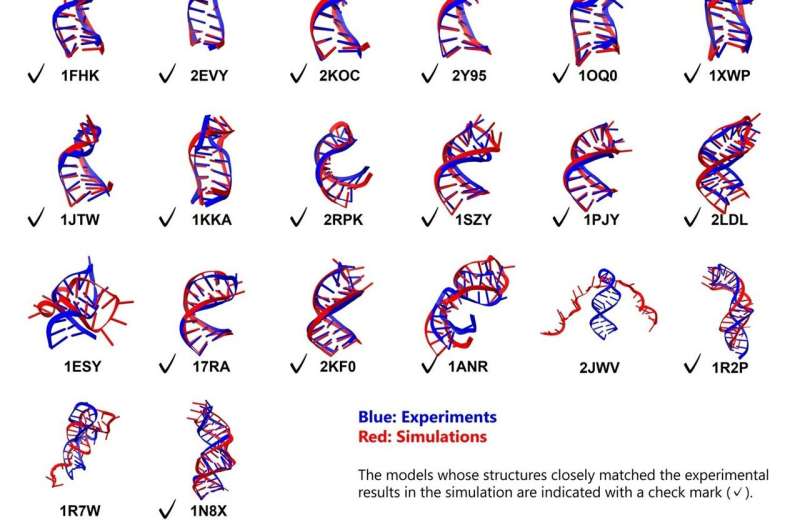
Groundbreaking research from the Tokyo University of Science has advanced understanding of RNA folding through enhanced molecular dynamics simulations. Published on November 4, 2025, in the journal ACS Omega, the study led by Associate Professor Tadashi Ando rigorously evaluated modern computational methods to simulate the folding processes of RNA stem-loops, significantly expanding the scope of previous research.
RNA plays a vital role in biological processes, extending beyond its function as a messenger of genetic information. Its ability to form complex three-dimensional structures is crucial for gene regulation and maintenance across living systems. As the demand for RNA-based therapeutics rises, accurately predicting these structures becomes essential for harnessing RNA’s full potential in biotechnology.
Historically, simulating RNA folding has proven challenging, with past studies achieving success only with simple stem-loop structures. The research team employed an innovative combination of the DESRES-RNA atomistic force field and the GB-neck2 implicit solvent model, which approximates the surrounding liquid as a continuous medium. This approach significantly improved the rate of conformational sampling over traditional explicit solvent models, which are more computationally intensive.
The study evaluated 26 RNA stem-loops, varying in length from 10 to 36 nucleotides, including structures with bulges and internal loops. All simulations commenced from fully extended, unfolded conformations. Remarkably, 23 out of 26 RNA molecules successfully folded into their anticipated structures, demonstrating the effectiveness of the chosen methodologies.
In the case of the 18 simpler stem loops, the simulations achieved exceptional accuracy, with root mean square deviation (RMSD) values—indicating deviation from known experimental structures—of less than 2 Å for the stems and less than 5 Å for the overall molecules. Notably, five out of eight more complex motifs, which included bulges or internal loops, also folded successfully, revealing distinct pathways for these structures.
Dr. Ando remarked on the significance of these findings, stating, “Previous studies have reported only two or three folding examples of simple stem-loop structures of approximately 10 residues, whereas this study deals with structures of much greater scale and complexity.” This research marks a pivotal milestone in computational biology, validating the reliability of the combined force field and solvent models for exploring large-scale conformational changes in RNA.
While the study achieved high accuracy for stem regions, the loop regions exhibited less precision, with RMSD values around 4 Å. This suggests that further optimization of the implicit solvent model parameters is necessary, particularly for modeling non-canonical base pairs and accounting for the effects of divalent cations like magnesium.
The implications of this research extend beyond theoretical modeling; understanding RNA folding is crucial for drug design targeting RNA molecules, which could lead to novel treatments for genetic disorders, viral infections such as COVID-19 and influenza, as well as certain cancers. Dr. Ando concluded, “The ability to reproduce the overall folding of the basic stem-loop structure is an important milestone in understanding and predicting the structure, dynamics, and function of RNA using highly accurate and reliable computational models. I expect this computational technique to lead to applications in RNA molecule design and drug discovery.”
This research represents a significant step forward in improving RNA-based medical tools and highlights the potential of advanced computational techniques in understanding complex biological systems.

Philadelphia Parks Launch Free Earth Month Events Starting April 1

Bradford’s Fish Fry Fridays Serve Community with Delicious Dinners

Trump Faces Growing Challenges Amid Rising Tensions with Iran

Scientists Probe the Universe’s Missing Topological Defects

Samsung Galaxy Watch 9 to Feature Larger 435mAh Battery

UConn Huskies Aim to Defend Title in 2026 NCAA Women’s Tournament

U.S. Littoral Combat Ships Dock in Malaysia Amid Regional Tensions

Healthy Choice Wellness Reports Quarterly Earnings, Shares Rise

Urgent News: Charles M. Payment Passes Away at 78 in Duluth

University of Hawaiʻi Joins $25.6M AI Project to Enhance Disaster Monitoring

Major Grant Enhances Cancer Care and Research in Hawaiʻi

Joleen Chaney, Beloved Journalist, Passes Leaving Lasting Legacy

San Francisco’s SFO to Welcome 16 Airlines with Nonstop Flights to Europe in 2026

Goldman Sachs Unveils 2026 Catalyst Playbook for Biotech Investors

Discover Top Business Smartphones for Professionals in 2026

Urgent Update: Tom Aspinall’s Vision Deteriorates After UFC 321

Texas Roadhouse Honors Veterans with Free Meal Vouchers

CD Projekt Red Confirms No Release for The Witcher 4 in 2026
-
Science9 months ago
University of Hawaiʻi Joins $25.6M AI Project to Enhance Disaster Monitoring
-
 Health8 months ago
Major Grant Enhances Cancer Care and Research in Hawaiʻi
-
 Top Stories9 months ago
Joleen Chaney, Beloved Journalist, Passes Leaving Lasting Legacy
-
 World7 months ago
San Francisco’s SFO to Welcome 16 Airlines with Nonstop Flights to Europe in 2026
-
 Business8 months ago
Goldman Sachs Unveils 2026 Catalyst Playbook for Biotech Investors
-
 Business8 months ago
Discover Top Business Smartphones for Professionals in 2026
-
 Top Stories9 months ago
Urgent Update: Tom Aspinall’s Vision Deteriorates After UFC 321
-
 Lifestyle9 months ago
Texas Roadhouse Honors Veterans with Free Meal Vouchers
-
 Entertainment8 months ago
CD Projekt Red Confirms No Release for The Witcher 4 in 2026
-

 Top Stories10 months ago
AI Disruption: AWS Faces Threat as Startups Shift Cloud Focus
-

 Health10 months ago
MIT Scientists Uncover Surprising Genomic Loops During Cell Division
-

 Entertainment10 months ago
Discover the Full Map of Pokémon Legends: Z-A’s Lumiose City