
Science
Chemists Unveil Innovative Method to Transform Everyday Plastics

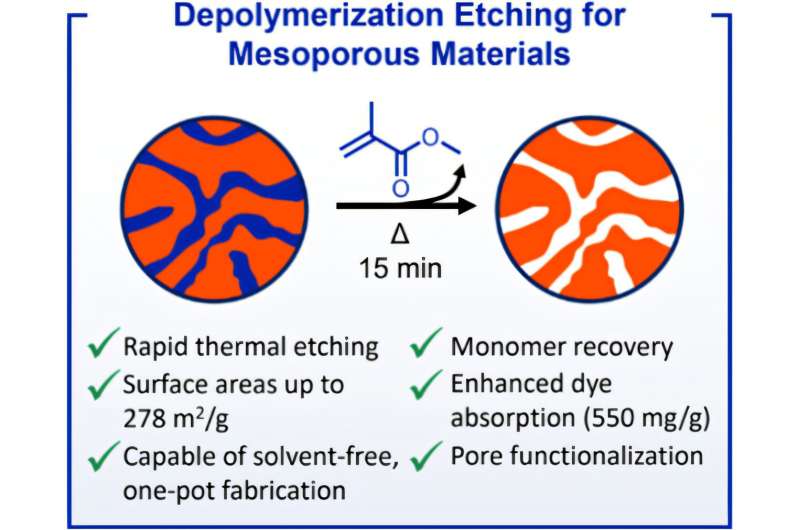
Chemists at the University of Florida have developed a groundbreaking technique to create advanced porous materials from common plastics, presenting new possibilities for various industries including electronics and battery manufacturing. This innovative method focuses on the removal of material, rather than the addition of new substances, enabling the transformation of everyday plastics into highly functional materials.
Brent Sumerlin, Ph.D., a professor of chemistry and senior author of the study, likened the process to sculpting. “It’s like what a sculptor might do with stone, where you gradually subtract more and more until you have what you want,” he explained. This approach allows for the creation of tiny pores within the material, which could not be achieved by traditional methods.
From Plastics to Pores: The Process
The research team utilized the breakdown of plastics—a pivotal aspect of enhancing plastic recycling. By understanding that different plastics decompose at varying temperatures, Sumerlin’s lab was able to exploit these differences to forge new materials. The combination of Plexiglass and Styrofoam, typically resistant to mixing, was subjected to precise heating. As a result, the components resembling Plexiglass evaporated, leaving behind polystyrene and creating trillions of minuscule gaps, even smaller than a virus.
Despite weighing only one gram, a sample of this newly created material boasts a surface area equivalent to a full-sized tennis court. This extensive surface area is crucial for advanced manufacturing processes, particularly in applications requiring efficient separation and filtration.
Potential Applications and Impact
The porous materials produced through this technique are in high demand for various applications. They can function as natural filters for contaminated water and enhance the performance of batteries by serving as high-efficiency membranes. Sumerlin noted that the method could lead to significant advancements in energy separation processes, which are essential for numerous industries.
“The new way to craft these porous filters, out of little more than plastic, may serve many different applications,” Sumerlin remarked. He has also filed a patent application to protect this novel technique, highlighting its potential impact on both recycling efforts and the manufacturing sector.
The findings of this research were published on November 4, 2025, in the journal ACS Central Science, showcasing how fundamental research can yield innovative solutions across diverse fields. Sumerlin emphasized the importance of such interdisciplinary advancements, stating, “This just shows how basic research in one area can inform new applications in a completely different area.”
As industries continue to seek sustainable materials and efficient processes, this innovative technique represents a promising step forward in the quest to repurpose everyday plastics into valuable resources.

Woman Arrested for Threatening U-Haul Worker with Baton

Japan’s PM Takaichi Vows Urgent Fiscal Management Amid Rate Trends

Bitcoin Plummets Below $88K Amid Tether Concerns and Warnings

Tottenville Falls Short in PSAL 4A Title Game Against Erasmus

Shark Teeth Study Reveals Urgent Clues to Prevent Extinction

Church Members Rally Together After Thanksgiving Fire Devastation

U.S. Investment in Canadian Energy Firms Surges Despite Low Oil Prices

Nick Jonas Unveils New Solo Album ‘Sunday Best’ Set for February Release

Researchers Urge Label Changes for Low-Alcohol Drinks to Aid Pregnant Women

Urgent Update: Tom Aspinall’s Vision Deteriorates After UFC 321

MIT Scientists Uncover Surprising Genomic Loops During Cell Division

University of Hawaiʻi Joins $25.6M AI Project to Enhance Disaster Monitoring

AI Disruption: AWS Faces Threat as Startups Shift Cloud Focus

Time Crystals Revolutionize Quantum Computing Potential

Honeywell Forecasts Record Business Jet Deliveries Over Next Decade

Discover the Full Map of Pokémon Legends: Z-A’s Lumiose City

GOP Faces Backlash as Protests Surge Against Trump Policies

Parenthood Set to Depart Hulu: What Fans Need to Know
-
 Top Stories1 month ago
Urgent Update: Tom Aspinall’s Vision Deteriorates After UFC 321
-
 Health1 month ago
MIT Scientists Uncover Surprising Genomic Loops During Cell Division
-
Science4 weeks ago
University of Hawaiʻi Joins $25.6M AI Project to Enhance Disaster Monitoring
-
 Top Stories1 month ago
AI Disruption: AWS Faces Threat as Startups Shift Cloud Focus
-
 Science2 months ago
Time Crystals Revolutionize Quantum Computing Potential
-
 World2 months ago
Honeywell Forecasts Record Business Jet Deliveries Over Next Decade
-
 Entertainment1 month ago
Discover the Full Map of Pokémon Legends: Z-A’s Lumiose City
-
 Top Stories2 months ago
GOP Faces Backlash as Protests Surge Against Trump Policies
-
 Entertainment2 months ago
Parenthood Set to Depart Hulu: What Fans Need to Know
-

 Politics2 months ago
Judge Signals Dismissal of Chelsea Housing Case Citing AI Flaws
-

 Sports2 months ago
Yoshinobu Yamamoto Shines in Game 2, Leading Dodgers to Victory
-

 Health2 months ago
Maine Insurers Cut Medicare Advantage Plans Amid Cost Pressures