
Science
Scientists Unveil Unique Hybrid Framework for Enhanced Gas Separation

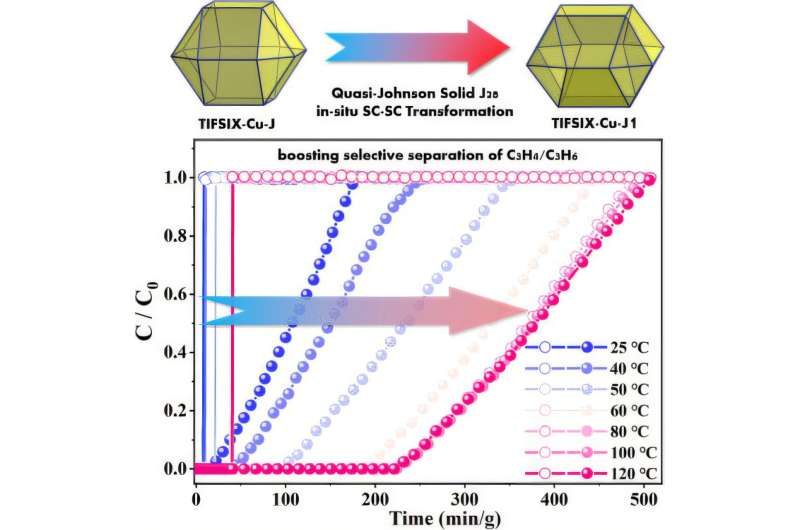
A research team led by Prof. Wu Mingyan from the Fujian Institute of Research on the Structure of Matter, part of the Chinese Academy of Sciences, has developed a novel hybrid porous framework designed to improve gas separation processes. The study, published on November 5, 2025, in the journal Chem, introduces the pillar-cage fluorinated hybrid framework known as TIFSIX-Cu-J, which features a rare quasi-Johnson solid J28 structure.
This innovative framework was synthesized using a bottom-up, self-assembly approach, incorporating geometrical elements of quadrangles and isosceles triangles. The team discovered that TIFSIX-Cu-J undergoes a significant heat-triggered structural transformation. During this process, the original J28 cage restructures into a distorted square orthobicupola structure, a change that was thoroughly analyzed through single-crystal-to-single-crystal (SC-SC) transformation and bulk crystalline powder X-ray diffraction.
Applications and Performance Metrics
The research highlights the practical applications of TIFSIX-Cu-J in gas separation. The framework demonstrated an impressive adsorption capacity for propylene (C3H4), reaching 140.5 cm³·g⁻¹. Notably, the differences in adsorption amounts between C3H4 and propene (C3H6) increased from 19.6 cm³·g⁻¹ to 34.8 cm³·g⁻¹. Furthermore, the selectivity of TIFSIX-Cu-J for C3H4/C3H6 improved significantly, indicating its potential effectiveness in industrial applications.
In practical tests, a packed column of TIFSIX-Cu-J achieved a production rate of C3H6 that was approximately twenty times greater than that of the previous structure. Theoretical calculations revealed that the optimal pore surface within the quasi-Johnson solid J28 cavity allows for preferential capture of C3H4, enhancing the selective separation process.
Implications for Future Research
This study not only advances the understanding of gas separation technologies but also opens new avenues for designing and synthesizing hybrid porous frameworks. The findings emphasize the efficacy of the bottom-up, self-assembly method in constructing artificial three-dimensional architectures with tailored separation properties.
By providing insights into the systematic design of these materials, the research could lead to significant improvements in energy-efficient gas purification processes. These advancements are particularly relevant as industries seek sustainable solutions for gas separation challenges.
For further details, see the full study by Cheng Chen et al, titled “Pillar-cage fluorinated hybrid porous frameworks featuring quasi-Johnson solid J28,” published in Chem. The DOI for the article is 10.1016/j.chempr.2025.102696.

Woman Arrested for Threatening U-Haul Worker with Baton

Japan’s PM Takaichi Vows Urgent Fiscal Management Amid Rate Trends

Bitcoin Plummets Below $88K Amid Tether Concerns and Warnings

Tottenville Falls Short in PSAL 4A Title Game Against Erasmus

Shark Teeth Study Reveals Urgent Clues to Prevent Extinction

Church Members Rally Together After Thanksgiving Fire Devastation

U.S. Investment in Canadian Energy Firms Surges Despite Low Oil Prices

Nick Jonas Unveils New Solo Album ‘Sunday Best’ Set for February Release

Researchers Urge Label Changes for Low-Alcohol Drinks to Aid Pregnant Women

Urgent Update: Tom Aspinall’s Vision Deteriorates After UFC 321

MIT Scientists Uncover Surprising Genomic Loops During Cell Division

University of Hawaiʻi Joins $25.6M AI Project to Enhance Disaster Monitoring

AI Disruption: AWS Faces Threat as Startups Shift Cloud Focus

Time Crystals Revolutionize Quantum Computing Potential

Honeywell Forecasts Record Business Jet Deliveries Over Next Decade

Discover the Full Map of Pokémon Legends: Z-A’s Lumiose City

GOP Faces Backlash as Protests Surge Against Trump Policies

Parenthood Set to Depart Hulu: What Fans Need to Know
-
 Top Stories1 month ago
Urgent Update: Tom Aspinall’s Vision Deteriorates After UFC 321
-
 Health1 month ago
MIT Scientists Uncover Surprising Genomic Loops During Cell Division
-
Science4 weeks ago
University of Hawaiʻi Joins $25.6M AI Project to Enhance Disaster Monitoring
-
 Top Stories1 month ago
AI Disruption: AWS Faces Threat as Startups Shift Cloud Focus
-
 Science2 months ago
Time Crystals Revolutionize Quantum Computing Potential
-
 World2 months ago
Honeywell Forecasts Record Business Jet Deliveries Over Next Decade
-
 Entertainment1 month ago
Discover the Full Map of Pokémon Legends: Z-A’s Lumiose City
-
 Top Stories2 months ago
GOP Faces Backlash as Protests Surge Against Trump Policies
-
 Entertainment2 months ago
Parenthood Set to Depart Hulu: What Fans Need to Know
-

 Politics2 months ago
Judge Signals Dismissal of Chelsea Housing Case Citing AI Flaws
-

 Sports2 months ago
Yoshinobu Yamamoto Shines in Game 2, Leading Dodgers to Victory
-

 Health2 months ago
Maine Insurers Cut Medicare Advantage Plans Amid Cost Pressures