
Science
Astronomers Uncover New Insights on Planet Formation with SPAM

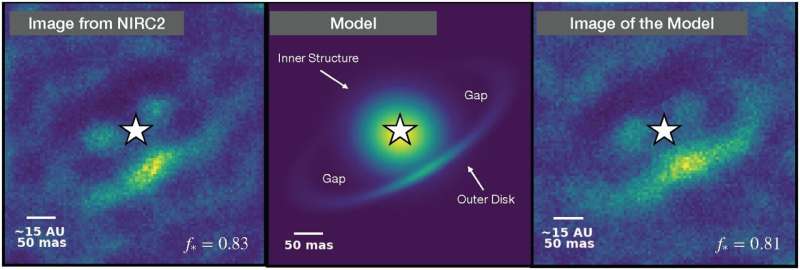
Astronomers at the W. M. Keck Observatory in Hawaiʻi have made significant strides in understanding how planets form by observing the dusty regions around young stars. Their latest study focuses on the star HD 34282, located approximately 400 light-years from Earth. This research is part of a broader initiative known as The Search for Protoplanets with Aperture Masking, or SPAM, which aims to provide deeper insights into the early stages of planetary development.
The research team utilized the observatory’s Near-Infrared Camera (NIRC2), enabling them to investigate regions closer to the star than traditional imaging can allow. The surrounding disk of dust and gas is considered a “transition disk,” a structure believed to be shaped by the gravitational influence of forming planets. Christina Vides, a graduate student at the University of California Irvine and lead author of the study published in The Astrophysical Journal, expressed the importance of this research, stating, “We all want to know where we came from and how our solar system formed.”
Exploring Planetary Nurseries
The team captured unprecedented details of the inner region of HD 34282‘s disk, revealing clumpy structures and brightness variations indicative of potential planet formation. Although the team did not detect any confirmed protoplanets, their observations provide crucial constraints on where a young planet might be located. Additionally, they gathered important data regarding the star’s mass and accretion rate, which are essential for modeling how material in the disk could evolve into planets.
Detecting protoplanets is notoriously challenging, with only two confirmed instances recorded to date: PDS 70 b and PDS 70 c, both of which were directly imaged in 2020 using the same NIRC2 instrument. Each new observation contributes valuable knowledge to the ongoing quest to unravel the mysteries of planetary system formation. “This work is pushing the boundaries of what we can see,” Vides noted, highlighting the capabilities of the observatory’s adaptive optics and masking technologies that allow astronomers to resolve features mere astronomical units from the star, areas typically invisible to other methods.
Future Endeavors
The research team plans to continue their investigations with Keck’s advanced instruments, focusing on additional young stars that exhibit promising disk characteristics. They are also preparing for future observations with new technologies, including the SCALES imager, which is expected to enhance the search for protoplanets with unprecedented clarity.
“Every new system we study helps us understand a little more about how planets form and evolve,” Vides added. The ability to observe conditions capable of giving rise to new worlds from hundreds of light-years away underscores the significant advancements in astronomical research and technology.
For more details on this research, refer to the study by Christina L. Vides and colleagues, “NIRC2 Interferometric Imaging of the HD 34282 Transition Disk’s Small Grain Structure,” published in The Astrophysical Journal on November 5, 2025.

Philadelphia Parks Launch Free Earth Month Events Starting April 1

Bradford’s Fish Fry Fridays Serve Community with Delicious Dinners

Trump Faces Growing Challenges Amid Rising Tensions with Iran

Scientists Probe the Universe’s Missing Topological Defects

Samsung Galaxy Watch 9 to Feature Larger 435mAh Battery

UConn Huskies Aim to Defend Title in 2026 NCAA Women’s Tournament

U.S. Littoral Combat Ships Dock in Malaysia Amid Regional Tensions

Healthy Choice Wellness Reports Quarterly Earnings, Shares Rise

Urgent News: Charles M. Payment Passes Away at 78 in Duluth

University of Hawaiʻi Joins $25.6M AI Project to Enhance Disaster Monitoring

Major Grant Enhances Cancer Care and Research in Hawaiʻi

Joleen Chaney, Beloved Journalist, Passes Leaving Lasting Legacy

San Francisco’s SFO to Welcome 16 Airlines with Nonstop Flights to Europe in 2026

Goldman Sachs Unveils 2026 Catalyst Playbook for Biotech Investors

Discover Top Business Smartphones for Professionals in 2026

Urgent Update: Tom Aspinall’s Vision Deteriorates After UFC 321

Texas Roadhouse Honors Veterans with Free Meal Vouchers

CD Projekt Red Confirms No Release for The Witcher 4 in 2026
-
Science9 months ago
University of Hawaiʻi Joins $25.6M AI Project to Enhance Disaster Monitoring
-
 Health8 months ago
Major Grant Enhances Cancer Care and Research in Hawaiʻi
-
 Top Stories9 months ago
Joleen Chaney, Beloved Journalist, Passes Leaving Lasting Legacy
-
 World7 months ago
San Francisco’s SFO to Welcome 16 Airlines with Nonstop Flights to Europe in 2026
-
 Business8 months ago
Goldman Sachs Unveils 2026 Catalyst Playbook for Biotech Investors
-
 Business8 months ago
Discover Top Business Smartphones for Professionals in 2026
-
 Top Stories9 months ago
Urgent Update: Tom Aspinall’s Vision Deteriorates After UFC 321
-
 Lifestyle9 months ago
Texas Roadhouse Honors Veterans with Free Meal Vouchers
-
 Entertainment8 months ago
CD Projekt Red Confirms No Release for The Witcher 4 in 2026
-

 Top Stories10 months ago
AI Disruption: AWS Faces Threat as Startups Shift Cloud Focus
-

 Health10 months ago
MIT Scientists Uncover Surprising Genomic Loops During Cell Division
-

 Entertainment10 months ago
Discover the Full Map of Pokémon Legends: Z-A’s Lumiose City