
Science
Researchers Develop AI Tool to Enhance Single-Cell Data Analysis

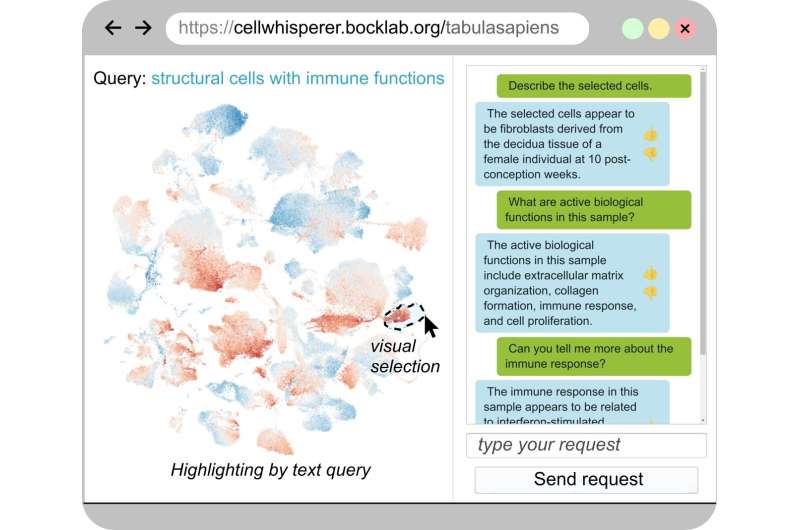
Biomedical researchers have made a significant advancement in the analysis of single-cell data with the development of an innovative AI tool called CellWhisperer. This tool, created by a team led by Christoph Bock at the CeMM Research Center for Molecular Medicine of the Austrian Academy of Sciences, aims to simplify the complex process of interpreting vast datasets generated from RNA sequencing technology. The findings were published on November 11, 2025, in the journal Nature Biotechnology.
The ability to measure gene activity across millions of single cells has transformed our understanding of tissues, organs, and diseases. However, analyzing such extensive datasets demands both biological knowledge and advanced coding skills. The introduction of CellWhisperer offers researchers a virtual colleague equipped with expertise in both biology and bioinformatics, streamlining the research process.
Revolutionizing Data Interaction
CellWhisperer utilizes multimodal deep learning to connect gene expression data with descriptive text from over a million biological samples. This unique approach allows scientists to conduct text-based searches within massive datasets. For example, a researcher can query, “Show me immune cells from the inflamed colon of patients with autoimmune diseases,” and receive relevant insights without needing to write complex code.
As co-first author Moritz Schaefer, a former Postdoctoral Researcher in Bock’s group now at Stanford University, explains, “By training on experimental data of 20,000 studies from the last two decades, CellWhisperer learned about the biological roles of genes and cells.” This comprehensive training equips the AI to analyze new single-cell RNA sequencing data across various biomedical fields, making data exploration more accessible and engaging.
The tool integrates a large language model designed to simulate conversations between biologists and bioinformaticians, enhancing the interaction experience. Researchers can ask CellWhisperer about active genes in specific cells, allowing the AI to provide comments on potential biological implications.
Enhancing Collaborative Research
To demonstrate the capabilities of CellWhisperer, the research team applied it to single-cell RNA sequencing data related to human embryonic development. Simple queries such as “heart” or “brain” enabled the model to identify developmental time points, cell populations, and marker genes linked to organ formation. Many of these markers corresponded with known developmental genes, while others revealed previously unrecognized candidates.
Peter Peneder, co-first author and researcher at the St. Anna Children’s Cancer Research Institute, highlighted the tool’s role in enhancing scientific collaboration. “CellWhisperer is not just making biomedical research easier; it helps me understand what is going on in the cells that I am studying,” he remarked. “With CellWhisperer, an AI research assistant has joined our team. It supports and empowers us as human scientists,” emphasized Bock.
As the field of biomedical research evolves, tools like CellWhisperer could play a crucial role in facilitating exploratory research. By allowing researchers to quickly grasp new datasets and identify areas for deeper investigation, this AI tool represents a promising step toward a future where artificial intelligence can significantly aid scientific discovery.
The publication in Nature Biotechnology underscores the potential of AI in transforming how scientists interact with and analyze biological data, paving the way for future innovations in the field.
More information on this study can be found in the article titled “Multimodal learning enables chat-based exploration of single-cell data,” published on November 11, 2025.

Bitcoin Plummets Below $88K Amid Tether Concerns and Warnings

Tottenville Falls Short in PSAL 4A Title Game Against Erasmus

Shark Teeth Study Reveals Urgent Clues to Prevent Extinction

Church Members Rally Together After Thanksgiving Fire Devastation

U.S. Investment in Canadian Energy Firms Surges Despite Low Oil Prices

Nick Jonas Unveils New Solo Album ‘Sunday Best’ Set for February Release

Researchers Urge Label Changes for Low-Alcohol Drinks to Aid Pregnant Women

Wedding Cookie Table Community Aims for World’s Largest Cookie Exchange

Mayor Appoints Alan Wong as New Supervisor for District 4

Urgent Update: Tom Aspinall’s Vision Deteriorates After UFC 321

MIT Scientists Uncover Surprising Genomic Loops During Cell Division

University of Hawaiʻi Joins $25.6M AI Project to Enhance Disaster Monitoring

AI Disruption: AWS Faces Threat as Startups Shift Cloud Focus

Time Crystals Revolutionize Quantum Computing Potential

Honeywell Forecasts Record Business Jet Deliveries Over Next Decade

Discover the Full Map of Pokémon Legends: Z-A’s Lumiose City

GOP Faces Backlash as Protests Surge Against Trump Policies

Parenthood Set to Depart Hulu: What Fans Need to Know
-
 Top Stories1 month ago
Urgent Update: Tom Aspinall’s Vision Deteriorates After UFC 321
-
 Health1 month ago
MIT Scientists Uncover Surprising Genomic Loops During Cell Division
-
Science4 weeks ago
University of Hawaiʻi Joins $25.6M AI Project to Enhance Disaster Monitoring
-
 Top Stories1 month ago
AI Disruption: AWS Faces Threat as Startups Shift Cloud Focus
-
 Science2 months ago
Time Crystals Revolutionize Quantum Computing Potential
-
 World2 months ago
Honeywell Forecasts Record Business Jet Deliveries Over Next Decade
-
 Entertainment1 month ago
Discover the Full Map of Pokémon Legends: Z-A’s Lumiose City
-
 Top Stories2 months ago
GOP Faces Backlash as Protests Surge Against Trump Policies
-
 Entertainment2 months ago
Parenthood Set to Depart Hulu: What Fans Need to Know
-

 Politics2 months ago
Judge Signals Dismissal of Chelsea Housing Case Citing AI Flaws
-

 Sports2 months ago
Yoshinobu Yamamoto Shines in Game 2, Leading Dodgers to Victory
-

 Health2 months ago
Maine Insurers Cut Medicare Advantage Plans Amid Cost Pressures