
Science
Chinese Astronauts Safely Return After Space Junk Delay

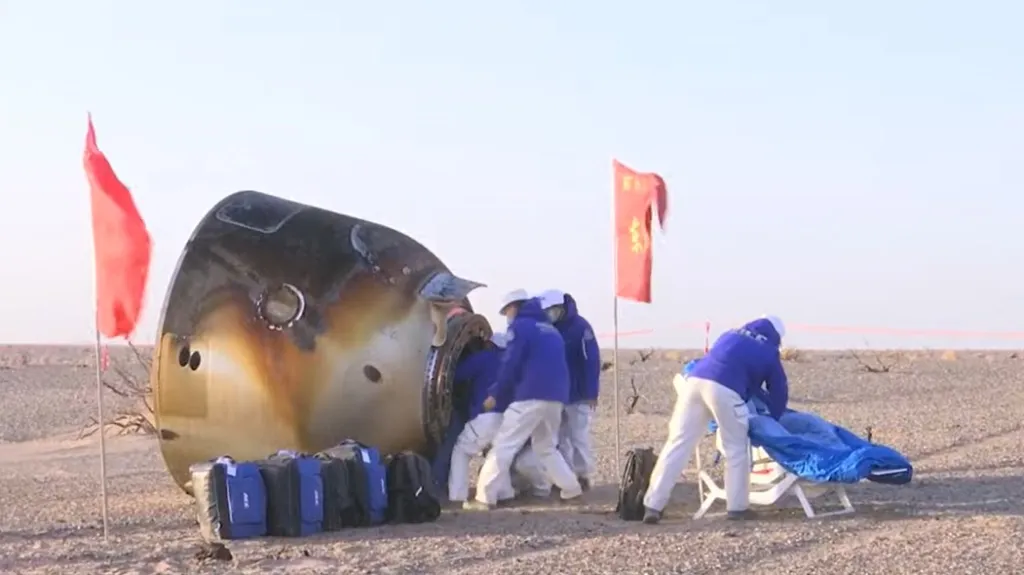
The crew of the Shenzhou-20 spacecraft returned safely to Earth on November 14, 2025, following a week’s delay caused by damage from space debris. The incident forced the three-person team, which included Commander Chen Dong, Chen Zhongrui, and Wang Jie, to utilize the newly arrived Shenzhou-21 spacecraft for their return journey. Originally scheduled to land on November 5, the crew postponed their return while six taikonauts aboard the Tiangong space station conducted inspections with support from the China Manned Space Agency (CMSA).
On November 11, the China Manned Space Engineering Office (CMSEO) confirmed that assessments and backup plans were in place to ensure the crew’s safe return. They departed the station aboard Shenzhou-21 at 10:14 p.m. EST (7:14 p.m. PST) on November 13, indicating the Shenzhou-20 was no longer deemed safe for reentry. They successfully landed in Inner Mongolia at 11:14 a.m. Beijing Time on November 14 (9:14 p.m. EST; 6:14 p.m. PST, November 15).
Upon landing, the astronauts underwent medical evaluations, which confirmed that all crew members were in good health, according to state-owned media outlet Xinhua. “Space exploration has never been easy for humankind. This mission was a true test, and we are proud to have completed it successfully,” Chen Dong stated to reporters. He emphasized that the mission showcased the strength of China’s space program and the priority placed on astronaut safety.
Significant Milestones and Future Plans
The Shenzhou-20 mission achieved several notable milestones. Commander Chen Dong completed six extravehicular activities, becoming the taikonaut with the most such tasks to date. The crew also made history as the first to spend over 200 consecutive days in space. Additionally, they celebrated a unique occasion by enjoying a barbecued meal in space, marking a welcoming gesture for the incoming Shenzhou-21 crew.
Following the departure of the Shenzhou-20 team, the Shenzhou-21 crew, comprising Zhang Lu, Wu Fei, and Zhang Hongzhang, now faces the challenge of operating the Tiangong space station without a clear return plan. The CMSEO indicated that this situation is likely to be addressed with the upcoming launch of the Shenzhou-22 spacecraft, which will not carry a crew but will support ongoing operations.
This incident highlights a crucial developmental milestone for China’s space program, showcasing its preparedness for unforeseen challenges in space. The effective contingency plans established by the CMSA suggest that operations aboard the Tiangong station will continue uninterrupted.
As the International Space Station approaches its retirement, China aims for Tiangong and its future stations to play a leading role in ongoing exploration and scientific activities in low Earth orbit. The successful return of the Shenzhou-20 crew further cements China’s position in the global space exploration arena, demonstrating resilience and adaptability in the face of challenges.

Philadelphia Parks Launch Free Earth Month Events Starting April 1

Bradford’s Fish Fry Fridays Serve Community with Delicious Dinners

Trump Faces Growing Challenges Amid Rising Tensions with Iran

Scientists Probe the Universe’s Missing Topological Defects

Samsung Galaxy Watch 9 to Feature Larger 435mAh Battery

UConn Huskies Aim to Defend Title in 2026 NCAA Women’s Tournament

U.S. Littoral Combat Ships Dock in Malaysia Amid Regional Tensions

Healthy Choice Wellness Reports Quarterly Earnings, Shares Rise

Urgent News: Charles M. Payment Passes Away at 78 in Duluth

University of Hawaiʻi Joins $25.6M AI Project to Enhance Disaster Monitoring

Major Grant Enhances Cancer Care and Research in Hawaiʻi

Joleen Chaney, Beloved Journalist, Passes Leaving Lasting Legacy

San Francisco’s SFO to Welcome 16 Airlines with Nonstop Flights to Europe in 2026

Goldman Sachs Unveils 2026 Catalyst Playbook for Biotech Investors

Discover Top Business Smartphones for Professionals in 2026

Urgent Update: Tom Aspinall’s Vision Deteriorates After UFC 321

Texas Roadhouse Honors Veterans with Free Meal Vouchers

CD Projekt Red Confirms No Release for The Witcher 4 in 2026
-
Science9 months ago
University of Hawaiʻi Joins $25.6M AI Project to Enhance Disaster Monitoring
-
 Health8 months ago
Major Grant Enhances Cancer Care and Research in Hawaiʻi
-
 Top Stories9 months ago
Joleen Chaney, Beloved Journalist, Passes Leaving Lasting Legacy
-
 World7 months ago
San Francisco’s SFO to Welcome 16 Airlines with Nonstop Flights to Europe in 2026
-
 Business8 months ago
Goldman Sachs Unveils 2026 Catalyst Playbook for Biotech Investors
-
 Business7 months ago
Discover Top Business Smartphones for Professionals in 2026
-
 Top Stories9 months ago
Urgent Update: Tom Aspinall’s Vision Deteriorates After UFC 321
-
 Lifestyle9 months ago
Texas Roadhouse Honors Veterans with Free Meal Vouchers
-
 Entertainment8 months ago
CD Projekt Red Confirms No Release for The Witcher 4 in 2026
-

 Top Stories10 months ago
AI Disruption: AWS Faces Threat as Startups Shift Cloud Focus
-

 Health10 months ago
MIT Scientists Uncover Surprising Genomic Loops During Cell Division
-

 Entertainment10 months ago
Discover the Full Map of Pokémon Legends: Z-A’s Lumiose City