
Science
NASA’s Perseverance Rover Discovers Alien Meteorite on Mars

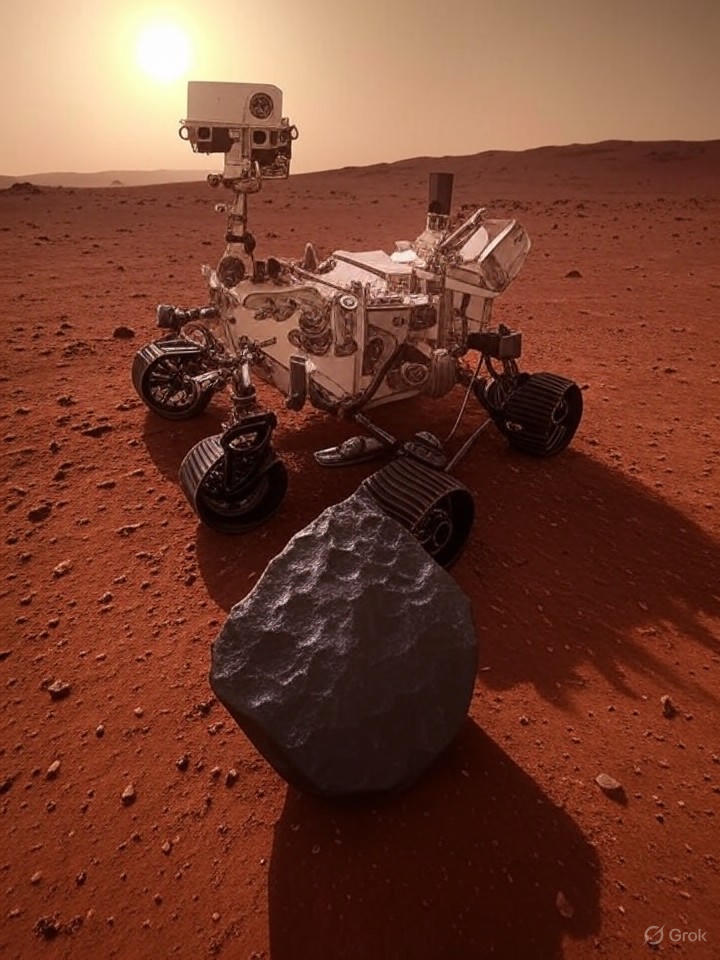
NASA’s Perseverance rover has made a remarkable discovery in the Jezero Crater on Mars, uncovering a fist-sized iron-nickel meteorite that challenges the planet’s geological narrative. Named ‘Bunsen Peak’ by the mission team, this anomaly is not comprised of the typical Martian basalt but is instead a cosmic interloper, likely originating from the asteroid belt or beyond. The discovery, highlighted in high-resolution images captured in September 2025, emphasizes the diverse history of Mars as a site for extraterrestrial impacts.
According to a report from NASA, the rover’s instruments identified the meteorite’s unusual composition during routine scans. Mission scientist Dr. Ken Farley stated, “This is not something formed on Mars,” reinforcing the notion that Mars has been influenced by outside cosmic events. This finding not only contributes to Perseverance’s mission to explore the planet’s geological past but also showcases the rover’s ability to identify unexpected treasures while searching for ancient life.
Insights from Perseverance’s Journey
Since its landing in February 2021, Perseverance has been navigating the Jezero Crater, an area believed to be an ancient lakebed. Equipped with advanced tools such as the SHERLOC instrument and a range of cameras, the rover has collected numerous samples, some potentially containing biosignatures of past microbial life. The recent meteorite discovery adds an intriguing layer to the ongoing research, as meteorites are thought to have delivered organic compounds to Mars billions of years ago, possibly aiding the emergence of microbial life.
NASA announced on September 10, 2025, that Perseverance had also collected a sample from an ancient dry riverbed that may preserve evidence of microbial life. The rock features distinctive mudstones that suggest an association with ancient microbes. This newly found biosignature aligns closely with the meteorite discovery, hinting at a connection between extraterrestrial impacts and the building blocks of life.
Dr. Abigail Allwood, a planetary geologist, expressed her excitement regarding the meteorite in an interview: “It’s incredibly exciting.” The eventual return of such samples to Earth, as part of the planned Mars Sample Return mission, will be essential for verifying these findings, as current rover instruments can only provide preliminary data.
The Broader Implications of Discoveries
The implications of these findings extend beyond Mars’ surface. Discussions on platforms like X have speculated about various anomalies observed by Perseverance, including formations interpreted by some as ‘crashed flying saucers’ or other mysterious objects. NASA has clarified that these are likely natural formations or debris rather than evidence of extraterrestrial technology. The ongoing public fascination with these discussions highlights the interest in Mars exploration.
Additionally, the detection of organic molecules in mudstone by Perseverance builds upon previous discoveries made by the Curiosity rover, which identified the largest organic molecules on Mars in March 2025. These findings contribute to a growing understanding of the potential for life on Mars.
The technological advancements of Perseverance have played a crucial role in these discoveries. The rover’s PIXL tool confirmed the meteorite’s non-Martian origins through real-time elemental analysis. This capability, combined with AI-driven navigation, enables the rover to traverse the Martian landscape more efficiently, enhancing the chances of discovering further anomalies.
As Mars exploration continues, the findings from Perseverance are invigorating interest in the private sector. Companies like SpaceX are closely monitoring the implications of meteorite impacts for future colonization efforts, considering how to design habitats that can withstand cosmic radiation. Recent reports have highlighted ‘unprecedented’ clues in Jezero Crater, suggesting a once-watery environment that may have supported life.
Looking ahead, the integration of these discoveries could reshape our understanding of Mars as a once-habitable world influenced by cosmic events. NASA’s Artemis program and potential human missions will build upon the insights gained from robotic explorations, potentially transforming our perspective on life beyond Earth. Each find by Perseverance not only enriches our knowledge of Mars but also stirs the imagination regarding the possibilities that lie within our solar system.

Bitcoin Plummets Below $88K Amid Tether Concerns and Warnings

Tottenville Falls Short in PSAL 4A Title Game Against Erasmus

Shark Teeth Study Reveals Urgent Clues to Prevent Extinction

Church Members Rally Together After Thanksgiving Fire Devastation

U.S. Investment in Canadian Energy Firms Surges Despite Low Oil Prices

Nick Jonas Unveils New Solo Album ‘Sunday Best’ Set for February Release

Researchers Urge Label Changes for Low-Alcohol Drinks to Aid Pregnant Women

Wedding Cookie Table Community Aims for World’s Largest Cookie Exchange

Mayor Appoints Alan Wong as New Supervisor for District 4

Urgent Update: Tom Aspinall’s Vision Deteriorates After UFC 321

MIT Scientists Uncover Surprising Genomic Loops During Cell Division

University of Hawaiʻi Joins $25.6M AI Project to Enhance Disaster Monitoring

AI Disruption: AWS Faces Threat as Startups Shift Cloud Focus

Time Crystals Revolutionize Quantum Computing Potential

Honeywell Forecasts Record Business Jet Deliveries Over Next Decade

Discover the Full Map of Pokémon Legends: Z-A’s Lumiose City

GOP Faces Backlash as Protests Surge Against Trump Policies

Parenthood Set to Depart Hulu: What Fans Need to Know
-
 Top Stories1 month ago
Urgent Update: Tom Aspinall’s Vision Deteriorates After UFC 321
-
 Health1 month ago
MIT Scientists Uncover Surprising Genomic Loops During Cell Division
-
Science4 weeks ago
University of Hawaiʻi Joins $25.6M AI Project to Enhance Disaster Monitoring
-
 Top Stories1 month ago
AI Disruption: AWS Faces Threat as Startups Shift Cloud Focus
-
 Science2 months ago
Time Crystals Revolutionize Quantum Computing Potential
-
 World2 months ago
Honeywell Forecasts Record Business Jet Deliveries Over Next Decade
-
 Entertainment1 month ago
Discover the Full Map of Pokémon Legends: Z-A’s Lumiose City
-
 Top Stories2 months ago
GOP Faces Backlash as Protests Surge Against Trump Policies
-
 Entertainment2 months ago
Parenthood Set to Depart Hulu: What Fans Need to Know
-

 Politics2 months ago
Judge Signals Dismissal of Chelsea Housing Case Citing AI Flaws
-

 Sports2 months ago
Yoshinobu Yamamoto Shines in Game 2, Leading Dodgers to Victory
-

 Health2 months ago
Maine Insurers Cut Medicare Advantage Plans Amid Cost Pressures