
Politics
Greek and American Forces Defend Outpost Harry Against 13,000 Chinese

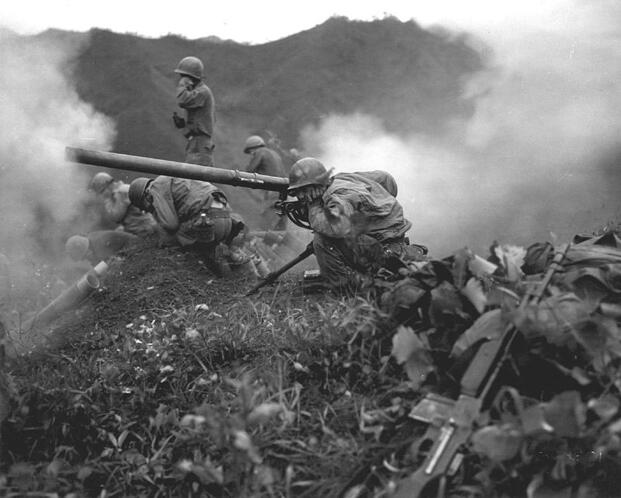
On June 10, 1953, American and Greek troops at Outpost Harry faced an overwhelming assault from approximately 13,000 Chinese soldiers. Capt. Martin Markley, leading around 150 men from K Company of the 15th Infantry Regiment, prepared his unit for a fierce battle in a strategic area of Korea’s Iron Triangle. The outpost, positioned on a hilltop just 400 yards wide, became the focal point of intense combat that lasted eight days.
American intelligence had identified enemy forces from the 74th Division’s 22nd and 221st Regiments gathering behind ridgelines. Markley briefed his soldiers before nightfall, knowing the artillery barrage would soon begin. As darkness fell, over 20,000 shells rained down on Outpost Harry, transforming the landscape into chaos. In the face of this onslaught, American defenders braced themselves for the inevitable charge of enemy troops.
The Battle Commences
Outpost Harry, located 425 yards ahead of the Main Line of Resistance, was vulnerable yet strategically positioned to monitor Chinese movements. The Chinese had occupied nearby Star Hill and had been preparing for the assault for weeks. The American defense consisted of a network of trenches and bunkers, designed for close-quarters combat, which would soon be put to the test.
On the first night of fighting, Chinese forces breached the wire defenses and surged into the trenches. American defenders, including notable figures like Sgt. Ola Mize, fought fiercely in brutal hand-to-hand combat. Mize, who would later receive the Medal of Honor, showcased extraordinary bravery by single-handedly repelling enemy troops and coordinating defenses despite sustaining multiple injuries.
The battle was relentless, with fresh companies rotating in to sustain the defense while casualties mounted. American artillery inflicted heavy losses on the attacking forces, and as daylight broke on June 11, the Chinese were forced to withdraw. Only a dozen American soldiers emerged from the night without serious wounds.
A Continuous Onslaught
The Chinese returned on consecutive nights, launching repeated assaults. American commanders employed a strategy of rotating companies to manage the intense pressure on the outpost. Soldiers like Pfc. Charles Johnson displayed incredible heroism by tending to wounded comrades while fighting off enemy attackers. His actions, which saved numerous lives, later earned him a Silver Star.
U.S. forces incorporated tanks and diversionary tactics, allowing artillery to target Chinese troops before they reached the outpost. Despite the high casualty rates on both sides, American and Greek troops managed to hold their ground, inflicting severe damage on the attacking Chinese forces.
The Greek Expeditionary Force, known for their valor, joined the defense of Outpost Harry in mid-June. Their battalion, likened to the ancient Spartans, had a storied history of combat alongside American forces. On June 17, they faced a final, desperate assault from the Chinese troops, who had regrouped and were determined to capture the outpost.
The Greeks and Americans Stand Firm
The assault began around midnight, with Chinese artillery pounding the hilltop before infantry charged from multiple directions. The Greek soldiers of Company P, tasked with defending the position, engaged the enemy in fierce hand-to-hand combat. Their refusal to yield mirrored the legendary stand of the Spartans at Thermopylae.
As the battle unfolded, Greek forces executed tactical maneuvers, drawing enemy reinforcements into pre-established artillery kill zones. After two hours of intense fighting, the Chinese forces retreated, marking the last major assault on Outpost Harry. By the morning of June 18, the 74th Division was rendered combat ineffective.
The Costly Defense
Throughout the eight-day battle, Chinese forces fired over 88,000 artillery and mortar rounds at Outpost Harry, while American and Greek artillery returned fire with approximately 368,000 rounds. U.S. intelligence estimated that around 13,000 Chinese soldiers had participated in the assaults, resulting in approximately 4,200 casualties among the attackers. Allied losses were significant, with 102 American soldiers killed, 553 wounded, and 44 missing, while the Greek battalion suffered 15 killed and 36 wounded.
For their extraordinary efforts, four American companies and one Greek company received Presidential Unit Citations, a historic recognition for their shared resilience in the defense of the outpost. The successful stand at Outpost Harry played a crucial role in shaping the final terms of the Korean War armistice, which took effect on July 27, 1953.
The Legacy of Outpost Harry
The fighting at Outpost Harry occurred during the final month of active combat in the Korean War, with negotiations underway just 50 miles away at Panmunjom. The defense of the outpost not only demonstrated the resolve of American and Greek forces but also ensured that the front lines remained favorable for the United Nations as the ceasefire approached.
In the years following the conflict, the bravery shown at Outpost Harry has been memorialized. Sgt. Ola Mize continued his military career, serving three tours in Vietnam and retiring as a colonel. Pfc. Charles Johnson’s Silver Star was later upgraded to the Medal of Honor, awarded posthumously to his sister by President Joe Biden in January 2025. Cpl. Donald L. Menken’s remains were identified and returned in 2022, nearly 69 years after he made the ultimate sacrifice defending the outpost.
Today, Outpost Harry remains a significant historical site within the Demilitarized Zone, a testament to the fierce combat that took place there. The actions of the American and Greek soldiers have become a symbol of bravery and sacrifice, underscoring the importance of their stand in the larger narrative of the Korean War.

Japan’s PM Takaichi Vows Urgent Fiscal Management Amid Rate Trends

Bitcoin Plummets Below $88K Amid Tether Concerns and Warnings

Tottenville Falls Short in PSAL 4A Title Game Against Erasmus

Shark Teeth Study Reveals Urgent Clues to Prevent Extinction

Church Members Rally Together After Thanksgiving Fire Devastation

U.S. Investment in Canadian Energy Firms Surges Despite Low Oil Prices

Nick Jonas Unveils New Solo Album ‘Sunday Best’ Set for February Release

Researchers Urge Label Changes for Low-Alcohol Drinks to Aid Pregnant Women

Wedding Cookie Table Community Aims for World’s Largest Cookie Exchange

Urgent Update: Tom Aspinall’s Vision Deteriorates After UFC 321

MIT Scientists Uncover Surprising Genomic Loops During Cell Division

University of Hawaiʻi Joins $25.6M AI Project to Enhance Disaster Monitoring

AI Disruption: AWS Faces Threat as Startups Shift Cloud Focus

Time Crystals Revolutionize Quantum Computing Potential

Honeywell Forecasts Record Business Jet Deliveries Over Next Decade

Discover the Full Map of Pokémon Legends: Z-A’s Lumiose City

GOP Faces Backlash as Protests Surge Against Trump Policies

Parenthood Set to Depart Hulu: What Fans Need to Know
-
 Top Stories1 month ago
Urgent Update: Tom Aspinall’s Vision Deteriorates After UFC 321
-
 Health1 month ago
MIT Scientists Uncover Surprising Genomic Loops During Cell Division
-
Science4 weeks ago
University of Hawaiʻi Joins $25.6M AI Project to Enhance Disaster Monitoring
-
 Top Stories1 month ago
AI Disruption: AWS Faces Threat as Startups Shift Cloud Focus
-
 Science2 months ago
Time Crystals Revolutionize Quantum Computing Potential
-
 World2 months ago
Honeywell Forecasts Record Business Jet Deliveries Over Next Decade
-
 Entertainment1 month ago
Discover the Full Map of Pokémon Legends: Z-A’s Lumiose City
-
 Top Stories2 months ago
GOP Faces Backlash as Protests Surge Against Trump Policies
-
 Entertainment2 months ago
Parenthood Set to Depart Hulu: What Fans Need to Know
-

 Politics2 months ago
Judge Signals Dismissal of Chelsea Housing Case Citing AI Flaws
-

 Sports2 months ago
Yoshinobu Yamamoto Shines in Game 2, Leading Dodgers to Victory
-

 Health2 months ago
Maine Insurers Cut Medicare Advantage Plans Amid Cost Pressures