
World
China Accelerates Shift to Electric Trucks, Reshaping Fuel Demand

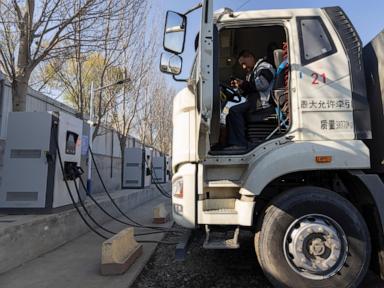
China is rapidly transitioning from diesel to electric trucks, a shift that could significantly alter global fuel consumption patterns and the future of heavy transportation. In 2020, nearly all new trucks sold in China relied on diesel, but projections indicate that by the first half of 2025, electric vehicles (EVs) will account for approximately 22% of new heavy truck sales, a substantial increase from just 9.2% in the same timeframe of 2024. This information comes from Commercial Vehicle World, a reputable trucking data provider based in Beijing.
According to forecasts from British research firm BMI, electric trucks may represent nearly 46% of new sales in 2025, with the figure potentially rising to 60% in 2026. These heavy-duty vehicles are crucial for modern economies, responsible for transporting goods while contributing significantly to global carbon emissions. In 2019, road freight was responsible for a third of all transport-related carbon emissions.
The transition to electric trucks has been a complex challenge due to their heavy batteries, which limit cargo capacity compared to diesel-powered models. Historically, proponents of liquefied natural gas (LNG) viewed it as a less polluting alternative as the technology for electric heavy vehicles continued to develop. LNG is natural gas cooled into a liquid state for easier storage and transport. Despite this, the landscape is shifting, with electric trucks now outselling LNG models in China.
Christopher Doleman, an analyst at the Institute for Energy Economics and Financial Analysis, observes that diesel use in China may decline more rapidly than anticipated, particularly as transport fuel demand stabilizes. The share of electric trucks in new sales has surged from 8% in 2024 to an expected 28% by August 2025, driven by falling prices and increasing consumer interest. Notably, electric trucks have outsold their LNG counterparts for five consecutive months this year, according to Commercial Vehicle World.
While electric trucks currently cost two to three times more than diesel models and approximately 18% more than LNG trucks, their enhanced energy efficiency and lower long-term operational costs can save owners an estimated 10% to 26% over the vehicle’s lifespan. Doleman emphasizes that fleet owners in China are highly motivated by bottom-line considerations, making this economic advantage significant.
Government incentives have further stimulated early sales. A 2024 scheme allows truck owners to trade in older vehicles for substantial rebates, up to about $19,000, when purchasing new or electric models. Moreover, investments in charging infrastructure are facilitating the transition. Major logistics hubs, particularly in the Yangtze River Delta, have established dedicated charging stations along key freight routes, while cities like Beijing and Shanghai have developed heavy-duty charging hubs capable of rapid charging.
In May 2024, CATL, the world’s largest electric vehicle battery manufacturer, introduced a battery-swapping system for heavy trucks and announced plans for a national network of swap stations spanning 150,000 kilometers (approximately 93,000 miles) of China’s expressways.
Analysts suggest that the surge in electric truck sales is already impacting diesel consumption, which fell to 3.9 million barrels per day in June 2024, marking an 11% decline year-on-year and the largest drop since mid-2021, according to the U.S. Energy Information Administration. Doleman underscores the importance of this trend, stating, “The rise of China’s electric truck sector is one of the more under-reported stories in the global energy transition, especially given its potential impact on regional diesel trade flows.”
Sales of LNG trucks peaked in September 2023 and March 2024 as China eased COVID-19 transport restrictions. However, by June 2025, LNG truck sales had declined by 6% as electric trucks gained market share. Shell’s 2025 LNG Outlook anticipates that demand for imported LNG in China will continue to rise, partly due to the presence of LNG trucks, while also hinting at potential expansion into markets like India.
Estimates from the Rhodium Group indicate that China’s electric trucks are already reducing oil demand by more than a million barrels a day. Doleman views LNG as a transitional option primarily relevant to China, where established pipeline infrastructure and domestic gas production create favorable conditions for LNG trucking not seen elsewhere.
China is also preparing to implement new emissions standards for vehicles, which will limit multiple pollutants and set average greenhouse gas targets across manufacturers’ fleets. Yang asserts that these standards will make it “almost impossible” for companies relying solely on fossil-fuel vehicles to meet compliance.
A 2020 study by the International Council on Clean Transportation (ICCT) found that LNG-fueled trucks could cut emissions by 2%-9% over a century. However, due to methane leakage, a potent greenhouse gas, they may pose more short-term pollution risks. Modern diesel trucks are now nearly on par with LNG in terms of air quality performance.
As the world’s largest exporter of passenger cars, China is turning its attention to the global electric truck market. Chinese manufacturers have managed to keep production costs low while accelerating manufacturing timelines, ensuring compatibility of components through in-house production of key parts.
During 2021-2023, exports of Chinese heavy-duty trucks, including electric models, to the Middle East and North Africa grew by approximately 73% annually, while shipments to Latin America rose by 46%, according to a report by McKinsey & Company. The share of electric trucks is expected to continue increasing, although limited charging infrastructure could present challenges.
In a notable development, Sany Heavy Industry announced plans to export its electric trucks to Europe starting in 2026. The company has already sent electric trucks to the United States, Thailand, India, and the United Arab Emirates. In June 2024, Chinese electric vehicle maker BYD began construction on a factory in Hungary aimed at producing electric trucks and buses, aligning with Europe’s 2040 target to reduce carbon emissions from new trucks by 90% compared to 2019 levels.
According to a 2024 study by McKinsey, the price of zero-emission trucks in Europe must be halved to become viable alternatives to diesel. In response, Volvo has stated that it welcomes “competition on fair terms,” while Scania did not provide comment.
As the industry evolves, Doleman concludes, “Things are shaking up.” The transition to electric trucks in China is poised to have lasting implications for global fuel demand and the future of heavy transport.

Hallmark’s ‘Christmas at the Catnip Café’ Premieres Tonight

Woman Arrested for Threatening U-Haul Worker with Baton

Japan’s PM Takaichi Vows Urgent Fiscal Management Amid Rate Trends

Bitcoin Plummets Below $88K Amid Tether Concerns and Warnings

Tottenville Falls Short in PSAL 4A Title Game Against Erasmus

Shark Teeth Study Reveals Urgent Clues to Prevent Extinction

Church Members Rally Together After Thanksgiving Fire Devastation

U.S. Investment in Canadian Energy Firms Surges Despite Low Oil Prices

Nick Jonas Unveils New Solo Album ‘Sunday Best’ Set for February Release

Urgent Update: Tom Aspinall’s Vision Deteriorates After UFC 321

MIT Scientists Uncover Surprising Genomic Loops During Cell Division

University of Hawaiʻi Joins $25.6M AI Project to Enhance Disaster Monitoring

AI Disruption: AWS Faces Threat as Startups Shift Cloud Focus

Time Crystals Revolutionize Quantum Computing Potential

Honeywell Forecasts Record Business Jet Deliveries Over Next Decade

Discover the Full Map of Pokémon Legends: Z-A’s Lumiose City

GOP Faces Backlash as Protests Surge Against Trump Policies

Parenthood Set to Depart Hulu: What Fans Need to Know
-
 Top Stories1 month ago
Urgent Update: Tom Aspinall’s Vision Deteriorates After UFC 321
-
 Health1 month ago
MIT Scientists Uncover Surprising Genomic Loops During Cell Division
-
Science4 weeks ago
University of Hawaiʻi Joins $25.6M AI Project to Enhance Disaster Monitoring
-
 Top Stories1 month ago
AI Disruption: AWS Faces Threat as Startups Shift Cloud Focus
-
 Science2 months ago
Time Crystals Revolutionize Quantum Computing Potential
-
 World2 months ago
Honeywell Forecasts Record Business Jet Deliveries Over Next Decade
-
 Entertainment1 month ago
Discover the Full Map of Pokémon Legends: Z-A’s Lumiose City
-
 Top Stories2 months ago
GOP Faces Backlash as Protests Surge Against Trump Policies
-
 Entertainment2 months ago
Parenthood Set to Depart Hulu: What Fans Need to Know
-

 Politics2 months ago
Judge Signals Dismissal of Chelsea Housing Case Citing AI Flaws
-

 Sports2 months ago
Yoshinobu Yamamoto Shines in Game 2, Leading Dodgers to Victory
-

 Health2 months ago
Maine Insurers Cut Medicare Advantage Plans Amid Cost Pressures