
Science
Study Reveals Importance of Finger Counting in Early Math Skills

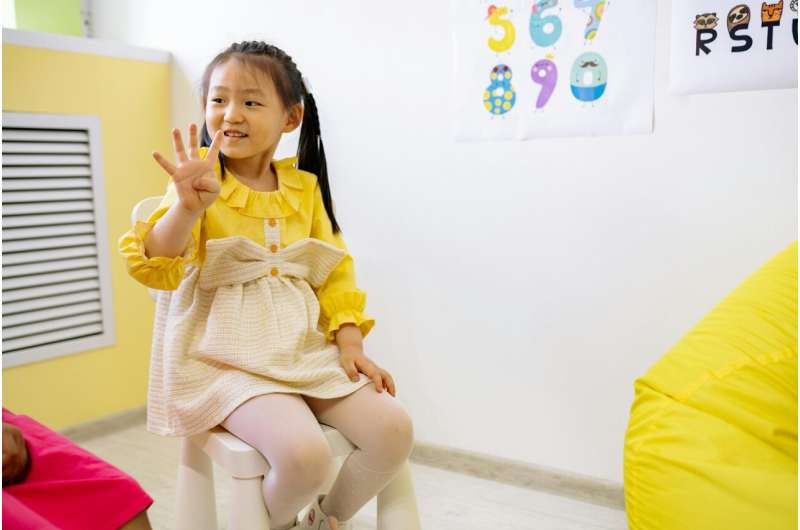
Children who engage in finger counting between the ages of 4 and 6.5 develop superior addition skills by age 7 compared to those who do not use this method, according to research published in the journal Developmental Psychology. This study, conducted by a team led by Catherine Thevenot, Ph.D., at the University of Lausanne in Switzerland, underscores the significance of finger counting as a foundational skill for mastering more complex mathematical concepts.
The study highlights that finger counting is a common strategy employed by young children to tackle arithmetic problems. Despite its benefits, many educators tend to discourage this practice early on. A French study noted that approximately 30% of first-grade teachers view finger counting as indicative of a child’s struggles with numerical understanding.
Research Methodology and Findings
Previous research primarily assessed children at a single point in time, showing that finger users performed better in arithmetic until around age 7. After this age, the trend reversed, with non-finger counters outperforming their peers. Thevenot and her colleague Marie Krenger, Ph.D., aimed to clarify whether non-finger users had never engaged in finger counting or were former users who had transitioned away from the method.
To explore this, the researchers tracked 211 Swiss children from ages 4.5 to 7.5, spanning pre-kindergarten to second grade. The children were tested biannually with progressively difficult addition problems, including tasks such as adding two digits between 1 and 5, and combinations of digits between 6 and 9. The researchers recorded whether the children used their fingers to solve the problems.
The data revealed that finger counting peaked between ages 5.5 and 6.5. Up to age 5, a majority of children tended to add without using their fingers. However, by age 6.5, 92% of children had utilized their fingers at least once during testing. By age 7.5, 43% of the participants had transitioned to being “ex-finger counters,” having previously used their fingers but no longer doing so, while 50% continued to rely on finger counting, and only 7% had never counted on their fingers.
Implications for Education
The study concluded that children who had previously used their fingers but had moved beyond this strategy tended to perform the best in arithmetic tasks. From age 6 onward, these former finger counters surpassed both those who had never used their fingers and those who still did.
Thevenot emphasized that the findings challenge the notion that finger counting should be discouraged in educational settings. She stated, “This research supports encouraging children to use their fingers in arithmetic without fear that they will become stuck in limited strategies.”
This study provides valuable insights into early childhood mathematics education and suggests that finger counting can be an essential tool for fostering advanced arithmetic skills. As educators reconsider their approaches, the evidence points towards a more supportive environment for young learners developing their numerical competencies.
More information can be found in the article titled “The Role of Children’s Finger Counting History on Their Addition Skills,” published in Developmental Psychology on November 20, 2025.

Shark Teeth Study Reveals Urgent Clues to Prevent Extinction

Church Members Rally Together After Thanksgiving Fire Devastation

U.S. Investment in Canadian Energy Firms Surges Despite Low Oil Prices

Nick Jonas Unveils New Solo Album ‘Sunday Best’ Set for February Release

Researchers Urge Label Changes for Low-Alcohol Drinks to Aid Pregnant Women

Wedding Cookie Table Community Aims for World’s Largest Cookie Exchange

Mayor Appoints Alan Wong as New Supervisor for District 4

UK Report Reveals Growing Role of AI in University Research Assessments

Mayor Lurie Appoints Alan Wong as New District 4 Supervisor

Urgent Update: Tom Aspinall’s Vision Deteriorates After UFC 321

MIT Scientists Uncover Surprising Genomic Loops During Cell Division

University of Hawaiʻi Joins $25.6M AI Project to Enhance Disaster Monitoring

AI Disruption: AWS Faces Threat as Startups Shift Cloud Focus

Time Crystals Revolutionize Quantum Computing Potential

Honeywell Forecasts Record Business Jet Deliveries Over Next Decade

Discover the Full Map of Pokémon Legends: Z-A’s Lumiose City

Parenthood Set to Depart Hulu: What Fans Need to Know

GOP Faces Backlash as Protests Surge Against Trump Policies
-
 Top Stories1 month ago
Urgent Update: Tom Aspinall’s Vision Deteriorates After UFC 321
-
 Health1 month ago
MIT Scientists Uncover Surprising Genomic Loops During Cell Division
-
Science4 weeks ago
University of Hawaiʻi Joins $25.6M AI Project to Enhance Disaster Monitoring
-
 Top Stories1 month ago
AI Disruption: AWS Faces Threat as Startups Shift Cloud Focus
-
 Science2 months ago
Time Crystals Revolutionize Quantum Computing Potential
-
 World2 months ago
Honeywell Forecasts Record Business Jet Deliveries Over Next Decade
-
 Entertainment1 month ago
Discover the Full Map of Pokémon Legends: Z-A’s Lumiose City
-
 Entertainment2 months ago
Parenthood Set to Depart Hulu: What Fans Need to Know
-
 Top Stories2 months ago
GOP Faces Backlash as Protests Surge Against Trump Policies
-

 Politics2 months ago
Judge Signals Dismissal of Chelsea Housing Case Citing AI Flaws
-

 Sports2 months ago
Yoshinobu Yamamoto Shines in Game 2, Leading Dodgers to Victory
-

 Health2 months ago
Maine Insurers Cut Medicare Advantage Plans Amid Cost Pressures