
Science
Blue Origin Unveils Ambitious Plans for New Glenn Rocket Expansion

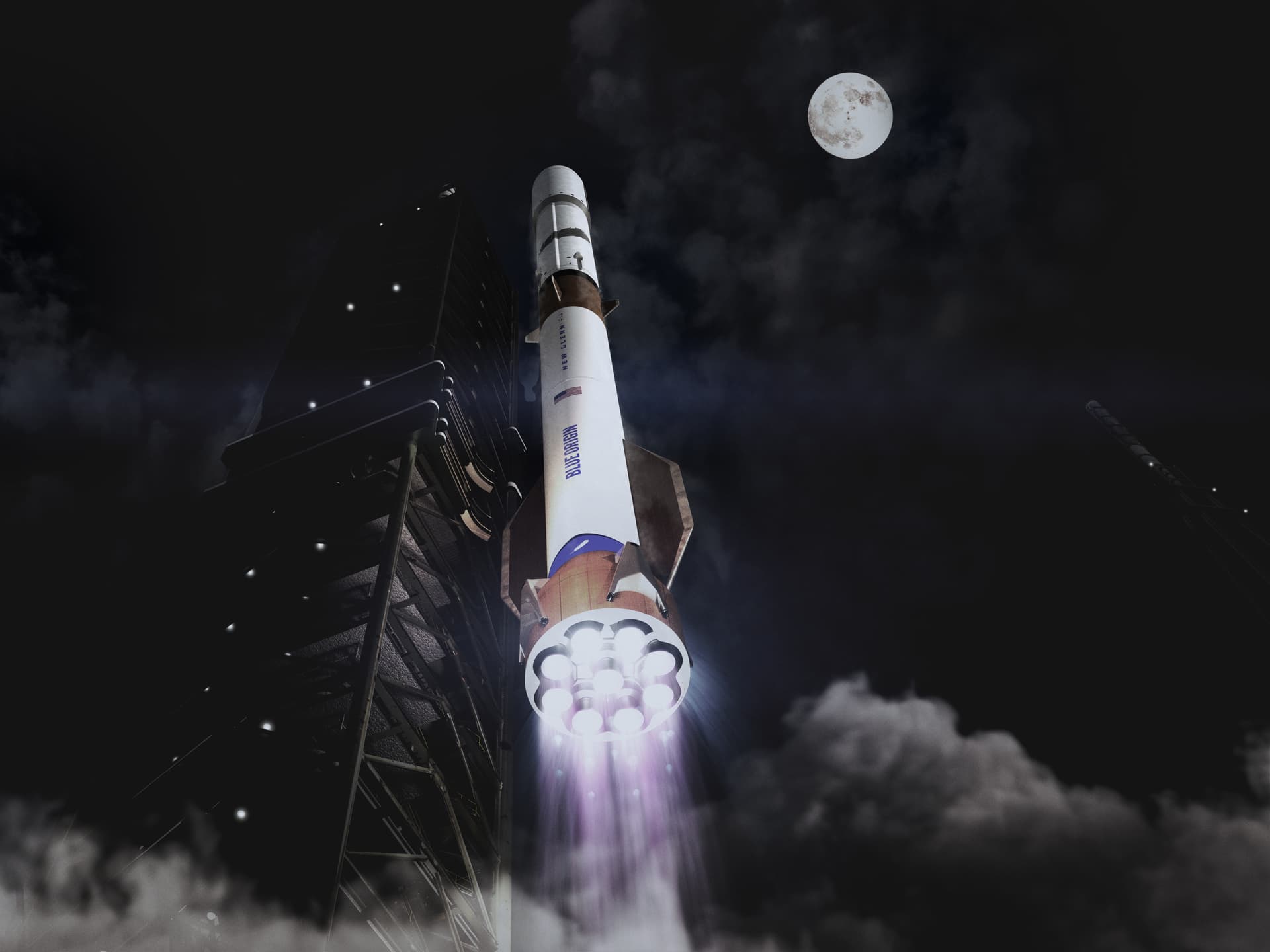
Blue Origin has marked a significant achievement with its heavy-launch vehicle, the New Glenn rocket, by successfully launching a NASA payload on November 13, 2023. The mission, known as ESCAPADE (Escape and Plasma Acceleration Dynamics Explorers), involved two twin satellites designed to investigate how solar wind interacts with Mars’ magnetic environment. This launch, the second of the New Glenn (NG-2), not only accomplished its primary objective but also demonstrated the company’s commitment to partial reusability by retrieving the rocket’s first stage.
Following this milestone, Blue Origin announced its plans to enhance the New Glenn rocket’s capabilities. The company intends to implement structural improvements, alongside upgrades in propulsion, avionics, reusability, and recovery mechanisms. Notably, Blue Origin aims to develop a “super-heavy” version of the New Glenn, designed to compete directly with SpaceX’s Starship.
The current New Glenn rocket is powered by seven BE-4 booster engines that generate a thrust of 2,400 kN (550,000 lbf) at sea level, amounting to a total thrust of 16,800 kN (3.5 million lbf). The new BE-4 engines are projected to deliver an increased thrust of 2,847 kN (642,850 lbf) each, bringing the total thrust capacity to 19,928 kN (4.5 million lbf). Blue Origin has already demonstrated capabilities of up to 2,780 kN (625,000 lbf) during testing and anticipates achieving the upgraded thrust specifications in future launches.
Future Developments and Competitive Landscape
In addition to the BE-4 enhancements, Blue Origin will upgrade the BE-3U thrusters, which power the rocket’s upper stage. The new version will produce 1,779 kN (400,000 lbf) of thrust, an improvement from the previous design of 1,423 kN (320,000 lbf). The integration of these enhancements is set to begin with the New Glenn’s next launch (NG-3), while the BE-3U upgrades will roll out over subsequent missions.
The company plans to introduce a super-heavy variant known as the New Glenn 9×4, which will feature a larger payload fairing measuring 8.7 meters (approximately 28 feet 6.5 inches) in diameter, compared to the current 7-meter (23-foot) fairing. This new design aims to deliver 70 metric tons to Low Earth Orbit (LEO), 14 metric tons to Geosynchronous Orbit (GSO), and 20 metric tons to a Trans-Lunar Injection (TLI) destined for the Moon.
Blue Origin’s ambitious plans come amid a rapidly evolving commercial launch market, where numerous providers are vying to challenge SpaceX’s dominance. The satellite launch sector is projected to grow into a $35.95 billion industry by 2030, prompting Blue Origin to enhance its performance and launch cadence to capture a larger share of this expanding market.
Navigating Future Opportunities with NASA
As part of its strategic direction, Blue Origin has secured contracts with NASA to support the Artemis Program, particularly for the upcoming Artemis V and VI missions. Although specific details remain uncertain beyond Artemis III, proposed cuts to the Space Launch System (SLS), Orion spacecraft, and Lunar Gateway outlined in the current administration’s FY 2026 Budget Request may lead to NASA increasingly outsourcing its launch and crewed spacecraft needs to commercial partners.
Acting NASA Director Sean Duffy has indicated that the agency will seek competitive bids for a Human Landing System (HLS), citing delays in the development of SpaceX’s Starship. This opens additional avenues for Blue Origin to secure contracts for deep space exploration missions, similar to the ESCAPADE endeavor, as well as for national security initiatives like Golden Dome.
Blue Origin’s commitment to innovation and competition marks a pivotal moment in the aerospace industry as the company prepares to elevate its capabilities and expand its role in both commercial and governmental space activities.

Philadelphia Parks Launch Free Earth Month Events Starting April 1

Bradford’s Fish Fry Fridays Serve Community with Delicious Dinners

Trump Faces Growing Challenges Amid Rising Tensions with Iran

Scientists Probe the Universe’s Missing Topological Defects

Samsung Galaxy Watch 9 to Feature Larger 435mAh Battery

UConn Huskies Aim to Defend Title in 2026 NCAA Women’s Tournament

U.S. Littoral Combat Ships Dock in Malaysia Amid Regional Tensions

Healthy Choice Wellness Reports Quarterly Earnings, Shares Rise

Urgent News: Charles M. Payment Passes Away at 78 in Duluth

University of Hawaiʻi Joins $25.6M AI Project to Enhance Disaster Monitoring

Major Grant Enhances Cancer Care and Research in Hawaiʻi

Joleen Chaney, Beloved Journalist, Passes Leaving Lasting Legacy

San Francisco’s SFO to Welcome 16 Airlines with Nonstop Flights to Europe in 2026

Goldman Sachs Unveils 2026 Catalyst Playbook for Biotech Investors

Discover Top Business Smartphones for Professionals in 2026

Urgent Update: Tom Aspinall’s Vision Deteriorates After UFC 321

Texas Roadhouse Honors Veterans with Free Meal Vouchers

CD Projekt Red Confirms No Release for The Witcher 4 in 2026
-
Science9 months ago
University of Hawaiʻi Joins $25.6M AI Project to Enhance Disaster Monitoring
-
 Health8 months ago
Major Grant Enhances Cancer Care and Research in Hawaiʻi
-
 Top Stories9 months ago
Joleen Chaney, Beloved Journalist, Passes Leaving Lasting Legacy
-
 World7 months ago
San Francisco’s SFO to Welcome 16 Airlines with Nonstop Flights to Europe in 2026
-
 Business8 months ago
Goldman Sachs Unveils 2026 Catalyst Playbook for Biotech Investors
-
 Business7 months ago
Discover Top Business Smartphones for Professionals in 2026
-
 Top Stories9 months ago
Urgent Update: Tom Aspinall’s Vision Deteriorates After UFC 321
-
 Lifestyle9 months ago
Texas Roadhouse Honors Veterans with Free Meal Vouchers
-
 Entertainment8 months ago
CD Projekt Red Confirms No Release for The Witcher 4 in 2026
-

 Top Stories10 months ago
AI Disruption: AWS Faces Threat as Startups Shift Cloud Focus
-

 Health10 months ago
MIT Scientists Uncover Surprising Genomic Loops During Cell Division
-

 Entertainment10 months ago
Discover the Full Map of Pokémon Legends: Z-A’s Lumiose City