
Politics
US Catholic Bishops Set to Elect New Leadership Amid Immigration Debate

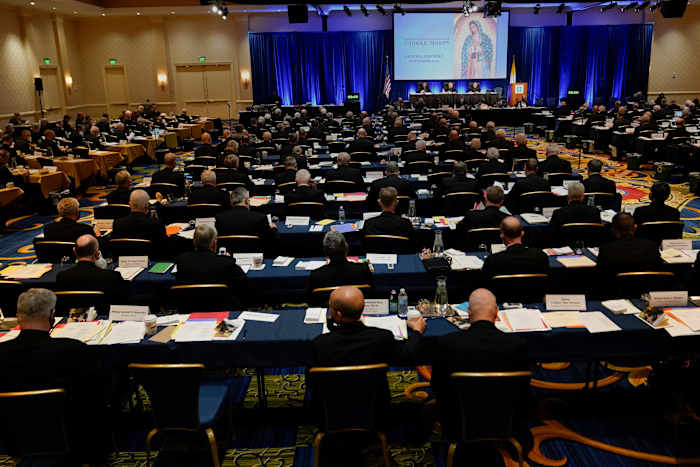
The United States Conference of Catholic Bishops (USCCB) is poised to elect a new president and vice president on November 14, 2023, in Baltimore. This election serves as a significant indicator of the bishops’ priorities, particularly in light of their contrasting views with Pope Francis on several key issues. The outcome could reflect a shift in leadership style, especially regarding social issues such as immigration, which has remained a contentious topic under the previous administration.
Of the ten candidates on the ballot, half align with the conservative wing of the conference. While the majority of U.S. Catholic bishops maintain a conservative stance on social matters, the emphasis varies, particularly on issues like abortion and LGBTQ+ rights. David Gibson, director of Fordham University’s Center on Religion and Culture, noted that the candidate slate captures the current dynamics within the American hierarchy, which is evenly split on ideological lines.
The winner of this election will replace outgoing president, Military Services Archbishop Timothy Broglio, who has served since 2020 and is completing his three-year term. Archbishop William Lori of Baltimore, the current vice president, is approaching the mandatory retirement age of 75, making it unlikely that he will ascend to the presidency.
Among the conservative candidates, Oklahoma City Archbishop Paul Coakley stands out as a strong contender. He previously held the position of secretary, the third-ranking official within the USCCB, and has connections to conservative networks, such as the Napa Institute. Coakley has also publicly supported critics of Pope Francis, adding to his polarizing profile.
Another prominent figure in the election is Bishop Robert Barron, the bishop of the Winona-Rochester diocese in Minnesota. Known for his popular Word on Fire ministry, Barron has become a significant voice in Catholic media. He currently serves on the Religious Liberty Commission established during former President Donald Trump’s administration, alongside Bishop Kevin Rhoades of Fort Wayne-South Bend, Indiana.
The bishops’ election comes at a critical time, as many within the Catholic community are advocating for a leader who can unify the body and foster better relations with the Vatican. Candidates like Archbishop Charles Thompson of Indianapolis and Bishop Daniel Flores of Brownsville, Texas, are viewed as potential unifiers. Both represent a growing Latino presence in the U.S. Catholic Church, which could influence the direction of the conference moving forward.
Flores, who has taken a leading role in the Vatican’s synodal process aimed at modernizing the Church, has a unique perspective shaped by his experiences along the U.S.-Mexico border. He is traditional in terms of sexual ethics but vocal in his defense of migrants, a position that resonates with many Catholic leaders as immigration continues to polarize the nation.
During this meeting, the bishops are expected to discuss immigration, reflecting a shared concern for the plight of migrants, even among conservative members. The bishops stand united in their advocacy for migrants, despite the political divides that characterize their discussions on other issues. The question remains, however, how forcefully the USCCB will address the immigration policies implemented during the Trump administration, which have significantly impacted local parishes and their congregations.
Reports indicate that fear surrounding immigration enforcement has led to decreased attendance at Mass in some areas. Local clergy members are striving to provide sacraments to detained immigrants, underscoring the urgency and human impact of this issue. The USCCB has already discontinued its longstanding refugee resettlement program following the cessation of federal funding for resettlement aid during the previous administration.
Pope Leo XIV has recently called for a “deep reflection” on the treatment of migrants, emphasizing the long-term consequences of current policies on individuals who have lived without causing problems. His remarks highlight the moral imperative facing U.S. bishops as they navigate the complexities of their leadership roles and the broader societal challenges surrounding immigration.
As the bishops prepare to elect their new leadership, the outcome will not only shape the direction of the USCCB but also influence how the Catholic Church in the United States responds to pressing social issues in the years to come.

Japan’s PM Takaichi Vows Urgent Fiscal Management Amid Rate Trends

Bitcoin Plummets Below $88K Amid Tether Concerns and Warnings

Tottenville Falls Short in PSAL 4A Title Game Against Erasmus

Shark Teeth Study Reveals Urgent Clues to Prevent Extinction

Church Members Rally Together After Thanksgiving Fire Devastation

U.S. Investment in Canadian Energy Firms Surges Despite Low Oil Prices

Nick Jonas Unveils New Solo Album ‘Sunday Best’ Set for February Release

Researchers Urge Label Changes for Low-Alcohol Drinks to Aid Pregnant Women

Wedding Cookie Table Community Aims for World’s Largest Cookie Exchange

Urgent Update: Tom Aspinall’s Vision Deteriorates After UFC 321

MIT Scientists Uncover Surprising Genomic Loops During Cell Division

University of Hawaiʻi Joins $25.6M AI Project to Enhance Disaster Monitoring

AI Disruption: AWS Faces Threat as Startups Shift Cloud Focus

Time Crystals Revolutionize Quantum Computing Potential

Honeywell Forecasts Record Business Jet Deliveries Over Next Decade

Discover the Full Map of Pokémon Legends: Z-A’s Lumiose City

GOP Faces Backlash as Protests Surge Against Trump Policies

Parenthood Set to Depart Hulu: What Fans Need to Know
-
 Top Stories1 month ago
Urgent Update: Tom Aspinall’s Vision Deteriorates After UFC 321
-
 Health1 month ago
MIT Scientists Uncover Surprising Genomic Loops During Cell Division
-
Science4 weeks ago
University of Hawaiʻi Joins $25.6M AI Project to Enhance Disaster Monitoring
-
 Top Stories1 month ago
AI Disruption: AWS Faces Threat as Startups Shift Cloud Focus
-
 Science2 months ago
Time Crystals Revolutionize Quantum Computing Potential
-
 World2 months ago
Honeywell Forecasts Record Business Jet Deliveries Over Next Decade
-
 Entertainment1 month ago
Discover the Full Map of Pokémon Legends: Z-A’s Lumiose City
-
 Top Stories2 months ago
GOP Faces Backlash as Protests Surge Against Trump Policies
-
 Entertainment2 months ago
Parenthood Set to Depart Hulu: What Fans Need to Know
-

 Politics2 months ago
Judge Signals Dismissal of Chelsea Housing Case Citing AI Flaws
-

 Sports2 months ago
Yoshinobu Yamamoto Shines in Game 2, Leading Dodgers to Victory
-

 Health2 months ago
Maine Insurers Cut Medicare Advantage Plans Amid Cost Pressures