
Science
Astronomers Detect Unexpected Nickel in Comet 3I/ATLAS

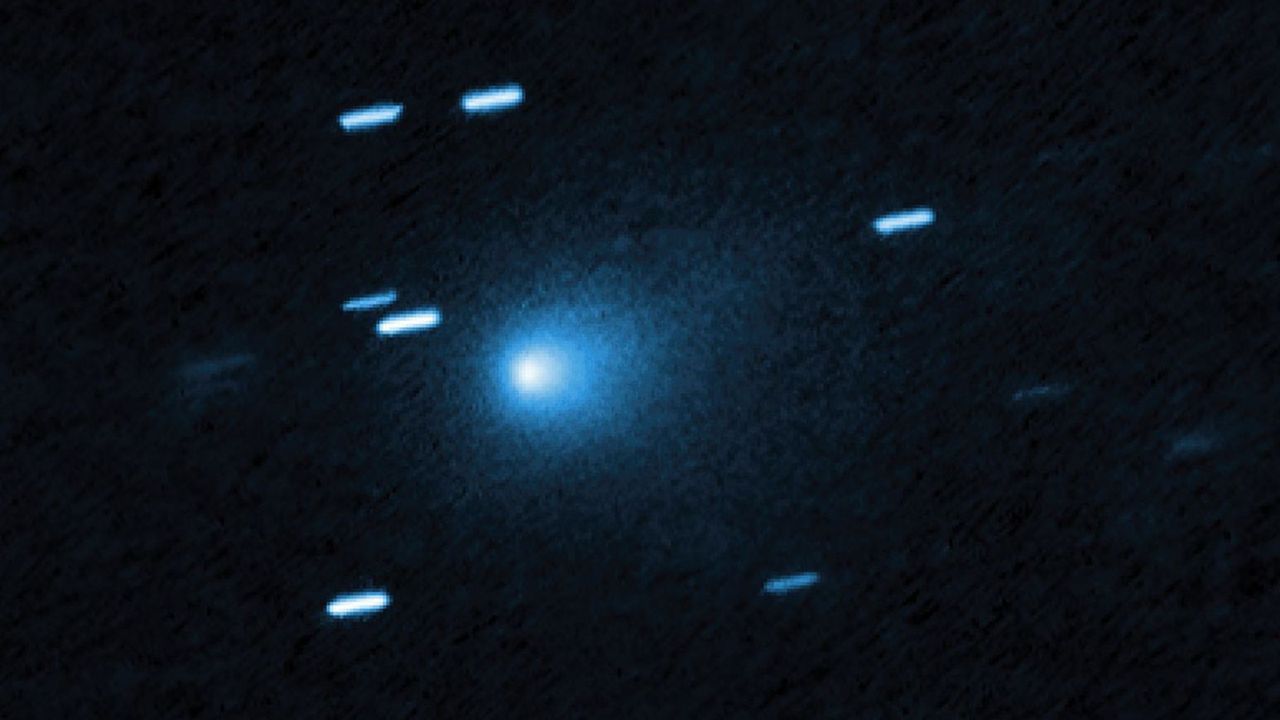
In a groundbreaking discovery, researchers have detected glowing nickel vapor in the gas surrounding the interstellar comet 3I/ATLAS, an unexpected finding given the extreme cold temperatures at its distance from the sun. This observation offers new insights into the chemical composition of materials originating from beyond our solar system. The detection was made by an international team, including Rohan Rahatgaonkar, a Ph.D. student at the Instituto de Astrofísica-Pontificia Universidad Católica de Chile, and Darryl Z. Seligman, an Assistant Professor of Physics and Astronomy at Michigan State University.
The comet was initially detected on July 1, 2025, by the Asteroid Terrestrial-impact Last Alert System (ATLAS), making it only the third confirmed interstellar object observed. Unlike its predecessors, ‘Oumuamua and comet Borisov, 3I/ATLAS was identified early in its journey, providing a unique chance for scientists to monitor its progression as it nears the sun.
3I/ATLAS is particularly valuable to researchers as it carries chemical and physical information from its origin, potentially billions of years ago. These interstellar objects serve as cosmic time capsules, revealing secrets about distant star systems that can be studied only through such encounters.
Tracking Chemical Activity from Afar
Using the Very Large Telescope (VLT) in Chile, the research team monitored the comet’s chemical activity as it approached the sun. Their observations, made with the X-shooter and UVES spectrographs, indicated that 3I/ATLAS may be significantly older than our solar system.
The first significant detection of nickel vapor occurred on July 20, 2025, at a distance of 3.88 astronomical units (AU) from the sun, nearly four times the distance from Earth. This finding was surprising, as such cold temperatures typically prevent metals from vaporizing. As the comet continued its trajectory, the researchers noted an increase in nickel emissions, suggesting dynamic chemical processes at play.
By mid-August, when 3I/ATLAS had approached 3.07 AU from the sun, the team detected cyanogen (CN) gas, a common molecular emission in solar system comets. This progression from dormant to dynamic reveals the comet’s complex chemistry as it warms under solar radiation.
Unraveling the Mystery of Nickel Emissions
The detection of nickel without concurrent iron signals a unique chemical process occurring within the comet. This observation suggests that nickel may be released through mechanisms that function at lower temperatures than those required for metal sublimation. Researchers propose that nickel atoms could be bound within specialized molecules that readily disintegrate under sunlight, potentially including compounds where nickel is attached to carbon monoxide or other organic materials.
Moreover, observations from the James Webb Space Telescope (JWST) support these findings. The JWST revealed that the comet’s coma contains a high concentration of carbon dioxide relative to water, an unusual ratio in comparison to typical solar system comets. The presence of water ice particles and carbon monoxide gas indicates a rich mix of frozen materials that facilitate the comet’s activity as it approaches the sun.
As 3I/ATLAS continues its journey towards its closest approach on October 29, 2025, researchers are collecting invaluable data about its chemical origins. The chemical signatures observed may reflect both the comet’s ancient formation and its extensive journey through interstellar space.
The implications of this research extend beyond 3I/ATLAS, as scientists aim to determine whether the building blocks of planetary systems are consistent across the galaxy or vary significantly among different environments. By comparing 3I/ATLAS with previous interstellar visitors like 2I/Borisov, researchers are piecing together a broader understanding of the material composition of planets around various stars.
The ongoing study of 3I/ATLAS exemplifies the beauty of scientific inquiry, as findings often challenge existing expectations and reveal the complexity of the universe. As the research team continues to monitor the comet, they anticipate further increases in activity and potentially new chemical species as temperatures rise, paving the way for deeper insights into this cosmic phenomenon.

Japan’s PM Takaichi Vows Urgent Fiscal Management Amid Rate Trends

Bitcoin Plummets Below $88K Amid Tether Concerns and Warnings

Tottenville Falls Short in PSAL 4A Title Game Against Erasmus

Shark Teeth Study Reveals Urgent Clues to Prevent Extinction

Church Members Rally Together After Thanksgiving Fire Devastation

U.S. Investment in Canadian Energy Firms Surges Despite Low Oil Prices

Nick Jonas Unveils New Solo Album ‘Sunday Best’ Set for February Release

Researchers Urge Label Changes for Low-Alcohol Drinks to Aid Pregnant Women

Wedding Cookie Table Community Aims for World’s Largest Cookie Exchange

Urgent Update: Tom Aspinall’s Vision Deteriorates After UFC 321

MIT Scientists Uncover Surprising Genomic Loops During Cell Division

University of Hawaiʻi Joins $25.6M AI Project to Enhance Disaster Monitoring

AI Disruption: AWS Faces Threat as Startups Shift Cloud Focus

Time Crystals Revolutionize Quantum Computing Potential

Honeywell Forecasts Record Business Jet Deliveries Over Next Decade

Discover the Full Map of Pokémon Legends: Z-A’s Lumiose City

GOP Faces Backlash as Protests Surge Against Trump Policies

Parenthood Set to Depart Hulu: What Fans Need to Know
-
 Top Stories1 month ago
Urgent Update: Tom Aspinall’s Vision Deteriorates After UFC 321
-
 Health1 month ago
MIT Scientists Uncover Surprising Genomic Loops During Cell Division
-
Science4 weeks ago
University of Hawaiʻi Joins $25.6M AI Project to Enhance Disaster Monitoring
-
 Top Stories1 month ago
AI Disruption: AWS Faces Threat as Startups Shift Cloud Focus
-
 Science2 months ago
Time Crystals Revolutionize Quantum Computing Potential
-
 World2 months ago
Honeywell Forecasts Record Business Jet Deliveries Over Next Decade
-
 Entertainment1 month ago
Discover the Full Map of Pokémon Legends: Z-A’s Lumiose City
-
 Top Stories2 months ago
GOP Faces Backlash as Protests Surge Against Trump Policies
-
 Entertainment2 months ago
Parenthood Set to Depart Hulu: What Fans Need to Know
-

 Politics2 months ago
Judge Signals Dismissal of Chelsea Housing Case Citing AI Flaws
-

 Sports2 months ago
Yoshinobu Yamamoto Shines in Game 2, Leading Dodgers to Victory
-

 Health2 months ago
Maine Insurers Cut Medicare Advantage Plans Amid Cost Pressures