
Science
Astrophysicists Study Ancient Comet 3I/ATLAS from Deep Space

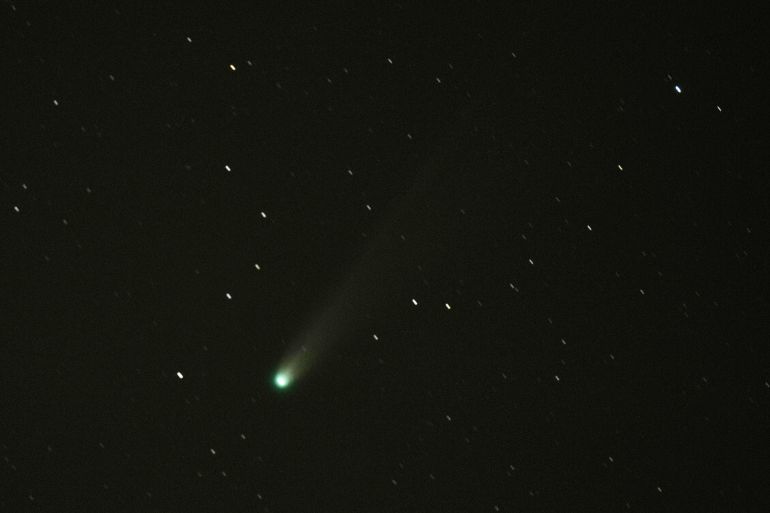
Astrophysicists are actively studying an ancient comet known as 3I/ATLAS, which entered the solar system earlier this year and has already passed by Mars. This interstellar comet, which poses no threat to Earth, has captured significant interest as it is only one of three confirmed interstellar objects detected to date.
What Is 3I/ATLAS?
Discovered in July 2023 by Larry Dennau of the Asteroid Terrestrial-impact Last Alert System (ATLAS) in Rio Hurtado, Chile, 3I/ATLAS is a rare celestial body composed of ice, dust, and gas. These comets are remnants from the formation of the solar system approximately 4.6 billion years ago. The “I” in its name signifies its origins from another star system.
Before 3I/ATLAS, two other interstellar objects were identified: 1I/’Oumuamua, a rocky entity discovered in October 2017, and 2I/Borisov, a comet found in August 2019. Both were notable for their unique properties and origins, with 2I/Borisov being classified as a rogue comet due to its unbound trajectory through space.
Trajectory and Future Observations
3I/ATLAS recently zipped past Mars, coming within 29 million km (approximately 18 million miles) of the planet at a staggering speed of 310,000 km/h (about 193,000 mph). The comet made its closest approach to the Sun at the end of October 2023, and is expected to pass Earth in December 2023, maintaining a distance of about 270 million km (around 170 million miles)—still farther than the Sun itself, which is about 150 million km (approximately 93 million miles) away.
As the comet travels along its path, it is currently obscured by the Sun, making it untrackable from Earth. However, NASA anticipates that 3I/ATLAS will become visible again by early December 2025. Various spacecraft, including the Hubble Space Telescope, are monitoring the object, with additional support from the European Space Agency’s Juice spacecraft, which is en route to Jupiter and its moons.
Research teams are keenly interested in determining the comet’s size and physical characteristics. Initial observations indicate that 3I/ATLAS has a teardrop-shaped cocoon of dust surrounding its solid, icy nucleus. The Hubble Space Telescope captured images in July, suggesting the nucleus is no larger than 5.6 km (around 3.5 miles440 meters (approximately 1,444 feet).
The coma, a fuzzy halo surrounding comets, is rich in carbon dioxide, indicating that 3I/ATLAS formed in extremely cold conditions, far from its original star. According to Darryl Seligman, a planetary scientist at Michigan State University, this finding adds another layer of intrigue to the study of this ancient interstellar visitor.
As scientists continue to gather data on 3I/ATLAS, its unique characteristics and origins will contribute to a deeper understanding of the universe and the objects that traverse it. The ongoing research underscores the importance of space exploration and the pursuit of knowledge about our cosmic neighbors.

Bitcoin Plummets Below $88K Amid Tether Concerns and Warnings

Tottenville Falls Short in PSAL 4A Title Game Against Erasmus

Shark Teeth Study Reveals Urgent Clues to Prevent Extinction

Church Members Rally Together After Thanksgiving Fire Devastation

U.S. Investment in Canadian Energy Firms Surges Despite Low Oil Prices

Nick Jonas Unveils New Solo Album ‘Sunday Best’ Set for February Release

Researchers Urge Label Changes for Low-Alcohol Drinks to Aid Pregnant Women

Wedding Cookie Table Community Aims for World’s Largest Cookie Exchange

Mayor Appoints Alan Wong as New Supervisor for District 4

Urgent Update: Tom Aspinall’s Vision Deteriorates After UFC 321

MIT Scientists Uncover Surprising Genomic Loops During Cell Division

University of Hawaiʻi Joins $25.6M AI Project to Enhance Disaster Monitoring

AI Disruption: AWS Faces Threat as Startups Shift Cloud Focus

Time Crystals Revolutionize Quantum Computing Potential

Honeywell Forecasts Record Business Jet Deliveries Over Next Decade

Discover the Full Map of Pokémon Legends: Z-A’s Lumiose City

GOP Faces Backlash as Protests Surge Against Trump Policies

Parenthood Set to Depart Hulu: What Fans Need to Know
-
 Top Stories1 month ago
Urgent Update: Tom Aspinall’s Vision Deteriorates After UFC 321
-
 Health1 month ago
MIT Scientists Uncover Surprising Genomic Loops During Cell Division
-
Science4 weeks ago
University of Hawaiʻi Joins $25.6M AI Project to Enhance Disaster Monitoring
-
 Top Stories1 month ago
AI Disruption: AWS Faces Threat as Startups Shift Cloud Focus
-
 Science2 months ago
Time Crystals Revolutionize Quantum Computing Potential
-
 World2 months ago
Honeywell Forecasts Record Business Jet Deliveries Over Next Decade
-
 Entertainment1 month ago
Discover the Full Map of Pokémon Legends: Z-A’s Lumiose City
-
 Top Stories2 months ago
GOP Faces Backlash as Protests Surge Against Trump Policies
-
 Entertainment2 months ago
Parenthood Set to Depart Hulu: What Fans Need to Know
-

 Politics2 months ago
Judge Signals Dismissal of Chelsea Housing Case Citing AI Flaws
-

 Sports2 months ago
Yoshinobu Yamamoto Shines in Game 2, Leading Dodgers to Victory
-

 Health2 months ago
Maine Insurers Cut Medicare Advantage Plans Amid Cost Pressures