
Science
CMS Collaboration Achieves First Observation of Single Top Quark

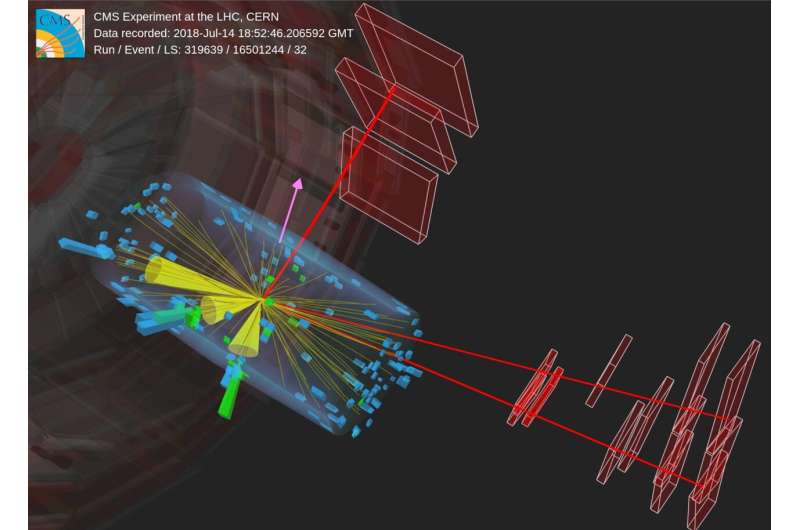
The *CMS collaboration* at CERN has made a groundbreaking observation by detecting the production of a single top quark in conjunction with a W and a Z boson. This rare event, known as tWZ production, occurs only once in every trillion proton collisions at the *Large Hadron Collider (LHC)*. The significance of this discovery not only enhances our understanding of fundamental forces but also opens pathways for potential new physics.
Understanding the Significance of tWZ Production
In particle physics, the top quark is recognized as the heaviest known fundamental particle. Its interactions with the *Higgs field* can provide insights into the Higgs mechanism, which is crucial for understanding mass generation in elementary particles. The tWZ process allows physicists to explore how the top quark interacts with the electroweak force, transmitted by the W and Z bosons.
The observation is akin to finding a needle in a haystack the size of an Olympic stadium. The complexity of the tWZ production event is compounded by its similarity to another process, known as ttZ production, where a top and an anti-top quark are produced alongside a Z boson. The ttZ process occurs approximately seven times more frequently than tWZ production, which introduces significant background noise that must be distinguished to confirm the findings.
Advanced Techniques in Data Analysis
To tackle the challenges of identifying this rare event, the CMS collaboration employed advanced analysis techniques, incorporating state-of-the-art machine learning. According to *Alberto Belvedere*, a researcher with the CMS collaboration at *DESY*, “Observing tWZ production requires advanced analysis techniques involving state-of-the-art machine learning.” This innovative approach enabled researchers to effectively separate the tWZ signal from the background data.
The findings, which were released on November 3, 2025, indicate that the rate of tWZ production is slightly higher than theoretical predictions. This discrepancy raises intriguing questions about the potential existence of unknown interactions or particles. As noted by *Roman Kogler*, also a researcher with the CMS collaboration at DESY, “If there are unknown interactions or particles involved, the observed deviation between the measured rate [of tWZ production] and the prediction would rapidly become larger with increasing energies of the outgoing particles.”
The observation of this phenomenon confirms the LHC’s ongoing capability to uncover the most elusive secrets of nature, marking a significant milestone in particle physics research. Future analyses and additional data will determine whether the observed rates represent a statistical anomaly or an indication of new physics beyond the established Standard Model.
The results are available on the *arXiv* preprint server, providing a resource for further exploration of this groundbreaking discovery. As the CMS collaboration continues its investigations, the implications of tWZ production may lead to deeper insights into the fundamental structure of matter and the forces that govern the universe.

Japan’s PM Takaichi Vows Urgent Fiscal Management Amid Rate Trends

Bitcoin Plummets Below $88K Amid Tether Concerns and Warnings

Tottenville Falls Short in PSAL 4A Title Game Against Erasmus

Shark Teeth Study Reveals Urgent Clues to Prevent Extinction

Church Members Rally Together After Thanksgiving Fire Devastation

U.S. Investment in Canadian Energy Firms Surges Despite Low Oil Prices

Nick Jonas Unveils New Solo Album ‘Sunday Best’ Set for February Release

Researchers Urge Label Changes for Low-Alcohol Drinks to Aid Pregnant Women

Wedding Cookie Table Community Aims for World’s Largest Cookie Exchange

Urgent Update: Tom Aspinall’s Vision Deteriorates After UFC 321

MIT Scientists Uncover Surprising Genomic Loops During Cell Division

University of Hawaiʻi Joins $25.6M AI Project to Enhance Disaster Monitoring

AI Disruption: AWS Faces Threat as Startups Shift Cloud Focus

Time Crystals Revolutionize Quantum Computing Potential

Honeywell Forecasts Record Business Jet Deliveries Over Next Decade

Discover the Full Map of Pokémon Legends: Z-A’s Lumiose City

GOP Faces Backlash as Protests Surge Against Trump Policies

Parenthood Set to Depart Hulu: What Fans Need to Know
-
 Top Stories1 month ago
Urgent Update: Tom Aspinall’s Vision Deteriorates After UFC 321
-
 Health1 month ago
MIT Scientists Uncover Surprising Genomic Loops During Cell Division
-
Science4 weeks ago
University of Hawaiʻi Joins $25.6M AI Project to Enhance Disaster Monitoring
-
 Top Stories1 month ago
AI Disruption: AWS Faces Threat as Startups Shift Cloud Focus
-
 Science2 months ago
Time Crystals Revolutionize Quantum Computing Potential
-
 World2 months ago
Honeywell Forecasts Record Business Jet Deliveries Over Next Decade
-
 Entertainment1 month ago
Discover the Full Map of Pokémon Legends: Z-A’s Lumiose City
-
 Top Stories2 months ago
GOP Faces Backlash as Protests Surge Against Trump Policies
-
 Entertainment2 months ago
Parenthood Set to Depart Hulu: What Fans Need to Know
-

 Politics2 months ago
Judge Signals Dismissal of Chelsea Housing Case Citing AI Flaws
-

 Sports2 months ago
Yoshinobu Yamamoto Shines in Game 2, Leading Dodgers to Victory
-

 Health2 months ago
Maine Insurers Cut Medicare Advantage Plans Amid Cost Pressures