
Science
Deep-Sea Squid Disguises as Sponge in Rare Pacific Observation

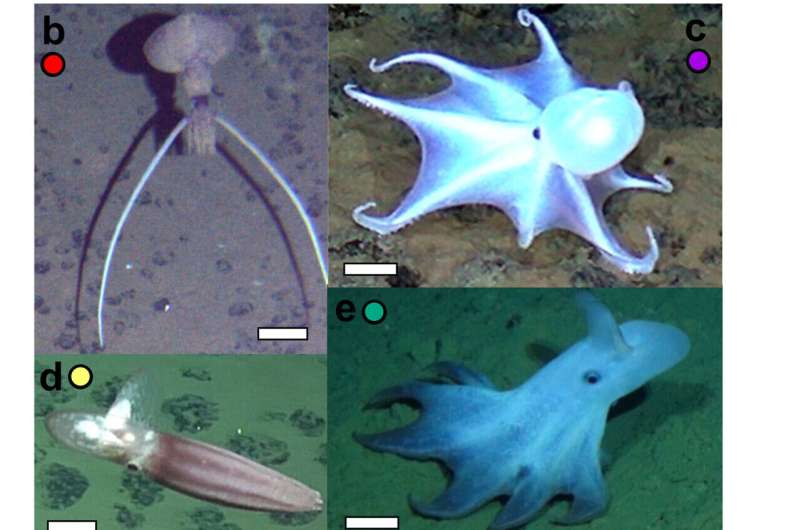
Researchers have documented a striking behavior in a deep-sea squid that camouflaged itself as sponge stalks in the Pacific Ocean. This observation occurred in the Clarion-Clipperton Zone (CCZ) and was published in the journal Ecology in December 2025. The findings highlight the complexities of cephalopod behavior and raise questions about their distribution and abundance in deep-sea environments.
The study was initiated in March 2023 during visual surveys conducted at a depth of approximately 4,100 meters using a remotely operated vehicle (ROV). Initially, the research team believed they were examining biogenic stalks, which are living structures found in deep-sea ecosystems. However, four seconds into the footage, a squid swiftly swam across the camera’s view, prompting further investigation.
Upon a closer examination of the video, the researchers discovered that the squid had been hidden beneath mud and polymetallic nodules, only surfacing just before being recorded. The squid was noted for its distinctive features: a mantle length of around 10 centimeters and long, white tentacles measuring approximately 22 centimeters. The team suspects it may be a previously unclassified species of whiplash squid within the family Mastigoteuthidae.
According to the study authors, this behavior, referred to as “masquerading,” allows the squid to conceal itself from predators, such as beaked whales, or to ambush prey. This observation marks the first recorded instance of masquerading in a deep-sea cephalopod. Prior to this, whiplash squids had been encountered only once in the Northeast Pacific abyss, with just four cephalopod sightings since seabed surveys began in the 1970s.
The researchers posit that the scarcity of sightings does not necessarily indicate low populations. Instead, it suggests that these creatures may be adept at avoiding detection. The authors of the study commented, “As with the number of genetic species, the occurrences and distributions we report here are most certainly an underestimate, since cephalopods can self-disguise as well as sense and potentially avoid underwater sampling vehicles.”
As these deep-sea areas face increasing threats from climate change and seabed mining, gaining a better understanding of their ecosystems is crucial. The abyssal plains span more than half of the Earth’s surface, yet much remains unknown about the habitats found there. Enhanced research methods with less intrusive camera platforms are essential for uncovering the diversity and behaviors of deep-sea cephalopods before these environments undergo irreversible changes.
The research team emphasizes the importance of this study in informing conservation and management strategies, particularly in regions targeted for resource extraction. By shedding light on the elusive lives of deep-sea cephalods, the findings contribute to a broader understanding of the ecological dynamics at play in one of the most obscure environments on the planet.
This article was authored by Krystal Kasal, edited by Gaby Clark, and reviewed by Robert Egan. It serves as a reminder of the complexities of marine life and the urgent need for continued exploration and conservation efforts in our oceans.

California Hires Ex-CDC Leaders for Urgent Public Health Initiative

Dolphins Clash with Steelers on Monday Night Football Showdown

Argentina’s Central Bank Adjusts Currency Band to Strengthen Peso

Contango Ore Merges with Dolly Varden Silver to Expand Alaskan Ventures

Rob Reiner: A Legendary Career in Comedy and Film Comes to a Close

Pediatrician Offers Guidance on Bringing Sick Kids to Parties

1,435 Couples Set New Record with Simultaneous Kiss in DC

Urgent: One Stabbed in North Beach Fight, Two Arrested Today

Avatar: Fire and Ash Premiere Canceled After Bondi Shooting

Urgent Update: Tom Aspinall’s Vision Deteriorates After UFC 321

University of Hawaiʻi Joins $25.6M AI Project to Enhance Disaster Monitoring

MIT Scientists Uncover Surprising Genomic Loops During Cell Division

AI Disruption: AWS Faces Threat as Startups Shift Cloud Focus

Time Crystals Revolutionize Quantum Computing Potential

Discover the Full Map of Pokémon Legends: Z-A’s Lumiose City

Honeywell Forecasts Record Business Jet Deliveries Over Next Decade

GOP Faces Backlash as Protests Surge Against Trump Policies

Judge Signals Dismissal of Chelsea Housing Case Citing AI Flaws
-
 Top Stories2 months ago
Urgent Update: Tom Aspinall’s Vision Deteriorates After UFC 321
-
Science1 month ago
University of Hawaiʻi Joins $25.6M AI Project to Enhance Disaster Monitoring
-
 Health2 months ago
MIT Scientists Uncover Surprising Genomic Loops During Cell Division
-
 Top Stories2 months ago
AI Disruption: AWS Faces Threat as Startups Shift Cloud Focus
-
 Science2 months ago
Time Crystals Revolutionize Quantum Computing Potential
-
 Entertainment2 months ago
Discover the Full Map of Pokémon Legends: Z-A’s Lumiose City
-
 World2 months ago
Honeywell Forecasts Record Business Jet Deliveries Over Next Decade
-
 Top Stories2 months ago
GOP Faces Backlash as Protests Surge Against Trump Policies
-
 Politics2 months ago
Judge Signals Dismissal of Chelsea Housing Case Citing AI Flaws
-

 Entertainment2 months ago
Parenthood Set to Depart Hulu: What Fans Need to Know
-

 Sports2 months ago
Yoshinobu Yamamoto Shines in Game 2, Leading Dodgers to Victory
-

 Health2 months ago
Maine Insurers Cut Medicare Advantage Plans Amid Cost Pressures