
Science
Interstellar Comet 3I/ATLAS Approaches Sun, Not a Threat to Earth

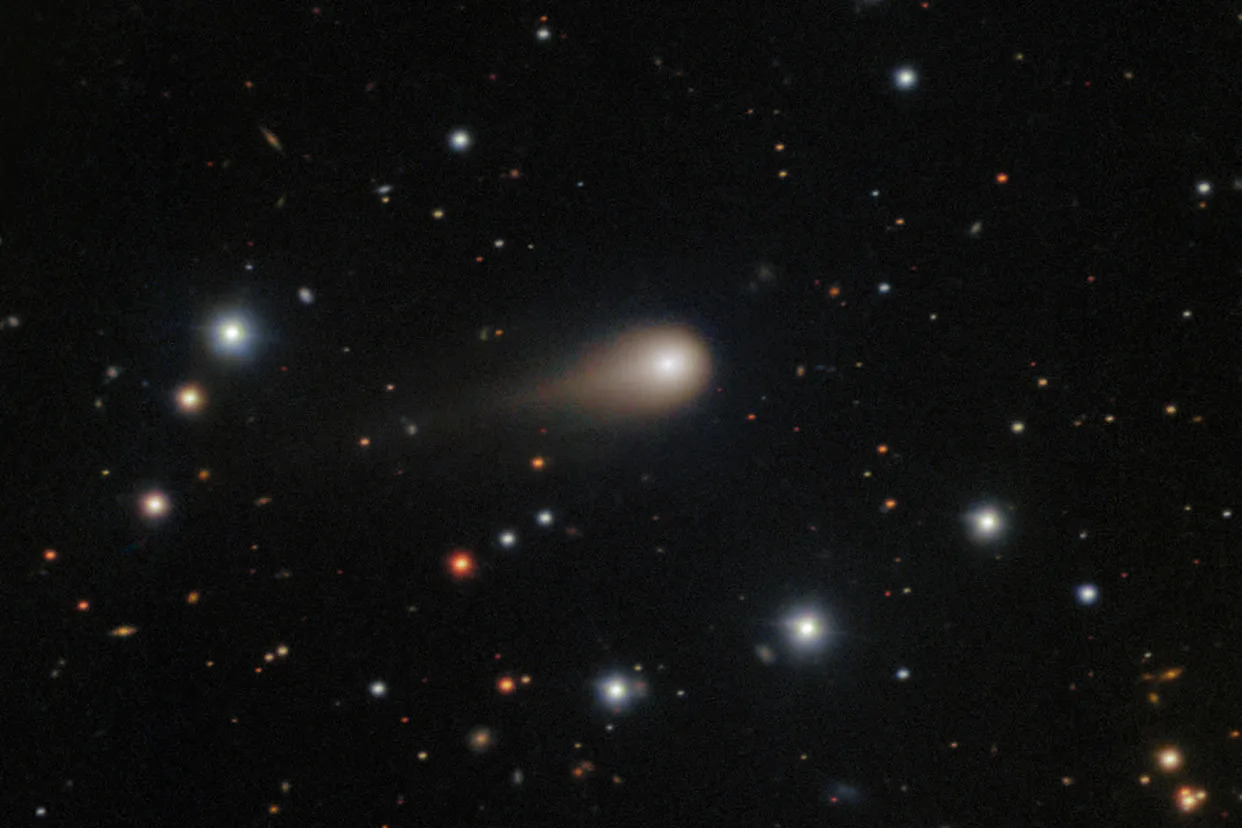
An interstellar comet, designated as 3I/ATLAS, is set to reach its closest point to the sun on October 30, 2025. This celestial body, which entered our solar system this year, has garnered significant interest from astronomers worldwide. Fortunately for Earth, it will not pose any threat, as it will remain over 170 million miles away from our planet.
Discovered on July 1, 2025, by the NASA-funded Asteroid Terrestrial-impact Last Alert System (ATLAS) survey telescope in Rio Hurtado, Chile, 3I/ATLAS is notable for being the third confirmed interstellar object ever detected in our solar system. Initial observations revealed that the comet had actually been spotted earlier, with telescope archives indicating sightings dating back to June 14.
Characteristics and Composition of 3I/ATLAS
Astronomers have utilized powerful telescopes, including the Hubble Telescope, to assess the comet’s characteristics. The nucleus of 3I/ATLAS measures between 1,444 feet and 3.5 miles in diameter. It is classified as a comet due to its icy composition and the presence of a bright cloud of gas and dust surrounding it, known as the coma. As the comet approaches the sun, the heat causes its ice to vaporize, creating a fuzzy appearance and potentially a tail.
The age of the comet adds to its intrigue; researchers believe it may have formed billions of years ago, possibly making it older than our own solar system. This places 3I/ATLAS in a unique category, alongside other interstellar visitors like 1I/’Oumuamua, discovered in 2017, and 2I/Borisov, found in 2019.
Understanding its Trajectory and Scientific Significance
3I/ATLAS follows a hyperbolic trajectory, meaning it does not orbit the sun but rather travels in a path that will eventually take it out of the solar system. Moving at an impressive speed of approximately 137,000 miles per hour, it is too fast for the sun’s gravity to significantly alter its course.
Despite its presence in our solar system, 3I/ATLAS will not come close enough to Earth to be observed without powerful telescopes. After reaching perihelion, the point of closest approach to the sun, it is expected to reappear beyond the sun’s position by early December.
Astrophysicists are keenly interested in studying 3I/ATLAS as it acts like a cosmic time capsule. Its composition may reveal crucial information about other star systems from which it originated. Recent findings have shown the presence of atomic nickel vapor emanating from the comet, detected at a significant distance from the sun. This observation raises questions, as nickel typically requires higher temperatures to vaporize, suggesting it may be interacting with carbon monoxide or other organic compounds.
In summary, Comet 3I/ATLAS offers a remarkable opportunity for astronomers to expand their understanding of interstellar objects and the origins of the materials that populate our solar system. Its journey through our celestial neighborhood serves as a reminder of the vast and dynamic nature of the universe.

Japan’s PM Takaichi Vows Urgent Fiscal Management Amid Rate Trends

Bitcoin Plummets Below $88K Amid Tether Concerns and Warnings

Tottenville Falls Short in PSAL 4A Title Game Against Erasmus

Shark Teeth Study Reveals Urgent Clues to Prevent Extinction

Church Members Rally Together After Thanksgiving Fire Devastation

U.S. Investment in Canadian Energy Firms Surges Despite Low Oil Prices

Nick Jonas Unveils New Solo Album ‘Sunday Best’ Set for February Release

Researchers Urge Label Changes for Low-Alcohol Drinks to Aid Pregnant Women

Wedding Cookie Table Community Aims for World’s Largest Cookie Exchange

Urgent Update: Tom Aspinall’s Vision Deteriorates After UFC 321

MIT Scientists Uncover Surprising Genomic Loops During Cell Division

University of Hawaiʻi Joins $25.6M AI Project to Enhance Disaster Monitoring

AI Disruption: AWS Faces Threat as Startups Shift Cloud Focus

Time Crystals Revolutionize Quantum Computing Potential

Honeywell Forecasts Record Business Jet Deliveries Over Next Decade

Discover the Full Map of Pokémon Legends: Z-A’s Lumiose City

GOP Faces Backlash as Protests Surge Against Trump Policies

Parenthood Set to Depart Hulu: What Fans Need to Know
-
 Top Stories1 month ago
Urgent Update: Tom Aspinall’s Vision Deteriorates After UFC 321
-
 Health1 month ago
MIT Scientists Uncover Surprising Genomic Loops During Cell Division
-
Science4 weeks ago
University of Hawaiʻi Joins $25.6M AI Project to Enhance Disaster Monitoring
-
 Top Stories1 month ago
AI Disruption: AWS Faces Threat as Startups Shift Cloud Focus
-
 Science2 months ago
Time Crystals Revolutionize Quantum Computing Potential
-
 World2 months ago
Honeywell Forecasts Record Business Jet Deliveries Over Next Decade
-
 Entertainment1 month ago
Discover the Full Map of Pokémon Legends: Z-A’s Lumiose City
-
 Top Stories2 months ago
GOP Faces Backlash as Protests Surge Against Trump Policies
-
 Entertainment2 months ago
Parenthood Set to Depart Hulu: What Fans Need to Know
-

 Politics2 months ago
Judge Signals Dismissal of Chelsea Housing Case Citing AI Flaws
-

 Sports2 months ago
Yoshinobu Yamamoto Shines in Game 2, Leading Dodgers to Victory
-

 Health2 months ago
Maine Insurers Cut Medicare Advantage Plans Amid Cost Pressures