
Science
James Webb Telescope Reveals Chaotic Nature of Early Galaxies

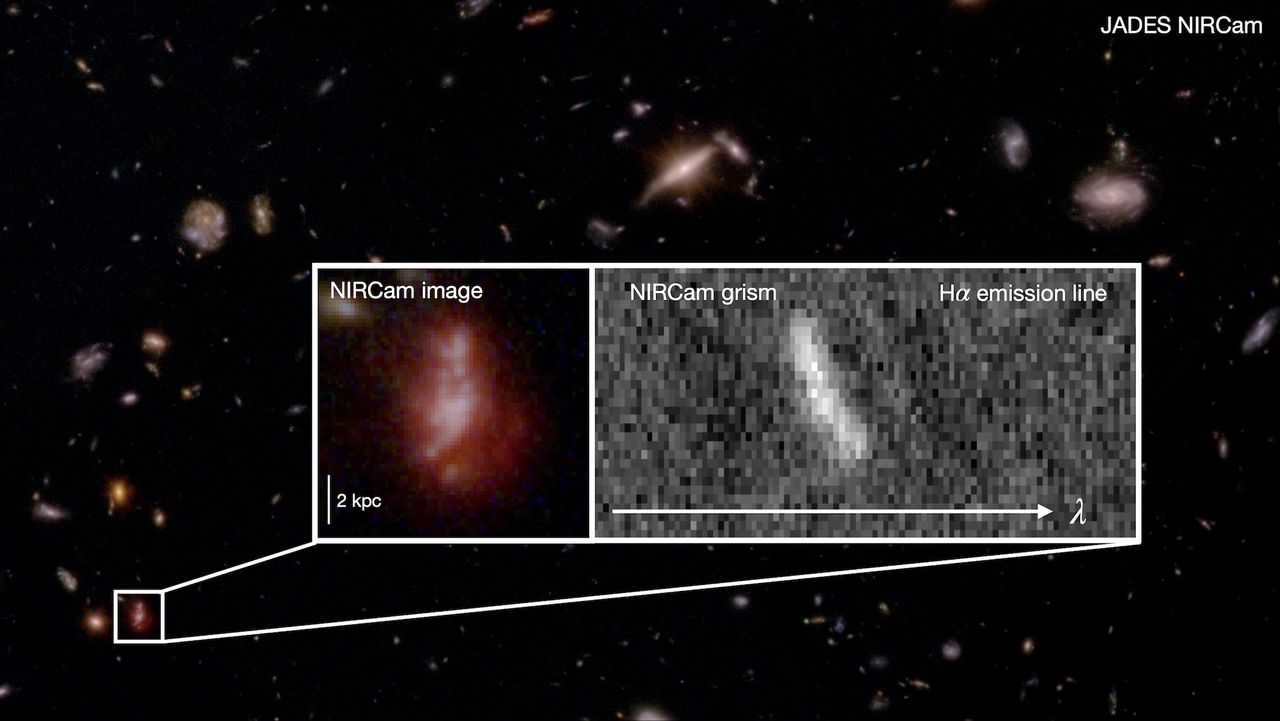
The James Webb Space Telescope (JWST) has unveiled new insights into the chaotic nature of galaxies in the early universe. A recent study examined more than 250 galaxies formed between 800 million and 1.5 billion years after the Big Bang, which occurred approximately 13.8 billion years ago. The findings, published on October 21, 2023, in the Monthly Notices of the Royal Astronomical Society, indicate that these early galaxies exhibited significant turbulence during their formative years.
The research, led by Lola Danhaive, a doctoral candidate at the University of Cambridge, challenges prior assumptions about galaxy formation. Danhaive explained that the focus on less massive galaxies revealed what the team termed “messy kinematics.” Unlike the stable, rotating disks of mature galaxies like the Milky Way, these early galaxies were characterized by instability and chaotic movement.
Danhaive noted that previous studies primarily concentrated on larger, more orderly galaxies, resulting in a skewed understanding of early cosmic turbulence. The new research highlights that earlier galaxies experienced greater turbulence than previously acknowledged. “We find evidence that this turbulence in the galaxy disk is caused by high amounts of gas, which fuels intense star formation and drives gravitational instabilities,” Danhaive stated.
The study not only showcases the chaotic nature of early galaxies but also traces their evolution towards the more stable structures observed today. As galaxies matured, they transitioned from these disordered forms to more stable configurations, influenced by the diminishing availability of gas. Danhaive elaborated on this process, stating, “At early times, galaxies are undergoing a turbulent phase of assembly, where strong bursts of star formation and high amounts of gas disrupt the ordered motions of the gas disk. At later times, galaxies grow their mass and become more stable.”
The findings underscore the pivotal role of the JWST, which operates in a gravitationally stable position far from Earth and the Moon, allowing it to capture detailed observations of the universe’s earliest galaxies. The telescope’s infrared capabilities enable it to peer deeper into space than any of its predecessors, leading to discoveries of some of the earliest known galaxies.
In addition to providing clarity on turbulent galaxy formation, the research team plans to further investigate the inflows and outflows of gas within individual galaxies. By analyzing how gas is chemically enriched, they aim to discover why some galaxies exhibit faster rotation than others. Danhaive expressed excitement about the potential for future discoveries, saying, “There is so much more to uncover with JWST’s amazing capabilities, and we look forward to exploring many more aspects of early galaxy formation.”
As the scientific community continues to unravel the complexities of early cosmic evolution, the insights gained from the James Webb Space Telescope are shaping a new understanding of our universe’s history. The ongoing research promises to deepen our knowledge of how galaxies formed and evolved from their chaotic beginnings to the structured systems we observe today.

Japan’s PM Takaichi Vows Urgent Fiscal Management Amid Rate Trends

Bitcoin Plummets Below $88K Amid Tether Concerns and Warnings

Tottenville Falls Short in PSAL 4A Title Game Against Erasmus

Shark Teeth Study Reveals Urgent Clues to Prevent Extinction

Church Members Rally Together After Thanksgiving Fire Devastation

U.S. Investment in Canadian Energy Firms Surges Despite Low Oil Prices

Nick Jonas Unveils New Solo Album ‘Sunday Best’ Set for February Release

Researchers Urge Label Changes for Low-Alcohol Drinks to Aid Pregnant Women

Wedding Cookie Table Community Aims for World’s Largest Cookie Exchange

Urgent Update: Tom Aspinall’s Vision Deteriorates After UFC 321

MIT Scientists Uncover Surprising Genomic Loops During Cell Division

University of Hawaiʻi Joins $25.6M AI Project to Enhance Disaster Monitoring

AI Disruption: AWS Faces Threat as Startups Shift Cloud Focus

Time Crystals Revolutionize Quantum Computing Potential

Honeywell Forecasts Record Business Jet Deliveries Over Next Decade

Discover the Full Map of Pokémon Legends: Z-A’s Lumiose City

GOP Faces Backlash as Protests Surge Against Trump Policies

Parenthood Set to Depart Hulu: What Fans Need to Know
-
 Top Stories1 month ago
Urgent Update: Tom Aspinall’s Vision Deteriorates After UFC 321
-
 Health1 month ago
MIT Scientists Uncover Surprising Genomic Loops During Cell Division
-
Science4 weeks ago
University of Hawaiʻi Joins $25.6M AI Project to Enhance Disaster Monitoring
-
 Top Stories1 month ago
AI Disruption: AWS Faces Threat as Startups Shift Cloud Focus
-
 Science2 months ago
Time Crystals Revolutionize Quantum Computing Potential
-
 World2 months ago
Honeywell Forecasts Record Business Jet Deliveries Over Next Decade
-
 Entertainment1 month ago
Discover the Full Map of Pokémon Legends: Z-A’s Lumiose City
-
 Top Stories2 months ago
GOP Faces Backlash as Protests Surge Against Trump Policies
-
 Entertainment2 months ago
Parenthood Set to Depart Hulu: What Fans Need to Know
-

 Politics2 months ago
Judge Signals Dismissal of Chelsea Housing Case Citing AI Flaws
-

 Sports2 months ago
Yoshinobu Yamamoto Shines in Game 2, Leading Dodgers to Victory
-

 Health2 months ago
Maine Insurers Cut Medicare Advantage Plans Amid Cost Pressures