
Science
NASA’s Chandra X-ray Observatory Reveals Insights on Small Galaxies

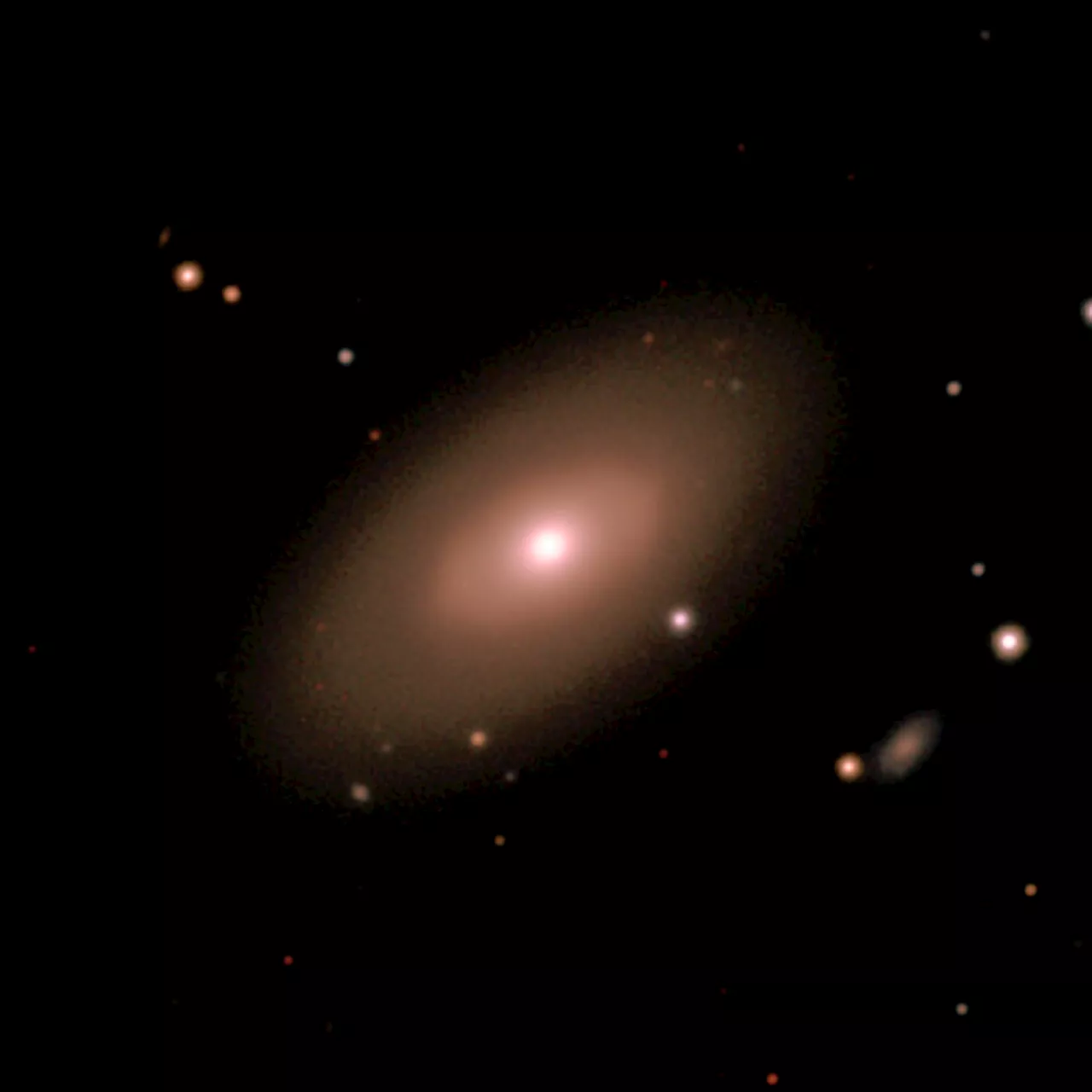
A recent study utilizing NASA’s Chandra X-ray Observatory indicates that many smaller galaxies may not host supermassive black holes at their centers. This finding contrasts with the prevailing notion that a vast majority of galaxies harbor these massive cosmic structures. The research focused on two galaxies, NGC 6278 and PGC 039620, from a comprehensive sample of over 1,600 galaxies observed over the past two decades.
The study analyzed data collected from these galaxies, revealing that the presence of supermassive black holes is significantly less frequent in smaller galaxies compared to their larger counterparts. The results have been published in The Astrophysical Journal and provide new insights into the formation and characteristics of black holes across different galaxy types.
New Findings Challenge Existing Theories
The research team, led by Fan Zou from the University of Michigan, examined galaxies that varied widely in mass, from those exceeding ten times the mass of the Milky Way down to dwarf galaxies, which possess stellar masses less than a few percent of that of the Milky Way. Zou emphasized the importance of accurately accounting for black holes in smaller galaxies, stating, “It’s more than just bookkeeping. Our study gives clues about how supermassive black holes are born.”
To determine the presence of black holes, the researchers looked for specific X-ray signatures produced as matter falls onto them, generating heat and thereby emitting X-rays. The analysis revealed that while more than 90% of massive galaxies, including those comparable to the Milky Way, contained detectable supermassive black holes, the same could not be said for smaller galaxies. For instance, galaxies with masses less than three billion solar masses, similar to the Large Magellanic Cloud, typically lack the bright X-ray sources indicative of black holes.
Understanding the Implications of Black Hole Absence
Two main explanations emerged regarding the absence of X-ray sources in smaller galaxies. The first suggests that the fraction of galaxies containing massive black holes is considerably lower among these less massive galaxies. The second theory posits that the X-rays generated by matter falling into these black holes are too faint for detection by Chandra.
Co-author Elena Gallo, also from the University of Michigan, stated, “We think, based on our analysis of the Chandra data, that there really are fewer black holes in these smaller galaxies than in their larger counterparts.” The researchers confirmed that the reduced gas inflow into smaller black holes results in fainter X-ray emissions, thereby complicating their detection.
However, the study further noted an unexpected decrease in the number of X-ray sources in lower mass galaxies beyond what would be anticipated solely from decreased gas inflow. This observation supports the conclusion that many low-mass galaxies likely do not possess any black holes at all.
The implications of this research extend to our understanding of how supermassive black holes form. Two primary theories exist: one suggests that a giant gas cloud collapses directly into a black hole weighing thousands of solar masses, while the other proposes that supermassive black holes arise from the merger of smaller black holes formed during the collapse of massive stars. Co-author Anil Seth from the University of Utah noted, “The formation of big black holes is expected to be rarer, occurring preferentially in the most massive galaxies.”
This study lends support to the hypothesis that supermassive black holes are born already possessing substantial mass, rather than from the accumulation of smaller black holes. The researchers argue that if the alternative theory were correct, smaller galaxies would likely exhibit a similar fraction of black holes as larger galaxies.
Additionally, this research could have significant implications for the detection of gravitational waves. A lower number of black holes in dwarf galaxies would reduce the potential sources for such waves, particularly during the mergers of dwarf galaxies. Consequently, astronomers may have fewer opportunities to observe these phenomena in the future.
NASA’s Chandra program is managed by the Marshall Space Flight Center in Huntsville, Alabama, with scientific operations coordinated by the Smithsonian Astrophysical Observatory. The findings from this study underscore the ongoing efforts to deepen our understanding of the universe and the complex role of black holes within it.

Massachusetts Begins Disbursing Taxpayer Rebates to Millions

Massachusetts Tax Rebates Start Today: Up to $7,000 Expected!

Helen Mirren Lauds Jane Fonda at Women of Worth Celebration

Men’s Skin Barriers: Expert Tips and Products for Repair

Amy Duggar Reflects on Shallow Cousin Relationships Growing Up

U.S. Judge Orders Immediate Release of Kilmar Abrego Garcia

NASA’s Chandra X-ray Observatory Reveals Insights on Small Galaxies

TikTok Star Vintage Dusties Reveals Secrets to Nail Polish Collecting

DNA Testing Exonerates Man Wrongfully Convicted of Rape After 40 Years

Urgent Update: Tom Aspinall’s Vision Deteriorates After UFC 321

University of Hawaiʻi Joins $25.6M AI Project to Enhance Disaster Monitoring

MIT Scientists Uncover Surprising Genomic Loops During Cell Division

AI Disruption: AWS Faces Threat as Startups Shift Cloud Focus

Time Crystals Revolutionize Quantum Computing Potential

Discover the Full Map of Pokémon Legends: Z-A’s Lumiose City

Parenthood Set to Depart Hulu: What Fans Need to Know

Judge Signals Dismissal of Chelsea Housing Case Citing AI Flaws

Honeywell Forecasts Record Business Jet Deliveries Over Next Decade
-
 Top Stories1 month ago
Urgent Update: Tom Aspinall’s Vision Deteriorates After UFC 321
-
Science1 month ago
University of Hawaiʻi Joins $25.6M AI Project to Enhance Disaster Monitoring
-
 Health2 months ago
MIT Scientists Uncover Surprising Genomic Loops During Cell Division
-
 Top Stories2 months ago
AI Disruption: AWS Faces Threat as Startups Shift Cloud Focus
-
 Science2 months ago
Time Crystals Revolutionize Quantum Computing Potential
-
 Entertainment2 months ago
Discover the Full Map of Pokémon Legends: Z-A’s Lumiose City
-
 Entertainment2 months ago
Parenthood Set to Depart Hulu: What Fans Need to Know
-
 Politics2 months ago
Judge Signals Dismissal of Chelsea Housing Case Citing AI Flaws
-
 World2 months ago
Honeywell Forecasts Record Business Jet Deliveries Over Next Decade
-

 Top Stories2 months ago
GOP Faces Backlash as Protests Surge Against Trump Policies
-

 Sports2 months ago
Yoshinobu Yamamoto Shines in Game 2, Leading Dodgers to Victory
-

 Health2 months ago
Maine Insurers Cut Medicare Advantage Plans Amid Cost Pressures