
Science
New Study Reveals Mechanosensor Behind Venus Flytrap’s Rapid Response

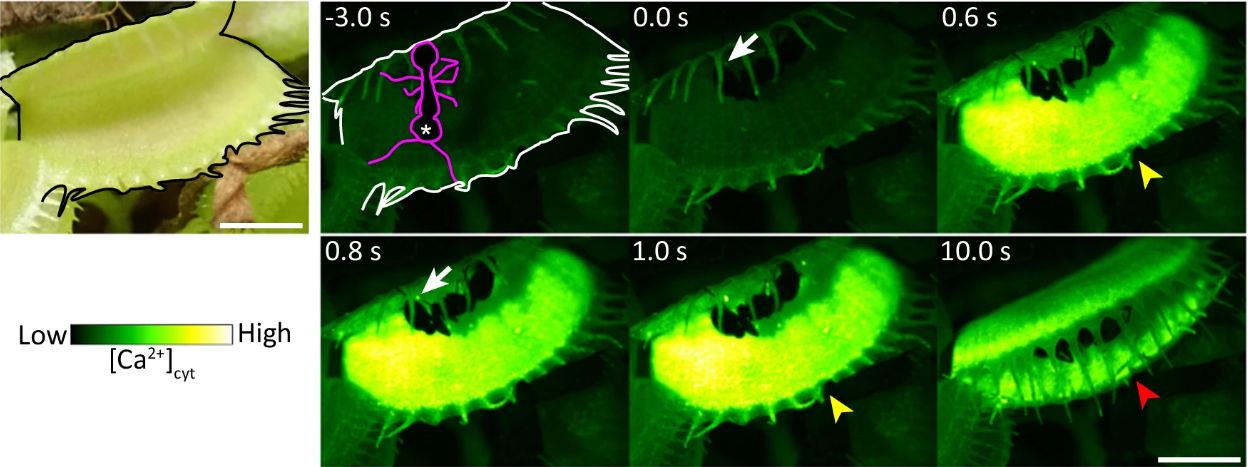
Recent research has uncovered the critical role of a mechanosensor in the rapid response of the Venus flytrap (Dionaea muscipula) to stimuli. A team led by Hiraku Suda published their findings in Nature Communications, providing insights into how this carnivorous plant captures prey with remarkable speed.
The Venus flytrap, known for its unique spring-loaded trap, relies on specialized sensory hairs that detect movement. These hairs respond to external stimuli through calcium signal thresholds. While previous studies established the importance of calcium in this process, the precise mechanism remained unclear until now.
DmMSL10, a stretch-activated chloride ion (Cl–) channel, has been identified as central to the plant’s sensitivity. Suda and his colleagues created a knockout variant of the DmMSL10 gene, effectively disabling this mechanosensor. By comparing the wild-type and knockout plants, they observed significant differences in their responses to mechanical stimulation.
In their experiments, both variants released calcium ions when stimulated; however, the knockout variant exhibited a markedly lower rate of action potential generation. The wild-type continued to produce action potentials even after stimulation had ceased, highlighting the essential role of DmMSL10 in detecting slight movements crucial for prey capture.
To further illustrate their findings, the research team conducted an experiment where ants were allowed to wander on the leaves of both plant types. The wild-type Venus flytrap successfully caught the first ant that landed, while the knockout variant failed to respond, even after multiple ants explored its surface. This stark contrast underscores the importance of DmMSL10 in the plant’s ability to generate long-range calcium signals necessary for prey detection.
The study not only sheds light on the rapid response mechanisms of the Venus flytrap but also opens avenues for further research into the evolutionary parallels between plant and animal sensory systems. Understanding how such mechanisms have developed can provide insights into the broader context of plant behavior and adaptation.
This groundbreaking research enhances our comprehension of the Venus flytrap’s unique abilities and may pave the way for deeper exploration of mechanosensing in both flora and fauna.

Tottenville Falls Short in PSAL 4A Title Game Against Erasmus

Shark Teeth Study Reveals Urgent Clues to Prevent Extinction

Church Members Rally Together After Thanksgiving Fire Devastation

U.S. Investment in Canadian Energy Firms Surges Despite Low Oil Prices

Nick Jonas Unveils New Solo Album ‘Sunday Best’ Set for February Release

Researchers Urge Label Changes for Low-Alcohol Drinks to Aid Pregnant Women

Wedding Cookie Table Community Aims for World’s Largest Cookie Exchange

Mayor Appoints Alan Wong as New Supervisor for District 4

UK Report Reveals Growing Role of AI in University Research Assessments

Urgent Update: Tom Aspinall’s Vision Deteriorates After UFC 321

MIT Scientists Uncover Surprising Genomic Loops During Cell Division

University of Hawaiʻi Joins $25.6M AI Project to Enhance Disaster Monitoring

AI Disruption: AWS Faces Threat as Startups Shift Cloud Focus

Time Crystals Revolutionize Quantum Computing Potential

Honeywell Forecasts Record Business Jet Deliveries Over Next Decade

Discover the Full Map of Pokémon Legends: Z-A’s Lumiose City

GOP Faces Backlash as Protests Surge Against Trump Policies

Parenthood Set to Depart Hulu: What Fans Need to Know
-
 Top Stories1 month ago
Urgent Update: Tom Aspinall’s Vision Deteriorates After UFC 321
-
 Health1 month ago
MIT Scientists Uncover Surprising Genomic Loops During Cell Division
-
Science4 weeks ago
University of Hawaiʻi Joins $25.6M AI Project to Enhance Disaster Monitoring
-
 Top Stories1 month ago
AI Disruption: AWS Faces Threat as Startups Shift Cloud Focus
-
 Science2 months ago
Time Crystals Revolutionize Quantum Computing Potential
-
 World2 months ago
Honeywell Forecasts Record Business Jet Deliveries Over Next Decade
-
 Entertainment1 month ago
Discover the Full Map of Pokémon Legends: Z-A’s Lumiose City
-
 Top Stories2 months ago
GOP Faces Backlash as Protests Surge Against Trump Policies
-
 Entertainment2 months ago
Parenthood Set to Depart Hulu: What Fans Need to Know
-

 Politics2 months ago
Judge Signals Dismissal of Chelsea Housing Case Citing AI Flaws
-

 Sports2 months ago
Yoshinobu Yamamoto Shines in Game 2, Leading Dodgers to Victory
-

 Health2 months ago
Maine Insurers Cut Medicare Advantage Plans Amid Cost Pressures