
Science
October New Moon to Conceal Antares for Stargazers in South America

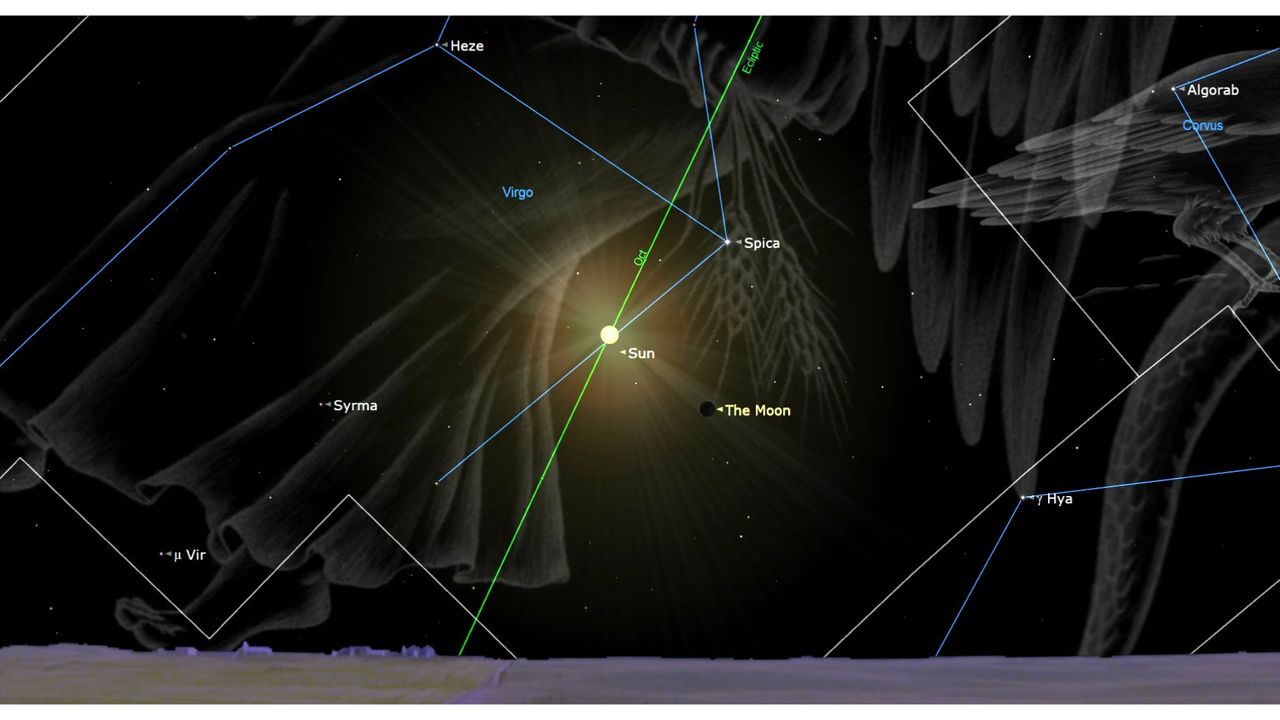
Stargazers in South America and the Falkland Islands will have the rare opportunity to witness the red star Antares disappear behind the young moon on October 24, 2025. This celestial event coincides with the peak of the Orionid meteor shower, providing an exceptional viewing experience for enthusiasts.
The new moon occurs when the sun and moon align perfectly from Earth’s perspective, resulting in a darkened sky ideal for meteor watching. According to the U.S. Naval Observatory, the new moon phase will officially take place on October 21 at 08:25 a.m. Eastern Daylight Time (12:25 UTC). While this new moon will not create a solar eclipse, it will lead to an occultation, where the moon obstructs the view of Antares, the brightest star in the constellation Scorpius.
Viewing Opportunities Across Locations
The occultation will begin in Ushuaia, Argentina, at 10:35 p.m. local time on October 24. Observers will see the moon positioned about 15 degrees above the southwestern horizon. The star Antares will vanish behind the moon’s upper right quadrant and reappear at 11:23 p.m. on the left side, approximately 9 degrees above the horizon. Moonset in Ushuaia will occur at 1:02 a.m. on October 25.
In Punta Arenas, Chile, the occultation follows closely, starting at 10:37 p.m. local time. Similar to Ushuaia, Antares will disappear behind the moon and reemerge shortly after, at 11:28 p.m. Observers in these regions will have a clear view, as the moon will be relatively high in the sky during the event.
Conversely, observers in the Northern Hemisphere, such as those in New York City, will not be able to see the occultation. Instead, the moon will appear below Antares, which will be below the horizon at that time.
Other Celestial Highlights in Late October
For those not in the path of the occultation, the late October skies still offer several planetary sightings. On October 21, Saturn will rise in New York at 5:54 p.m. and will be visible at an altitude of 27 degrees above the southeastern horizon by 7:30 p.m. The planet will set at 4:36 a.m. on October 22.
Jupiter will follow, rising at 11:16 p.m. on October 21 and reaching an altitude of 71 degrees by 6:37 a.m. the next day. Positioned in the constellation Gemini, it will appear just below Pollux, Gemini’s second-brightest star.
The visibility of planets like Saturn and Jupiter will be enhanced in regions with less light pollution, creating an exceptional opportunity for amateur astronomers and casual observers alike.
Venus will rise just before dawn on October 22, becoming the third brightest object in the sky after the sun and moon. It will be visible until shortly before sunrise, allowing for a unique observational experience for early risers.
As the Southern Hemisphere approaches summer, planets like Saturn, Jupiter, and Venus will appear higher in the sky, offering a different viewing experience than their Northern Hemisphere counterparts. In cities such as Santiago, Chile, Saturn will rise at 5:17 p.m., becoming visible about 30 minutes after sunset.
As October progresses, constellations will transition as well, with the summer zodiac constellations giving way to fall stars. Stargazers will find the Great Square of Pegasus and other notable formations as night falls.
This October presents a remarkable opportunity for both seasoned astronomers and casual stargazers to engage with the wonders of the night sky. The alignment of the new moon with the Orionid meteor shower, along with the occultation of Antares, offers a blend of celestial phenomena that are not to be missed.

Tottenville Falls Short in PSAL 4A Title Game Against Erasmus

Shark Teeth Study Reveals Urgent Clues to Prevent Extinction

Church Members Rally Together After Thanksgiving Fire Devastation

U.S. Investment in Canadian Energy Firms Surges Despite Low Oil Prices

Nick Jonas Unveils New Solo Album ‘Sunday Best’ Set for February Release

Researchers Urge Label Changes for Low-Alcohol Drinks to Aid Pregnant Women

Wedding Cookie Table Community Aims for World’s Largest Cookie Exchange

Mayor Appoints Alan Wong as New Supervisor for District 4

UK Report Reveals Growing Role of AI in University Research Assessments

Urgent Update: Tom Aspinall’s Vision Deteriorates After UFC 321

MIT Scientists Uncover Surprising Genomic Loops During Cell Division

University of Hawaiʻi Joins $25.6M AI Project to Enhance Disaster Monitoring

AI Disruption: AWS Faces Threat as Startups Shift Cloud Focus

Time Crystals Revolutionize Quantum Computing Potential

Honeywell Forecasts Record Business Jet Deliveries Over Next Decade

Discover the Full Map of Pokémon Legends: Z-A’s Lumiose City

GOP Faces Backlash as Protests Surge Against Trump Policies

Parenthood Set to Depart Hulu: What Fans Need to Know
-
 Top Stories1 month ago
Urgent Update: Tom Aspinall’s Vision Deteriorates After UFC 321
-
 Health1 month ago
MIT Scientists Uncover Surprising Genomic Loops During Cell Division
-
Science4 weeks ago
University of Hawaiʻi Joins $25.6M AI Project to Enhance Disaster Monitoring
-
 Top Stories1 month ago
AI Disruption: AWS Faces Threat as Startups Shift Cloud Focus
-
 Science2 months ago
Time Crystals Revolutionize Quantum Computing Potential
-
 World2 months ago
Honeywell Forecasts Record Business Jet Deliveries Over Next Decade
-
 Entertainment1 month ago
Discover the Full Map of Pokémon Legends: Z-A’s Lumiose City
-
 Top Stories2 months ago
GOP Faces Backlash as Protests Surge Against Trump Policies
-
 Entertainment2 months ago
Parenthood Set to Depart Hulu: What Fans Need to Know
-

 Politics2 months ago
Judge Signals Dismissal of Chelsea Housing Case Citing AI Flaws
-

 Sports2 months ago
Yoshinobu Yamamoto Shines in Game 2, Leading Dodgers to Victory
-

 Health2 months ago
Maine Insurers Cut Medicare Advantage Plans Amid Cost Pressures