
Science
Researchers Identify Sulfur Compounds in Interstellar Medium

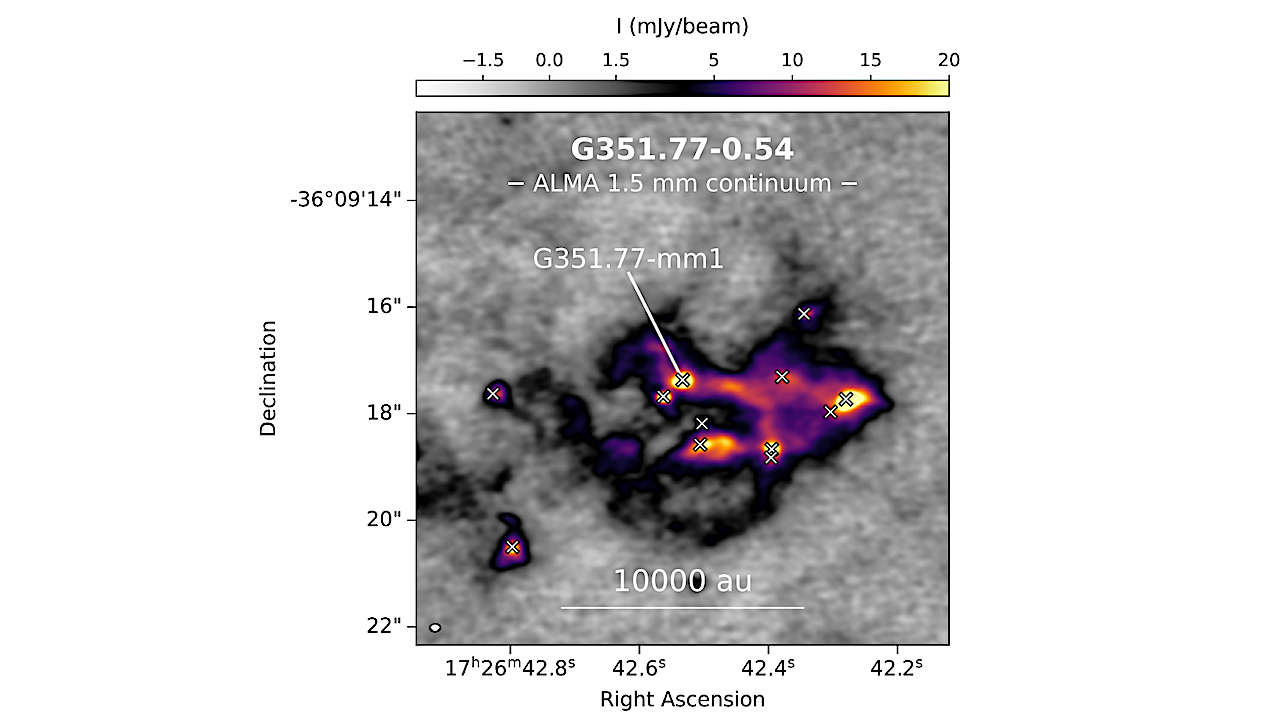
The identification of sulfur-bearing refractory molecules in the interstellar medium marks a significant advance in astrophysical research. Recent observations in massive star-forming regions have led to the detection of calcium sulfide (CaS), along with tentative findings of potassium sulfide (KS) and potassium hydrosulfide (KSH). This breakthrough provides a new avenue for exploring the chemical composition of these extreme environments.
Research conducted by a team including Aitana Tasa-Chaveli and Á. Sánchez-Monge indicates that these findings could illuminate the sulfur budget in regions surrounding massive stars. The detections were made in the disk designated G351.77-mm1, a location that serves as a critical site for understanding the formation of gas-phase refractory molecules.
The significance of these discoveries cannot be overstated. The column densities of CaS, KS, and KSH were found to be approximately three orders of magnitude lower than those of more abundant sulfur compounds like sulfur dioxide (SO2), methanethiol (CH3SH), and silicon monosulfide (SiS). This suggests that while these new species are present, they do not constitute the primary reservoir of sulfur in the observed regions.
To confirm these initial findings, researchers emphasize the necessity for higher angular resolution observations at various wavelengths. Such advancements are essential to deepen our understanding of the formation and distribution of these refractory compounds, which are crucial for the chemical evolution of the universe.
The study has been accepted for publication in the Astrophysical Journal Letters, highlighting its importance to the fields of astrobiology and astrochemistry. The research spans 17 pages and includes 6 figures detailing the findings.
This research opens the door to further exploration of sulfur’s role in the cosmos, potentially connecting it to the broader narrative of stellar formation and evolution. As scientists continue to investigate the chemical complexities of the interstellar medium, the identification of CaS, KS, and KSH represents a significant step forward in our understanding of these celestial bodies.
For more information, the full study can be accessed via arXiv with the citation: arXiv:2510.02937 [astro-ph.GA].

Church Members Rally Together After Thanksgiving Fire Devastation

U.S. Investment in Canadian Energy Firms Surges Despite Low Oil Prices

Nick Jonas Unveils New Solo Album ‘Sunday Best’ Set for February Release

Researchers Urge Label Changes for Low-Alcohol Drinks to Aid Pregnant Women

Wedding Cookie Table Community Aims for World’s Largest Cookie Exchange

Mayor Appoints Alan Wong as New Supervisor for District 4

UK Report Reveals Growing Role of AI in University Research Assessments

Mayor Lurie Appoints Alan Wong as New District 4 Supervisor

South Korea Strengthens FX Oversight in Urgent Market Stabilization

Urgent Update: Tom Aspinall’s Vision Deteriorates After UFC 321

MIT Scientists Uncover Surprising Genomic Loops During Cell Division

University of Hawaiʻi Joins $25.6M AI Project to Enhance Disaster Monitoring

AI Disruption: AWS Faces Threat as Startups Shift Cloud Focus

Time Crystals Revolutionize Quantum Computing Potential

Honeywell Forecasts Record Business Jet Deliveries Over Next Decade

Discover the Full Map of Pokémon Legends: Z-A’s Lumiose City

GOP Faces Backlash as Protests Surge Against Trump Policies

Parenthood Set to Depart Hulu: What Fans Need to Know
-
 Top Stories1 month ago
Urgent Update: Tom Aspinall’s Vision Deteriorates After UFC 321
-
 Health1 month ago
MIT Scientists Uncover Surprising Genomic Loops During Cell Division
-
Science4 weeks ago
University of Hawaiʻi Joins $25.6M AI Project to Enhance Disaster Monitoring
-
 Top Stories1 month ago
AI Disruption: AWS Faces Threat as Startups Shift Cloud Focus
-
 Science2 months ago
Time Crystals Revolutionize Quantum Computing Potential
-
 World2 months ago
Honeywell Forecasts Record Business Jet Deliveries Over Next Decade
-
 Entertainment1 month ago
Discover the Full Map of Pokémon Legends: Z-A’s Lumiose City
-
 Top Stories2 months ago
GOP Faces Backlash as Protests Surge Against Trump Policies
-
 Entertainment2 months ago
Parenthood Set to Depart Hulu: What Fans Need to Know
-

 Politics2 months ago
Judge Signals Dismissal of Chelsea Housing Case Citing AI Flaws
-

 Sports2 months ago
Yoshinobu Yamamoto Shines in Game 2, Leading Dodgers to Victory
-

 Health2 months ago
Maine Insurers Cut Medicare Advantage Plans Amid Cost Pressures