
Science
Researchers Map Dynamics of Self-Censorship in New Study

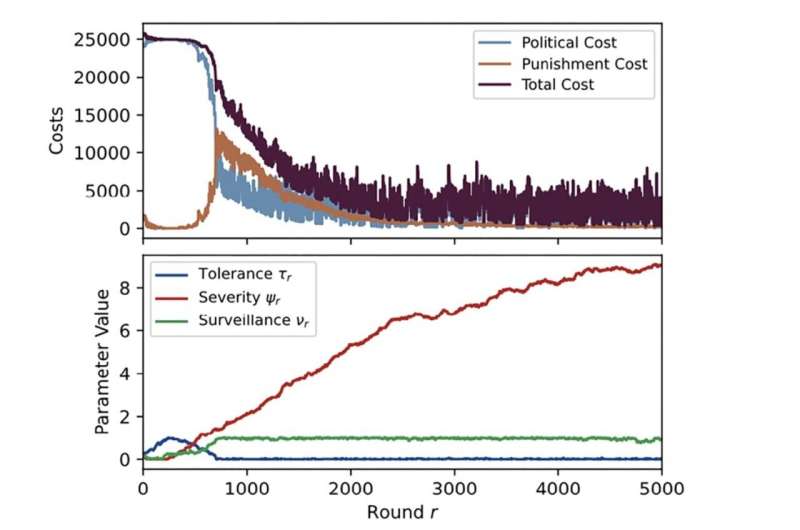
A new study from researchers at Arizona State University (ASU) and the University of Michigan has unveiled the intricate dynamics of self-censorship, illustrating how individuals navigate the risks of expressing dissent in an increasingly surveilled society. Published on November 3, 2025, in the Proceedings of the National Academy of Sciences, this research introduces a mathematical model that sheds light on the strategic choices people make when faced with potential punishment for speaking out.
The collaboration features contributions from Professor Stephanie Forrest and Assistant Professor Joshua J. Daymude from ASU’s School of Computing and Augmented Intelligence, alongside political scientist Robert Axelrod from the University of Michigan. Their work aims to decode the conditions under which individuals opt for self-censorship instead of voicing dissent, especially in environments where authoritarian practices are prevalent.
Understanding the Mechanics of Dissent
The paper, titled “Strategic Analysis of Dissent and Self-Censorship,” examines the ongoing interaction between individuals and governing authorities. According to Daymude, “Modern technologies—from facial recognition to algorithmic content moderation—have transformed the landscape of dissent.” The researchers developed a simulation to explore how individuals balance their urge to express dissent with their fear of repercussions. Notably, authorities also adapt their surveillance and policies to minimize dissent and enforcement costs.
Findings indicate that self-censorship is not merely driven by fear; rather, it is a rational, strategic response influenced by factors such as boldness, surveillance intensity, and the severity of punishments. The model identifies three key behavioral responses: compliance, self-censorship, and defiance. The researchers discovered that in contexts where punishments are applied uniformly, such as blanket bans or internet shutdowns, self-censorship becomes the dominant behavior. In contrast, when faced with proportional punishments—like escalating penalties for repeated offenses—individuals may be more inclined to take calculated risks in expressing their dissent.
Forrest emphasizes the importance of early dissent, stating, “A population’s willingness to speak out early on, and suffer the negative consequences, has an outsized effect on how long it takes an authority to suppress all dissent.” The study suggests that the costs associated with punishing an entire population simultaneously can deter total suppression, allowing for pockets of resistance.
The Broader Implications of Self-Censorship
The research implications extend beyond theoretical applications. The pressures that influence public expression are pervasive, affecting individuals in various contexts, from authoritarian regimes to users on global social media platforms. The study highlights how self-censorship can proliferate and become entrenched, making it difficult to reverse once it is established. Daymude warns, “Self-censorship can start as a form of self-protection. But when people begin to silence themselves preemptively, before any punishment occurs, it becomes a powerful tool for control.”
By clarifying the strategic nature of dissent, the researchers aim to inform policymakers, social media platform designers, and advocates for free expression. Forrest concludes, “Ultimately, our findings show that preserving open dialogue depends not only on laws or technology but on the courage of individuals and the collective willingness to keep speaking, even when it’s uncomfortable.”
This study represents a significant contribution to understanding the delicate balance between individual expression and societal control, revealing the complexities that shape our modern communication landscape.

Japan’s PM Takaichi Vows Urgent Fiscal Management Amid Rate Trends

Bitcoin Plummets Below $88K Amid Tether Concerns and Warnings

Tottenville Falls Short in PSAL 4A Title Game Against Erasmus

Shark Teeth Study Reveals Urgent Clues to Prevent Extinction

Church Members Rally Together After Thanksgiving Fire Devastation

U.S. Investment in Canadian Energy Firms Surges Despite Low Oil Prices

Nick Jonas Unveils New Solo Album ‘Sunday Best’ Set for February Release

Researchers Urge Label Changes for Low-Alcohol Drinks to Aid Pregnant Women

Wedding Cookie Table Community Aims for World’s Largest Cookie Exchange

Urgent Update: Tom Aspinall’s Vision Deteriorates After UFC 321

MIT Scientists Uncover Surprising Genomic Loops During Cell Division

University of Hawaiʻi Joins $25.6M AI Project to Enhance Disaster Monitoring

AI Disruption: AWS Faces Threat as Startups Shift Cloud Focus

Time Crystals Revolutionize Quantum Computing Potential

Honeywell Forecasts Record Business Jet Deliveries Over Next Decade

Discover the Full Map of Pokémon Legends: Z-A’s Lumiose City

GOP Faces Backlash as Protests Surge Against Trump Policies

Parenthood Set to Depart Hulu: What Fans Need to Know
-
 Top Stories1 month ago
Urgent Update: Tom Aspinall’s Vision Deteriorates After UFC 321
-
 Health1 month ago
MIT Scientists Uncover Surprising Genomic Loops During Cell Division
-
Science4 weeks ago
University of Hawaiʻi Joins $25.6M AI Project to Enhance Disaster Monitoring
-
 Top Stories1 month ago
AI Disruption: AWS Faces Threat as Startups Shift Cloud Focus
-
 Science2 months ago
Time Crystals Revolutionize Quantum Computing Potential
-
 World2 months ago
Honeywell Forecasts Record Business Jet Deliveries Over Next Decade
-
 Entertainment1 month ago
Discover the Full Map of Pokémon Legends: Z-A’s Lumiose City
-
 Top Stories2 months ago
GOP Faces Backlash as Protests Surge Against Trump Policies
-
 Entertainment2 months ago
Parenthood Set to Depart Hulu: What Fans Need to Know
-

 Politics2 months ago
Judge Signals Dismissal of Chelsea Housing Case Citing AI Flaws
-

 Sports2 months ago
Yoshinobu Yamamoto Shines in Game 2, Leading Dodgers to Victory
-

 Health2 months ago
Maine Insurers Cut Medicare Advantage Plans Amid Cost Pressures