
Science
Researchers Slash CO2 Emissions in Fuel Synthesis by 99%

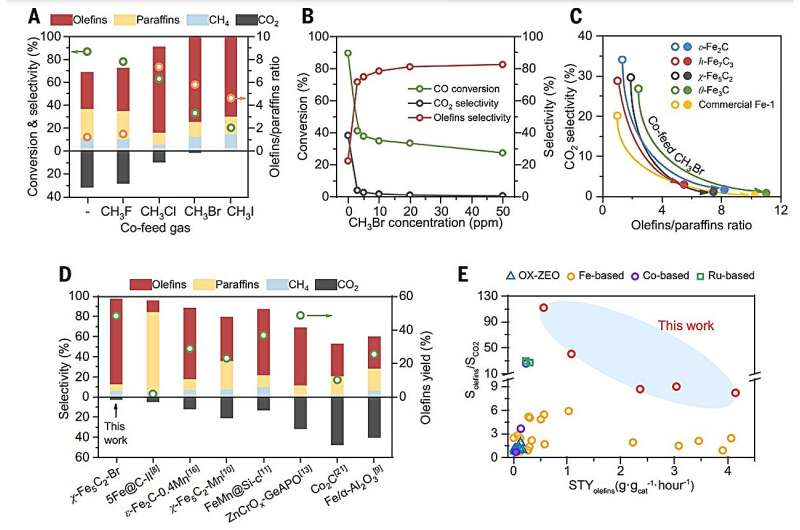
Scientists have achieved a remarkable breakthrough in reducing carbon dioxide emissions during the conversion of synthesis gas (syngas) into liquid fuels, cutting CO2 production by over 99%. A study led by researchers from China, published in the journal Science on November 4, 2025, reveals that the strategic addition of bromomethane (CH3Br) to syngas in the Fischer–Tropsch synthesis (FTS) process significantly enhances environmental performance.
The FTS process is pivotal in the petrochemical industry, converting syngas—a mixture of carbon monoxide (CO) and hydrogen (H2)—into liquid hydrocarbons. Traditionally, this method has been associated with substantial CO2 emissions, often ranging from 18% to 35% during production. The innovative approach introduced by the research team not only minimizes CO2 selectivity to near zero but also increases the yield of olefins, valuable hydrocarbons that are essential in various chemical applications.
By incorporating trace amounts of bromomethane into the syngas feed, the researchers altered the reaction dynamics on iron-based catalysts. This method resulted in an impressive olefin selectivity of 85%, accompanied by a notable olefin-to-paraffin ratio of 13:1—an improvement from the previous ratio of 1.3:1 with unmodified catalysts.
Transforming the Fischer–Tropsch Synthesis Process
The FTS process was developed in the 1920s by German chemists Franz Fischer and Hans Tropsch, gaining prominence during World War II as it provided critical liquid fuels for military operations. Today, iron-based catalysts dominate the FTS landscape, producing approximately 15.70 million tons of hydrocarbons annually. Their affordability and natural abundance make them a preferred choice, but they also tend to catalyze unwanted reactions that generate excess CO2.
Previous attempts to reduce CO2 emissions included coating iron catalysts with hydrophobic materials or graphene layers, which only yielded limited improvements. The new study’s approach circumvents these issues by forming surface-bound bromine species that effectively inhibit the water-gas shift and Boudouard reactions, both of which produce CO and CO2 as byproducts. This advancement not only mitigates CO2 output but also facilitates the release of olefins from the catalyst surface, preventing further hydrogenation into less desirable products.
Implications for Sustainable Energy
The researchers emphasize that this practical strategy can be integrated with a wide variety of iron-based FTS catalysts, including those used commercially. By enabling a carbon-neutral conversion pathway for coal and syngas, this research provides a crucial link between fossil fuel chemistry and climate sustainability.
As the world continues to shift toward greener energy technologies, fossil fuels still constitute over 80% of global energy consumption. Enhancing the efficiency of existing fossil fuel processes is essential for reducing their environmental impact. This study represents a significant step forward in making the FTS process not only more sustainable but also more compatible with future energy needs.
The long-term stability of the modified catalyst, which performed efficiently for over 450 hours, indicates its potential for real-world applications. By addressing the pressing challenge of CO2 emissions in fuel synthesis, these findings mark a pivotal advancement in the quest for more sustainable energy solutions.
This report was authored by Sanjukta Mondal, edited by Sadie Harley, and fact-checked by Robert Egan, ensuring a comprehensive and reliable exploration of this significant scientific development.

Japan’s PM Takaichi Vows Urgent Fiscal Management Amid Rate Trends

Bitcoin Plummets Below $88K Amid Tether Concerns and Warnings

Tottenville Falls Short in PSAL 4A Title Game Against Erasmus

Shark Teeth Study Reveals Urgent Clues to Prevent Extinction

Church Members Rally Together After Thanksgiving Fire Devastation

U.S. Investment in Canadian Energy Firms Surges Despite Low Oil Prices

Nick Jonas Unveils New Solo Album ‘Sunday Best’ Set for February Release

Researchers Urge Label Changes for Low-Alcohol Drinks to Aid Pregnant Women

Wedding Cookie Table Community Aims for World’s Largest Cookie Exchange

Urgent Update: Tom Aspinall’s Vision Deteriorates After UFC 321

MIT Scientists Uncover Surprising Genomic Loops During Cell Division

University of Hawaiʻi Joins $25.6M AI Project to Enhance Disaster Monitoring

AI Disruption: AWS Faces Threat as Startups Shift Cloud Focus

Time Crystals Revolutionize Quantum Computing Potential

Honeywell Forecasts Record Business Jet Deliveries Over Next Decade

Discover the Full Map of Pokémon Legends: Z-A’s Lumiose City

Parenthood Set to Depart Hulu: What Fans Need to Know

GOP Faces Backlash as Protests Surge Against Trump Policies
-
 Top Stories1 month ago
Urgent Update: Tom Aspinall’s Vision Deteriorates After UFC 321
-
 Health1 month ago
MIT Scientists Uncover Surprising Genomic Loops During Cell Division
-
Science4 weeks ago
University of Hawaiʻi Joins $25.6M AI Project to Enhance Disaster Monitoring
-
 Top Stories1 month ago
AI Disruption: AWS Faces Threat as Startups Shift Cloud Focus
-
 Science2 months ago
Time Crystals Revolutionize Quantum Computing Potential
-
 World2 months ago
Honeywell Forecasts Record Business Jet Deliveries Over Next Decade
-
 Entertainment1 month ago
Discover the Full Map of Pokémon Legends: Z-A’s Lumiose City
-
 Entertainment2 months ago
Parenthood Set to Depart Hulu: What Fans Need to Know
-
 Top Stories2 months ago
GOP Faces Backlash as Protests Surge Against Trump Policies
-

 Politics2 months ago
Judge Signals Dismissal of Chelsea Housing Case Citing AI Flaws
-

 Sports2 months ago
Yoshinobu Yamamoto Shines in Game 2, Leading Dodgers to Victory
-

 Health2 months ago
Maine Insurers Cut Medicare Advantage Plans Amid Cost Pressures