
Science
Scientists Unveil Rare Dinosaur ‘Mummies’ with Stunning Detail

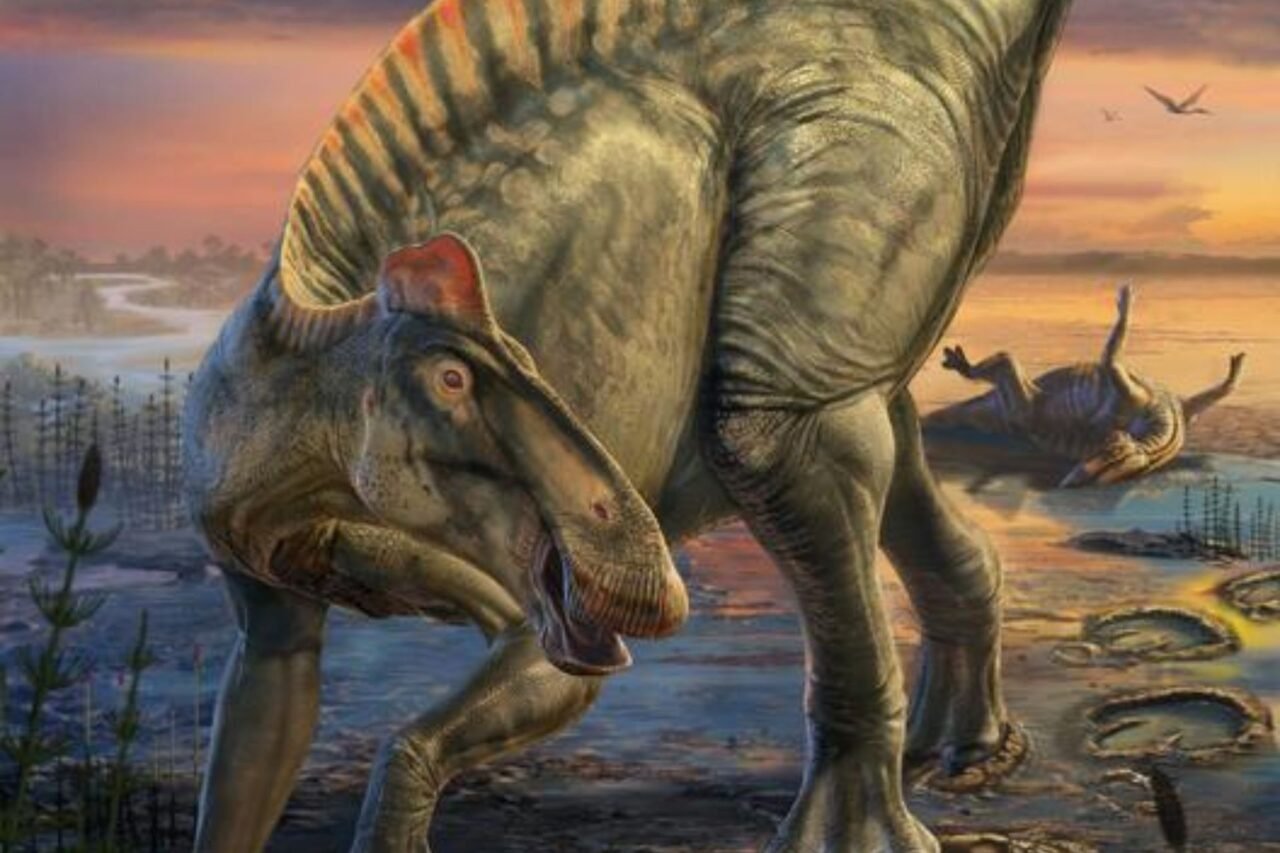
In a groundbreaking study, scientists have revealed unprecedented details about the appearance of a long-lost dinosaur species, Edmontosaurus annectens, through the examination of remarkably preserved “mummy” fossils. Discovered in the badlands of Wyoming, these specimens offer a vivid glimpse into the lives of these creatures that roamed the Earth approximately 66 million years ago.
Published on October 12, 2023, in the journal Science, the study showcases how two well-preserved fossils from the “mummy zone” allowed researchers to reconstruct the living appearance of this large, duck-billed dinosaur. Co-author Paul Sereno, a professor of organismal biology and anatomy at the University of Chicago, expressed excitement about the findings, stating, “It’s the first time we’ve had a complete, fleshed-out view of a large dinosaur that we can really feel confident about.”
Preservation Techniques Revealed
The fossils were unearthed in the early 2000s, following a century of discoveries in a specific section of the Lance Formation, known for its exceptional fossil preservation attributed to unique geological conditions. This area, referred to as the “mummy zone,” has yielded several specimens that provide insights into dinosaur morphology.
Unlike traditional mummies, which preserve organic tissue, the Edmontosaurus specimens were encased in a thin layer of clay, a process known as clay templating. After the dinosaurs died, a flash flood buried their bodies in sediment. Bacteria formed a film over the decaying carcasses, which attracted clay particles from the surrounding sediment, forming a delicate mask that preserved their external features.
Sereno explained, “This is a mask, a template, a clay layer so thin you could blow it away. It was attracted to the outside of the carcass in a fluke event of preservation.” This unique process created a three-dimensional cast of the dinosaurs’ true surfaces, allowing scientists to study details that would otherwise be lost to time.
Insights into Dinosaur Physiology
Using modern imaging techniques, the research team was able to reconstruct the living appearance of Edmontosaurus annectens. They discovered that the dinosaur had a fleshy crest along its neck and back, which transitioned into a row of spikes along its tail. The surface of its skin was primarily covered with small, pebble-like scales, a feature that adds depth to our understanding of its physiology.
One of the most striking findings was the nature of the adult dinosaur’s hind feet, which exhibited wedge-shaped hooves. “There are so many amazing ‘firsts’ preserved in these duck-billed mummies—the earliest hooves documented in a land vertebrate, the first confirmed hooved reptile, and the first hooved four-legged animal with different forelimb and hindlimb posture,” Sereno noted.
Digital artists collaborated with researchers to create visual reconstructions of the dinosaur’s movements, depicting it walking on soft mud as it did during the late Cretaceous Period. This artistic interpretation brings the ancient creature to life, illustrating how it interacted with its environment.
As investigations into the “mummy zone” continue, Sereno and his team remain hopeful for further discoveries. Each finding not only enriches the scientific community’s understanding of dinosaur biology but also ignites public interest in the rich prehistoric past that shaped our planet.

Bitcoin Plummets Below $88K Amid Tether Concerns and Warnings

Tottenville Falls Short in PSAL 4A Title Game Against Erasmus

Shark Teeth Study Reveals Urgent Clues to Prevent Extinction

Church Members Rally Together After Thanksgiving Fire Devastation

U.S. Investment in Canadian Energy Firms Surges Despite Low Oil Prices

Nick Jonas Unveils New Solo Album ‘Sunday Best’ Set for February Release

Researchers Urge Label Changes for Low-Alcohol Drinks to Aid Pregnant Women

Wedding Cookie Table Community Aims for World’s Largest Cookie Exchange

Mayor Appoints Alan Wong as New Supervisor for District 4

Urgent Update: Tom Aspinall’s Vision Deteriorates After UFC 321

MIT Scientists Uncover Surprising Genomic Loops During Cell Division

University of Hawaiʻi Joins $25.6M AI Project to Enhance Disaster Monitoring

AI Disruption: AWS Faces Threat as Startups Shift Cloud Focus

Time Crystals Revolutionize Quantum Computing Potential

Honeywell Forecasts Record Business Jet Deliveries Over Next Decade

Discover the Full Map of Pokémon Legends: Z-A’s Lumiose City

GOP Faces Backlash as Protests Surge Against Trump Policies

Parenthood Set to Depart Hulu: What Fans Need to Know
-
 Top Stories1 month ago
Urgent Update: Tom Aspinall’s Vision Deteriorates After UFC 321
-
 Health1 month ago
MIT Scientists Uncover Surprising Genomic Loops During Cell Division
-
Science4 weeks ago
University of Hawaiʻi Joins $25.6M AI Project to Enhance Disaster Monitoring
-
 Top Stories1 month ago
AI Disruption: AWS Faces Threat as Startups Shift Cloud Focus
-
 Science2 months ago
Time Crystals Revolutionize Quantum Computing Potential
-
 World2 months ago
Honeywell Forecasts Record Business Jet Deliveries Over Next Decade
-
 Entertainment1 month ago
Discover the Full Map of Pokémon Legends: Z-A’s Lumiose City
-
 Top Stories2 months ago
GOP Faces Backlash as Protests Surge Against Trump Policies
-
 Entertainment2 months ago
Parenthood Set to Depart Hulu: What Fans Need to Know
-

 Politics2 months ago
Judge Signals Dismissal of Chelsea Housing Case Citing AI Flaws
-

 Sports2 months ago
Yoshinobu Yamamoto Shines in Game 2, Leading Dodgers to Victory
-

 Health2 months ago
Maine Insurers Cut Medicare Advantage Plans Amid Cost Pressures