
World
Comparing the F-22 Raptor and Su-57 Felon: A 2025 Overview

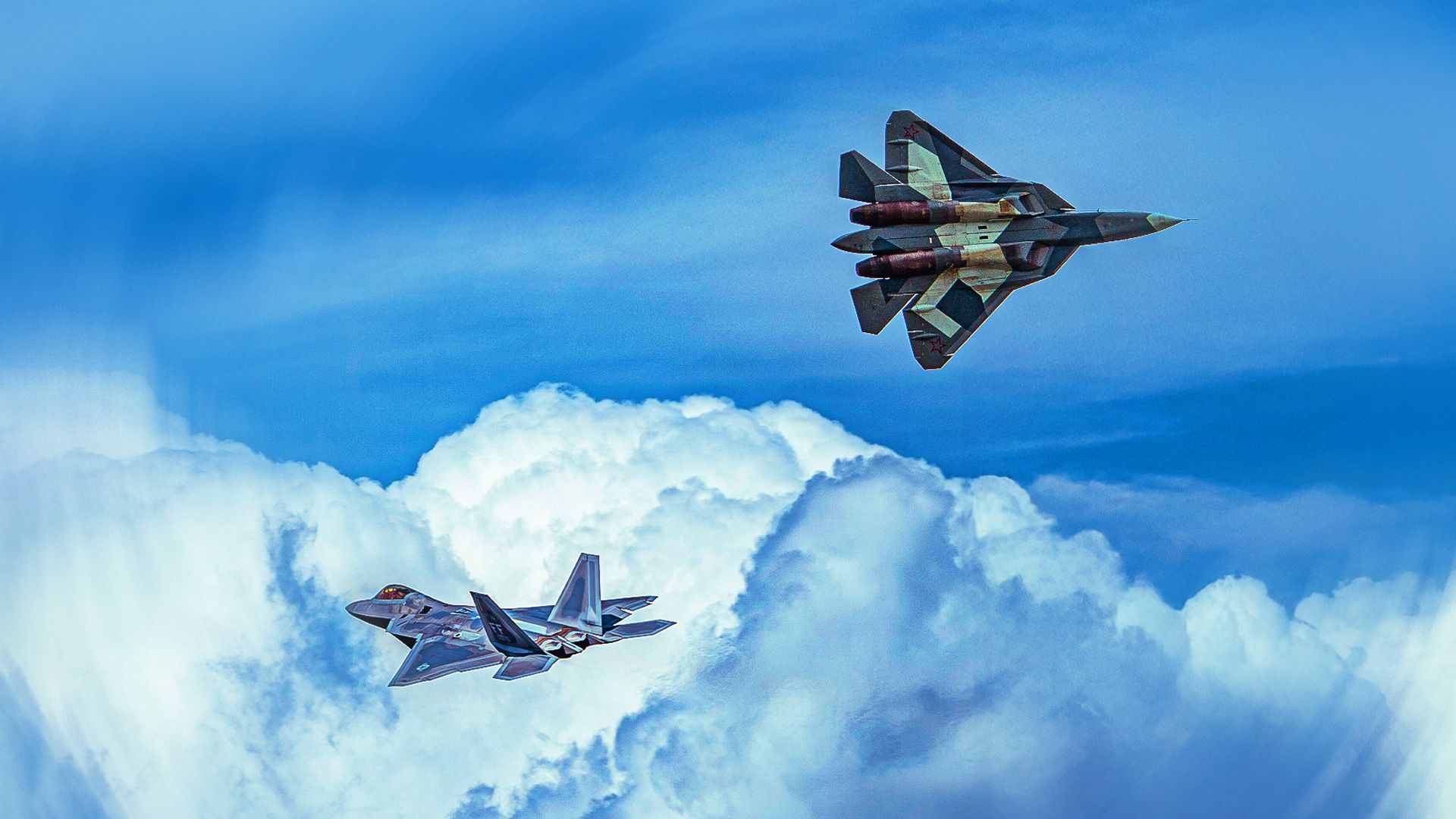
The Lockheed Martin F-22 Raptor and Sukhoi Su-57 Felon represent the forefront of fifth-generation fighter jets, each showcasing advanced technology for stealthy multirole operations. While the F-22 has served the United States Air Force since December 15, 2005, the Su-57, which entered service in December 2020, is a more recent addition to the Russian Aerospace Forces. As both nations prepare for future conflicts, these jets remain pivotal in air superiority strategies, even as sixth-generation fighters loom on the horizon.
The F-22 Raptor is often hailed as the stealthiest fighter jet in existence. Its design emphasizes low observability, allowing the US to maintain air dominance globally. With a radar cross-section of merely 0.0001 m², the F-22 utilizes advanced radar-absorbent materials and internal weapon bays to enhance its stealth capabilities. The aircraft is equipped with the AN/APG-77 active electronically scanned array (AESA) radar, enabling it to identify and engage targets before being detected.
In terms of specifications, the F-22 boasts impressive dimensions and performance metrics. It has a wingspan of 44 ft 6 in (13.6 m) and a length of 62 ft 1 in (18.9 m), powered by two Pratt & Whitney F119-PW-100 engines, each producing 35,000 lbf (156 kN) of thrust. The F-22 can achieve a maximum speed of over Mach 2, with supercruise capabilities up to Mach 1.82 without afterburners.
Despite its exceptional capabilities, the F-22 comes with a staggering price tag. The unit acquisition cost is approximately $143 million, but factoring in research and development expenses, the total cost can soar to around $350 million per aircraft. The United States has limited foreign sales of the F-22 to maintain its technological edge, resulting in a production total of just 195 units.
On the other hand, the Su-57 Felon was developed to succeed the Su-27 Flanker series. Although its development began in the early 2000s, it faced numerous challenges before achieving operational status. As of now, Russia has produced an estimated 40 Su-57 units, constrained by Western sanctions and technical issues.
The Su-57 is designed to balance stealth, agility, and multirole functionality, incorporating the N036 Byelka AESA radar system to enhance situational awareness. With a wingspan of 46 ft 3 in (14.1 m) and a length of 65 ft 11 in (20.1 m), the Su-57 features two engine options, the Saturn AL-41F1 or the Izdeliye-30, providing a thrust of 32,000 lbf (144 kN) per engine. The fighter can also reach a maximum speed of Mach 2 and supercruise up to Mach 1.6.
While the Su-57’s unit cost is significantly lower at around $50 million, the aircraft has yet to demonstrate its full potential in combat scenarios. Its versatility allows it to carry a variety of air-to-air and ground munitions, making it a flexible option for diverse mission profiles.
The contrasting design philosophies of these two jets lead to noteworthy differences in their operational capabilities. The F-22 prioritizes stealth and first-strike capability, while the Su-57 emphasizes adaptability across various roles. The F-22’s advanced avionics and integration with US military networks provide superior targeting and situational awareness, enhancing its effectiveness in combat.
Despite its advantages, the F-22 has faced challenges related to high operating costs. Reports indicate that its cost per flight hour can range between $60,000 and $80,000, which is substantially higher than the Su-57’s estimated cost of $24,000 per flight hour. This disparity highlights the economic realities of operating advanced military aircraft, particularly in the context of the ongoing conflict in Ukraine, which has strained Russian resources.
Both programs have encountered significant production hurdles. The US aimed for a fleet of up to 750 F-22s, but rising costs led to a reduction in production to just 187 units. The program’s classified systems have also prevented foreign sales, limiting its operational reach. Conversely, the Su-57’s production has been complicated by material shortages and technical setbacks. Although officially in full production, Russia’s ability to scale up remains uncertain.
With the potential for future growth in the Su-57 program, Russia may still find an opportunity to bolster its capabilities. Reports suggest limited foreign sales, with Algeria being mentioned as a prospective buyer, indicating that the Su-57 might expand its operational footprint.
In conclusion, the F-22 Raptor and Su-57 Felon exemplify the evolving landscape of military aviation. Each fighter jet brings unique strengths and challenges, shaping the air power strategies of their respective nations. As technology advances and geopolitical dynamics shift, the capabilities of these aircraft will continue to be scrutinized in the coming years.

Urgent: Vehicle Fire Closes Two Lanes on I-215 in Salt Lake City

Knicks Dominate Raptors 116-94, Extend Home Winning Streak

Hallmark’s ‘Christmas at the Catnip Café’ Premieres Tonight

Woman Arrested for Threatening U-Haul Worker with Baton

Japan’s PM Takaichi Vows Urgent Fiscal Management Amid Rate Trends

Bitcoin Plummets Below $88K Amid Tether Concerns and Warnings

Tottenville Falls Short in PSAL 4A Title Game Against Erasmus

Shark Teeth Study Reveals Urgent Clues to Prevent Extinction

Church Members Rally Together After Thanksgiving Fire Devastation

Urgent Update: Tom Aspinall’s Vision Deteriorates After UFC 321

MIT Scientists Uncover Surprising Genomic Loops During Cell Division

University of Hawaiʻi Joins $25.6M AI Project to Enhance Disaster Monitoring

AI Disruption: AWS Faces Threat as Startups Shift Cloud Focus

Time Crystals Revolutionize Quantum Computing Potential

Honeywell Forecasts Record Business Jet Deliveries Over Next Decade

Discover the Full Map of Pokémon Legends: Z-A’s Lumiose City

GOP Faces Backlash as Protests Surge Against Trump Policies

Parenthood Set to Depart Hulu: What Fans Need to Know
-
 Top Stories1 month ago
Urgent Update: Tom Aspinall’s Vision Deteriorates After UFC 321
-
 Health1 month ago
MIT Scientists Uncover Surprising Genomic Loops During Cell Division
-
Science4 weeks ago
University of Hawaiʻi Joins $25.6M AI Project to Enhance Disaster Monitoring
-
 Top Stories1 month ago
AI Disruption: AWS Faces Threat as Startups Shift Cloud Focus
-
 Science2 months ago
Time Crystals Revolutionize Quantum Computing Potential
-
 World2 months ago
Honeywell Forecasts Record Business Jet Deliveries Over Next Decade
-
 Entertainment1 month ago
Discover the Full Map of Pokémon Legends: Z-A’s Lumiose City
-
 Top Stories2 months ago
GOP Faces Backlash as Protests Surge Against Trump Policies
-
 Entertainment2 months ago
Parenthood Set to Depart Hulu: What Fans Need to Know
-

 Politics2 months ago
Judge Signals Dismissal of Chelsea Housing Case Citing AI Flaws
-

 Sports2 months ago
Yoshinobu Yamamoto Shines in Game 2, Leading Dodgers to Victory
-

 Health2 months ago
Maine Insurers Cut Medicare Advantage Plans Amid Cost Pressures