
Science
Mars’ Gravitational Pull Shapes Earth’s Climate Patterns

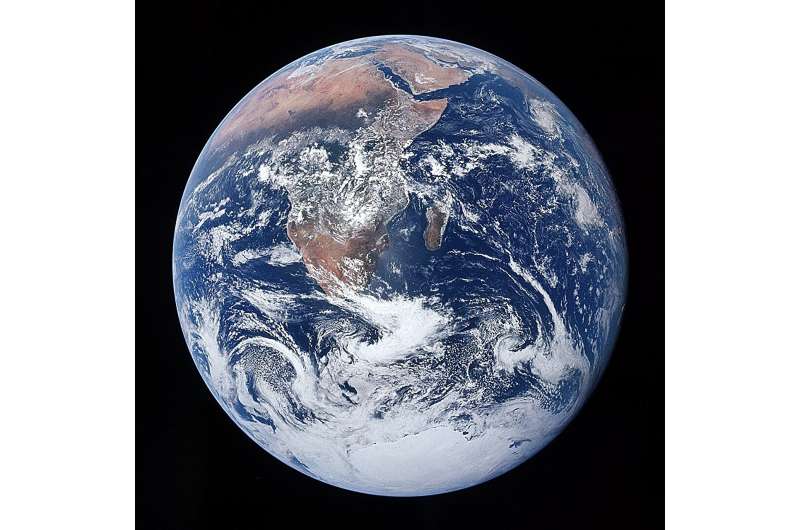
Understanding Earth’s climate requires delving into the intricate interplay between various celestial bodies in our solar system. A recent study led by Stephen Kane reveals that Mars, despite its smaller size, significantly influences Earth’s climate through gravitational interactions. This research highlights Mars’s role in the long-standing cycles that govern our planet’s climate, particularly the Milankovitch cycles.
The Milankovitch cycles, which occur due to subtle changes in Earth’s orbit and axial tilt, have been known to be affected by larger planets like Jupiter and Venus. However, Kane and his team employed computer simulations to assess how variations in Mars’s mass—from zero to ten times its current value—impact these cycles over millions of years. Their findings, published on the arXiv preprint server, establish Mars as a pivotal player in shaping Earth’s seasonal variations.
Mars’s Influence on Climate Cycles
Among the various climate cycles, the most stable is the 405,000-year eccentricity cycle, primarily influenced by interactions between Venus and Jupiter. This cycle serves as a reliable framework for understanding Earth’s climatic shifts. In contrast, the shorter cycles, approximately 100,000 years in duration, which are crucial for transitioning between ice ages, heavily depend on Mars’s gravitational influence.
As simulations indicated, increasing Mars’s mass results in lengthened and more powerful cycles. Remarkably, when simulating a Mars with negligible mass, a significant climate pattern—the 2.4 million-year “grand cycle”—vanishes entirely. This cycle generates long-term climate fluctuations and is essential for determining how much sunlight Earth receives over extended periods.
Moreover, Mars’s gravitational pull also shapes Earth’s axial tilt, or obliquity. The well-documented 41,000-year obliquity cycle lengthens with a more massive Mars. When modeled as ten times its actual mass, this cycle shifts to span 45,000 to 55,000 years, fundamentally altering patterns of ice sheet formation and retreat.
Implications for Exoplanets and Habitability
These findings extend beyond Earth, offering insights into the habitability of Earth-like exoplanets. A terrestrial planet in close proximity to a massive neighbor could experience climate variations that foster conditions favorable for life, such as preventing extreme cold or creating seasons suited for sustaining ecosystems.
The research underscores that Earth’s Milankovitch cycles are not solely a result of its relationship with the sun. They are shaped by the broader planetary context, with Mars playing an unexpectedly significant role.
In summary, Kane’s work not only enhances our understanding of Earth’s climate dynamics but also opens new avenues for assessing the potential habitability of distant worlds. The intricate gravitational dance of planets in our solar system is vital for understanding not just the past, but also the future of Earth’s climate and possibly that of other planets in similar systems.
For further details, consult the original study by Stephen R. Kane et al titled “The Dependence of Earth Milankovitch Cycles on Martian Mass,” available on the arXiv platform.

Urgent Snowfall Expected Tonight in Central Indiana: Prepare Now!

House Republicans Face Deadline on Health Care Plan Before Holidays

Twins Conclude Productive Winter Meetings with Strategic Moves

U.S. Proposes Plan to Unlock Russian Funds, Igniting European Tensions

Vail Pass Sales Rise Slightly as Oxford Lowers Earnings Forecast

New Musical ‘Dypsy!’ Inspired by Gypsy Rose Blanchard Set for 2026

ProMedica Closes Flower Hospital Obstetrics Program, Staff Redirected

Local Veterans Groups Deliver Holiday Cheer to Troops

Local Moms Deliver Holiday Cheer to Troops Worldwide

Urgent Update: Tom Aspinall’s Vision Deteriorates After UFC 321

University of Hawaiʻi Joins $25.6M AI Project to Enhance Disaster Monitoring

MIT Scientists Uncover Surprising Genomic Loops During Cell Division

AI Disruption: AWS Faces Threat as Startups Shift Cloud Focus

Time Crystals Revolutionize Quantum Computing Potential

Discover the Full Map of Pokémon Legends: Z-A’s Lumiose City

Parenthood Set to Depart Hulu: What Fans Need to Know

Honeywell Forecasts Record Business Jet Deliveries Over Next Decade

GOP Faces Backlash as Protests Surge Against Trump Policies
-
 Top Stories1 month ago
Urgent Update: Tom Aspinall’s Vision Deteriorates After UFC 321
-
Science1 month ago
University of Hawaiʻi Joins $25.6M AI Project to Enhance Disaster Monitoring
-
 Health2 months ago
MIT Scientists Uncover Surprising Genomic Loops During Cell Division
-
 Top Stories2 months ago
AI Disruption: AWS Faces Threat as Startups Shift Cloud Focus
-
 Science2 months ago
Time Crystals Revolutionize Quantum Computing Potential
-
 Entertainment2 months ago
Discover the Full Map of Pokémon Legends: Z-A’s Lumiose City
-
 Entertainment2 months ago
Parenthood Set to Depart Hulu: What Fans Need to Know
-
 World2 months ago
Honeywell Forecasts Record Business Jet Deliveries Over Next Decade
-
 Top Stories2 months ago
GOP Faces Backlash as Protests Surge Against Trump Policies
-

 Politics2 months ago
Judge Signals Dismissal of Chelsea Housing Case Citing AI Flaws
-

 Health2 months ago
Maine Insurers Cut Medicare Advantage Plans Amid Cost Pressures
-

 Sports2 months ago
Yoshinobu Yamamoto Shines in Game 2, Leading Dodgers to Victory