
Science
Gravitational Wave Astronomy Breakthroughs from Black Hole Mergers

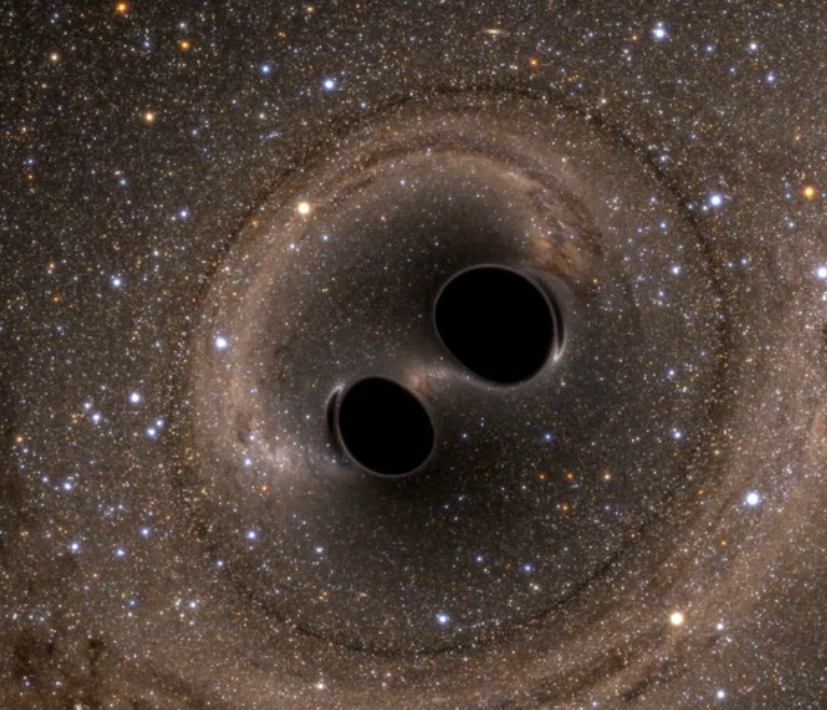
Recent months have marked a significant advancement in gravitational wave astronomy, with the LIGO-Virgo-KAGRA collaboration detecting two extraordinary black hole mergers. These events, observed in October and November 2024, challenge existing theories regarding the formation and evolution of black holes, particularly due to their unusual properties.
The first event, designated GW241011, occurred approximately 700 million light years from Earth. It involved two black holes with masses of 20 and 6 solar masses spiraling together. Notably, the larger black hole was one of the fastest rotating black holes ever recorded through gravitational waves. Just a month later, astronomers detected GW241110, which took place at a staggering 2.4 billion light years away and involved black holes weighing 17 and 8 solar masses. In this merger, the primary black hole was found to be spinning in the opposite direction of its orbit, a configuration never directly observed before.
Implications for Black Hole Formation
The unique spin characteristics of these black holes provide crucial insights into their origins. Typically, massive stars that collapse leave behind black holes with modest spins aligned with their original orbital motion. However, the rapid spins observed in both GW241011 and GW241110 suggest that these are not first-generation black holes formed from direct stellar collapse. Instead, they likely represent second-generation black holes, products of earlier mergers.
This notion is supported by the mass disparity between the black holes in each merger, with the larger black hole almost double the mass of its companion. Such a pattern aligns more closely with hierarchical mergers occurring in dense stellar environments, like globular clusters, where black holes frequently encounter one another and merge repeatedly.
Confirmation of Einstein’s Predictions
The clear signal from GW241011 provided astronomers with a unique opportunity to test Einstein’s general relativity with remarkable accuracy. The rapid rotation of the primary black hole leads to a slight deformation of the object, an effect predicted by mathematician Roy Kerr‘s solution for rotating black holes. This deformation manifests as a distinctive signature in the gravitational waves, which closely matches theoretical predictions.
Additionally, the signal includes higher harmonics, akin to overtones in musical instruments, further validating Einstein’s theories. As the sensitivity of gravitational wave detectors continues to improve, scientists anticipate uncovering more discoveries akin to GW241011 and GW241110. These findings will not only enhance our understanding of black hole collisions but also refine the fundamental laws governing these extreme objects in the universe.
In summary, the recent observations of these black hole mergers signify a leap forward in our comprehension of cosmic phenomena and challenge existing paradigms regarding black hole formation. As investigations continue, the potential for new revelations about the universe’s most enigmatic entities remains high.

Philadelphia Parks Launch Free Earth Month Events Starting April 1

Bradford’s Fish Fry Fridays Serve Community with Delicious Dinners

Trump Faces Growing Challenges Amid Rising Tensions with Iran

Scientists Probe the Universe’s Missing Topological Defects

Samsung Galaxy Watch 9 to Feature Larger 435mAh Battery

UConn Huskies Aim to Defend Title in 2026 NCAA Women’s Tournament

U.S. Littoral Combat Ships Dock in Malaysia Amid Regional Tensions

Healthy Choice Wellness Reports Quarterly Earnings, Shares Rise

Urgent News: Charles M. Payment Passes Away at 78 in Duluth

University of Hawaiʻi Joins $25.6M AI Project to Enhance Disaster Monitoring

Major Grant Enhances Cancer Care and Research in Hawaiʻi

Joleen Chaney, Beloved Journalist, Passes Leaving Lasting Legacy

San Francisco’s SFO to Welcome 16 Airlines with Nonstop Flights to Europe in 2026

Goldman Sachs Unveils 2026 Catalyst Playbook for Biotech Investors

Discover Top Business Smartphones for Professionals in 2026

Urgent Update: Tom Aspinall’s Vision Deteriorates After UFC 321

Texas Roadhouse Honors Veterans with Free Meal Vouchers

CD Projekt Red Confirms No Release for The Witcher 4 in 2026
-
Science9 months ago
University of Hawaiʻi Joins $25.6M AI Project to Enhance Disaster Monitoring
-
 Health8 months ago
Major Grant Enhances Cancer Care and Research in Hawaiʻi
-
 Top Stories9 months ago
Joleen Chaney, Beloved Journalist, Passes Leaving Lasting Legacy
-
 World7 months ago
San Francisco’s SFO to Welcome 16 Airlines with Nonstop Flights to Europe in 2026
-
 Business8 months ago
Goldman Sachs Unveils 2026 Catalyst Playbook for Biotech Investors
-
 Business8 months ago
Discover Top Business Smartphones for Professionals in 2026
-
 Top Stories9 months ago
Urgent Update: Tom Aspinall’s Vision Deteriorates After UFC 321
-
 Lifestyle9 months ago
Texas Roadhouse Honors Veterans with Free Meal Vouchers
-
 Entertainment8 months ago
CD Projekt Red Confirms No Release for The Witcher 4 in 2026
-

 Top Stories10 months ago
AI Disruption: AWS Faces Threat as Startups Shift Cloud Focus
-

 Health10 months ago
MIT Scientists Uncover Surprising Genomic Loops During Cell Division
-

 Entertainment10 months ago
Discover the Full Map of Pokémon Legends: Z-A’s Lumiose City