
Science
Astronomers Discover Massive Twin Cosmic Rings in Distant Galaxy

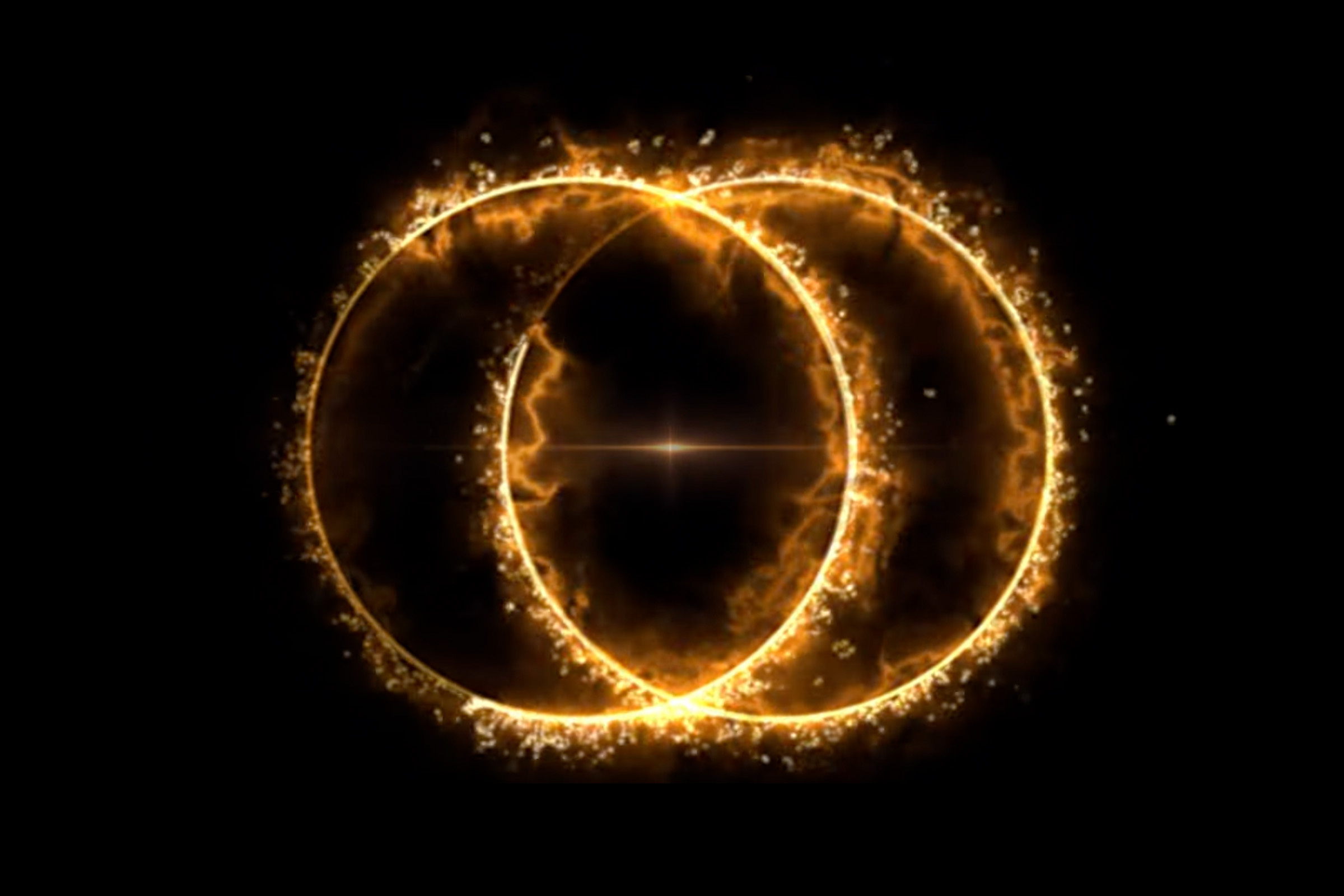
Astronomers have made a groundbreaking discovery with the identification of a colossal double-ring structure, located approximately 7.5 billion light years from Earth. This remarkable formation, known as an Odd Radio Circle (ORC), spans hundreds of thousands of light years across and emits a striking glow in radio wavelengths. The findings were detailed in a study published in the Monthly Notices of the Royal Astronomical Society.
Unraveling the Mystery of Odd Radio Circles
Since their initial discovery just six years ago, only a small number of ORCs have been detected, making this find particularly significant. The recent ORC, designated RAD J131346.9+500320, is only the second of its kind to feature two rings. ORCs are believed to consist of magnetized plasma, which is visible exclusively in radio light. They typically encircle a galaxy and can measure dozens of times the diameter of the entire Milky Way.
Despite their enormous scale, the formation mechanisms behind ORCs remain largely elusive. Astronomers speculate that they may represent echoes of ancient cosmic events that occurred billions of years ago. According to Ananda Hota, the lead author of the study and an assistant professor at the University of Mumbai, “ORCs are among the most bizarre and beautiful cosmic structures we’ve ever seen — and they may hold vital clues about how galaxies and black holes co-evolve.”
The discovery of RAD J131346.9+500320 suggests that interactions between surrounding plasma and the energetic jets from supermassive black holes may play a pivotal role in shaping these structures. Such jets, produced by black holes at the centers of galaxies, may create magnetized plasma clouds that are subsequently energized by massive explosions in the galactic core. This re-energization would cause the clouds to emanate the radio waves observed.
Broader Implications for Astrophysics
Co-author Pratik Dabhade, an assistant professor at the National Centre For Nuclear Research in Warsaw, Poland, noted that these discoveries indicate that ORCs and similar radio rings are not isolated phenomena. Instead, they belong to a broader category of exotic plasma structures influenced by black hole activity and their environments.
This research contributes to an emerging understanding of what astronomers are calling a “low-surface brightness universe,” where many objects were previously hidden from view but are now being revealed by advanced radio telescopes. Other noteworthy discoveries in this realm include a perfectly round supernova remnant and extremely luminous Wolf-Rayet stars, which burn intensely for relatively short cosmic durations.
As these findings unfold, they provide exciting opportunities for further exploration into the complexities of the universe. The continued study of ORCs may ultimately enhance our comprehension of the intricate relationships between galaxies and the supermassive black holes that inhabit their centers.

Shark Teeth Study Reveals Urgent Clues to Prevent Extinction

Church Members Rally Together After Thanksgiving Fire Devastation

U.S. Investment in Canadian Energy Firms Surges Despite Low Oil Prices

Nick Jonas Unveils New Solo Album ‘Sunday Best’ Set for February Release

Researchers Urge Label Changes for Low-Alcohol Drinks to Aid Pregnant Women

Wedding Cookie Table Community Aims for World’s Largest Cookie Exchange

Mayor Appoints Alan Wong as New Supervisor for District 4

UK Report Reveals Growing Role of AI in University Research Assessments

Mayor Lurie Appoints Alan Wong as New District 4 Supervisor

Urgent Update: Tom Aspinall’s Vision Deteriorates After UFC 321

MIT Scientists Uncover Surprising Genomic Loops During Cell Division

University of Hawaiʻi Joins $25.6M AI Project to Enhance Disaster Monitoring

AI Disruption: AWS Faces Threat as Startups Shift Cloud Focus

Time Crystals Revolutionize Quantum Computing Potential

Honeywell Forecasts Record Business Jet Deliveries Over Next Decade

Discover the Full Map of Pokémon Legends: Z-A’s Lumiose City

GOP Faces Backlash as Protests Surge Against Trump Policies

Parenthood Set to Depart Hulu: What Fans Need to Know
-
 Top Stories1 month ago
Urgent Update: Tom Aspinall’s Vision Deteriorates After UFC 321
-
 Health1 month ago
MIT Scientists Uncover Surprising Genomic Loops During Cell Division
-
Science4 weeks ago
University of Hawaiʻi Joins $25.6M AI Project to Enhance Disaster Monitoring
-
 Top Stories1 month ago
AI Disruption: AWS Faces Threat as Startups Shift Cloud Focus
-
 Science2 months ago
Time Crystals Revolutionize Quantum Computing Potential
-
 World2 months ago
Honeywell Forecasts Record Business Jet Deliveries Over Next Decade
-
 Entertainment1 month ago
Discover the Full Map of Pokémon Legends: Z-A’s Lumiose City
-
 Top Stories2 months ago
GOP Faces Backlash as Protests Surge Against Trump Policies
-
 Entertainment2 months ago
Parenthood Set to Depart Hulu: What Fans Need to Know
-

 Politics2 months ago
Judge Signals Dismissal of Chelsea Housing Case Citing AI Flaws
-

 Sports2 months ago
Yoshinobu Yamamoto Shines in Game 2, Leading Dodgers to Victory
-

 Health2 months ago
Maine Insurers Cut Medicare Advantage Plans Amid Cost Pressures