
Science
Astronomers Investigate Mysterious Gamma-Ray Glow in Milky Way

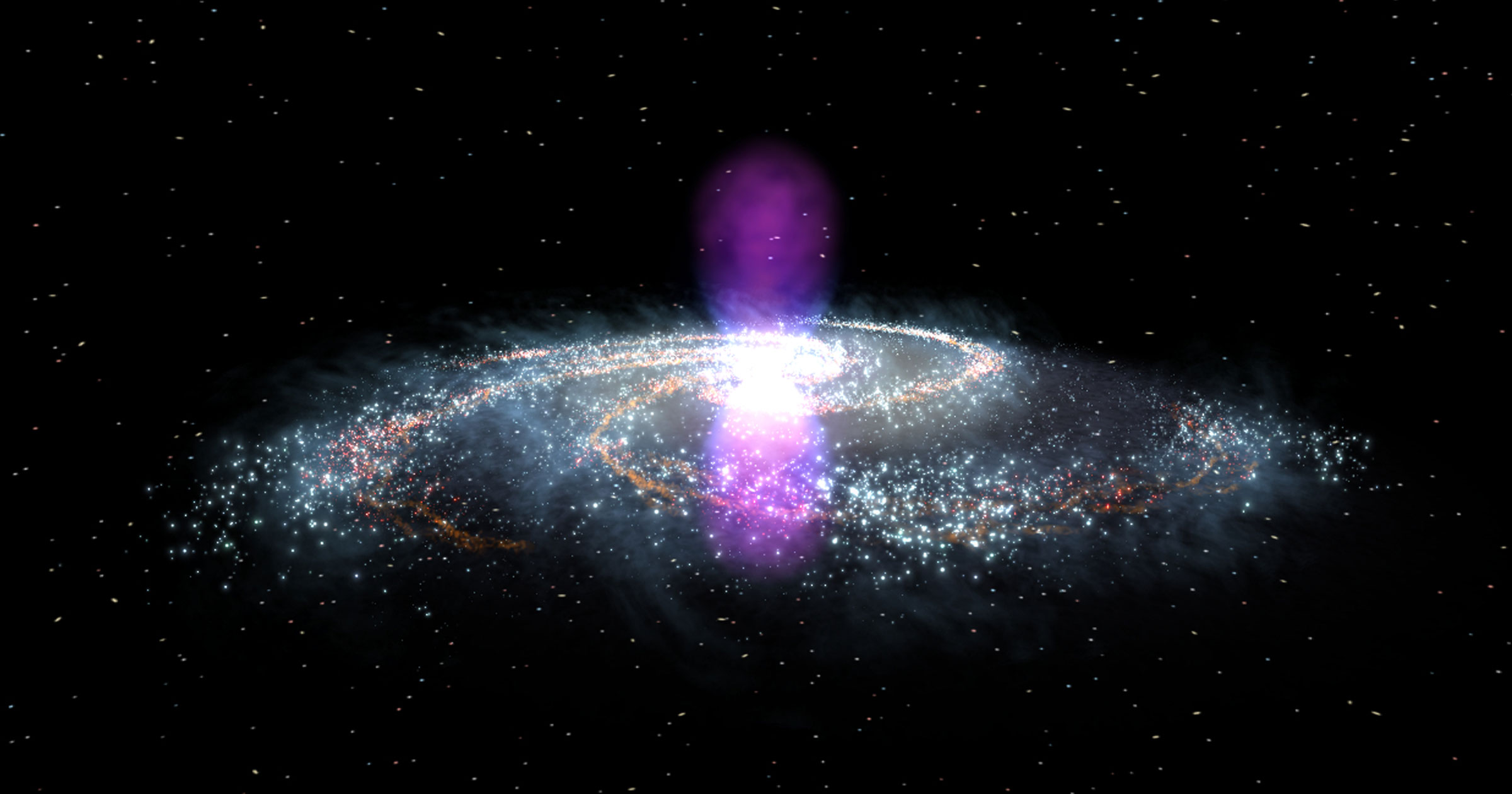
Astronomers have long been intrigued by a mysterious glow of gamma rays detected near the center of the Milky Way Galaxy. Recent research, published in the journal Physical Review Letters, explores two competing theories regarding the source of this enigmatic light. Scientists propose that it may either be the result of dark matter particles colliding or the emissions from rapidly spinning neutron stars, known as pulsars.
The paper’s findings suggest that both possibilities are equally plausible. If the gamma rays indeed originate from dark matter interactions, it could provide the first tangible evidence of the existence of dark matter, which is theorized to comprise more than 26 percent of the universe. “Dark matter dominates the universe and holds galaxies together,” stated Joseph Silk, a coauthor and professor of astronomy at Johns Hopkins University. He emphasized the significance of these findings, saying, “It’s extremely consequential, and we’re desperately thinking all the time of ideas as to how we could detect it.”
To investigate this phenomenon, Silk and his international team developed a dark matter map that illustrates where these elusive particles should be located within the galaxy. Their research posits that billions of years ago, smaller galaxy-like systems of dark matter coalesced at the center of the Milky Way, leading to increased collisions among these clumps. By simulating these interactions, they discovered that their dark matter map coincided with existing gamma ray data collected from NASA’s Fermi Gamma-ray Space Telescope.
While this correlation is intriguing, scientists remain cautious about concluding that the glow results from dark matter collisions. Pulsars could still be responsible for the emissions. To further investigate, the upcoming Cherenkov Telescope Array Observatory aims to enhance gamma-ray imaging. This multinational initiative will feature 60 telescopes positioned across two locations: one on the Spanish island of La Palma and another in the Atacama Desert of Chile.
With the advanced capabilities of this new observatory, researchers anticipate obtaining clearer images that may pinpoint the source of the gamma-ray glow that has baffled astronomers for decades. “A clean signal would be a smoking gun, in my opinion,” Silk noted.
In the meantime, Silk and his colleagues are also focusing on nearby dwarf galaxies to examine dark matter distribution and determine if it aligns with current gamma-ray maps. “It’s possible we will see the new data and confirm one theory over the other,” Silk concluded. “Or maybe we’ll find nothing, in which case it’ll be an even greater mystery to resolve.”
As astronomers continue to unravel the complexities of dark matter and its potential implications, this ongoing research promises to deepen our understanding of the universe.

Shark Teeth Study Reveals Urgent Clues to Prevent Extinction

Church Members Rally Together After Thanksgiving Fire Devastation

U.S. Investment in Canadian Energy Firms Surges Despite Low Oil Prices

Nick Jonas Unveils New Solo Album ‘Sunday Best’ Set for February Release

Researchers Urge Label Changes for Low-Alcohol Drinks to Aid Pregnant Women

Wedding Cookie Table Community Aims for World’s Largest Cookie Exchange

Mayor Appoints Alan Wong as New Supervisor for District 4

UK Report Reveals Growing Role of AI in University Research Assessments

Mayor Lurie Appoints Alan Wong as New District 4 Supervisor

Urgent Update: Tom Aspinall’s Vision Deteriorates After UFC 321

MIT Scientists Uncover Surprising Genomic Loops During Cell Division

University of Hawaiʻi Joins $25.6M AI Project to Enhance Disaster Monitoring

AI Disruption: AWS Faces Threat as Startups Shift Cloud Focus

Time Crystals Revolutionize Quantum Computing Potential

Honeywell Forecasts Record Business Jet Deliveries Over Next Decade

Discover the Full Map of Pokémon Legends: Z-A’s Lumiose City

GOP Faces Backlash as Protests Surge Against Trump Policies

Parenthood Set to Depart Hulu: What Fans Need to Know
-
 Top Stories1 month ago
Urgent Update: Tom Aspinall’s Vision Deteriorates After UFC 321
-
 Health1 month ago
MIT Scientists Uncover Surprising Genomic Loops During Cell Division
-
Science4 weeks ago
University of Hawaiʻi Joins $25.6M AI Project to Enhance Disaster Monitoring
-
 Top Stories1 month ago
AI Disruption: AWS Faces Threat as Startups Shift Cloud Focus
-
 Science2 months ago
Time Crystals Revolutionize Quantum Computing Potential
-
 World2 months ago
Honeywell Forecasts Record Business Jet Deliveries Over Next Decade
-
 Entertainment1 month ago
Discover the Full Map of Pokémon Legends: Z-A’s Lumiose City
-
 Top Stories2 months ago
GOP Faces Backlash as Protests Surge Against Trump Policies
-
 Entertainment2 months ago
Parenthood Set to Depart Hulu: What Fans Need to Know
-

 Politics2 months ago
Judge Signals Dismissal of Chelsea Housing Case Citing AI Flaws
-

 Sports2 months ago
Yoshinobu Yamamoto Shines in Game 2, Leading Dodgers to Victory
-

 Health2 months ago
Maine Insurers Cut Medicare Advantage Plans Amid Cost Pressures