
Science
ALMA and JWST Uncover Secrets of Star Formation in HH 211

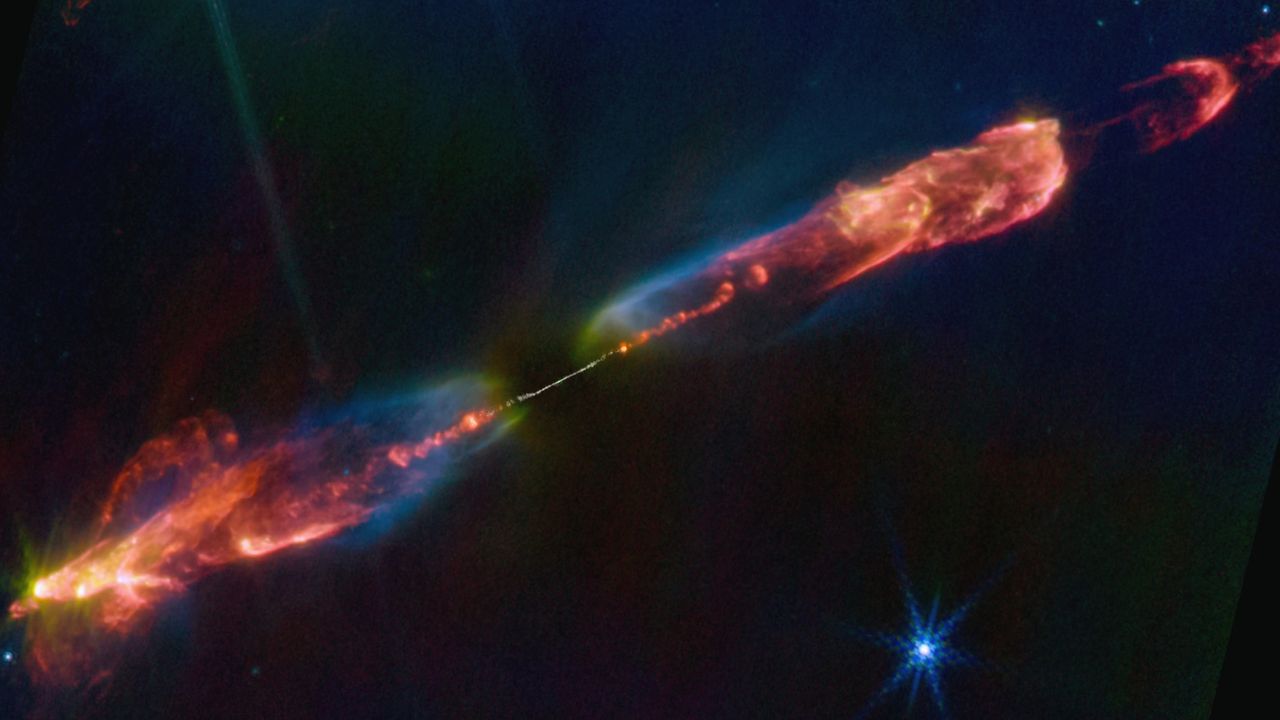
A groundbreaking study utilizing the Atacama Large Millimeter/submillimeter Array (ALMA) and the James Webb Space Telescope (JWST) has shed light on the intricate processes of star formation, focusing on a protostar known as HH 211. Located approximately 1,000 light-years away in the constellation Perseus, this research reveals how energetic jets emitted from young stars play a crucial role in their development. The findings were published in the journal Scientific Reports on August 13, 2023.
Unveiling the Nature of HH 211
HH 211 is categorized as a Herbig-Haro object, characterized by its bright nebulosity generated by powerful jets from newborn stars. This particular protostellar system is notably young, estimated to be only 35,000 years old, with a central protostar that has a mass of 0.06 solar masses. Researchers have emphasized the significance of this system, as it is one of the few instances where a magnetic field has been detected, providing a rare opportunity to explore models that describe how such fields can influence jet formation.
The study captured the dynamics of the bipolar jet, which consists of two beams of energized ionized material shooting in opposite directions at staggering speeds of around 66 miles per second (or 107 kilometers per second). Despite its rapid movement, the jet exhibits a slow rotation, which researchers suggest indicates that it is effectively removing excess rotational energy from the surrounding accretion disk.
Significance of the Findings
The team calculated that the jet originates from a mere 0.02 astronomical units (approximately 1.85 million miles or 3 million kilometers) from the protostar, a groundbreaking revelation in the study of star formation. This finding aligns with existing models proposing that magnetic fields act as a slingshot, propelling gas outward and facilitating the star’s growth.
Images from JWST, while spectacular, are obstructed by thick cosmic dust surrounding the central region where the jet is launched. ALMA’s observations, however, provided crucial insights by revealing the thin area at the center in submillimeter wavelengths. This synergy of ALMA and JWST data has created a comprehensive image of how stars form, marking the first time researchers have captured the launch location of a protostellar jet.
“This discovery highlights the essential role these jets play in the growth of newborn stars by eliminating angular momentum from the accretion disk, allowing material to fall onto the star more efficiently,” said lead researcher from the study.
The implications of this research extend beyond HH 211, as it enhances the overall understanding of star formation. By studying such protostellar systems, astronomers can gain insights into the fundamental processes that govern star development throughout the universe.
As investigations into star formation continue, the collaboration between ALMA and JWST promises to unveil more mysteries of the cosmos, providing valuable knowledge that could reshape our understanding of the universe and our place within it.

Philadelphia Parks Launch Free Earth Month Events Starting April 1

Bradford’s Fish Fry Fridays Serve Community with Delicious Dinners

Trump Faces Growing Challenges Amid Rising Tensions with Iran

Scientists Probe the Universe’s Missing Topological Defects

Samsung Galaxy Watch 9 to Feature Larger 435mAh Battery

UConn Huskies Aim to Defend Title in 2026 NCAA Women’s Tournament

U.S. Littoral Combat Ships Dock in Malaysia Amid Regional Tensions

Healthy Choice Wellness Reports Quarterly Earnings, Shares Rise

Urgent News: Charles M. Payment Passes Away at 78 in Duluth

University of Hawaiʻi Joins $25.6M AI Project to Enhance Disaster Monitoring

Major Grant Enhances Cancer Care and Research in Hawaiʻi

Joleen Chaney, Beloved Journalist, Passes Leaving Lasting Legacy

San Francisco’s SFO to Welcome 16 Airlines with Nonstop Flights to Europe in 2026

Goldman Sachs Unveils 2026 Catalyst Playbook for Biotech Investors

Discover Top Business Smartphones for Professionals in 2026

Urgent Update: Tom Aspinall’s Vision Deteriorates After UFC 321

Texas Roadhouse Honors Veterans with Free Meal Vouchers

CD Projekt Red Confirms No Release for The Witcher 4 in 2026
-
Science9 months ago
University of Hawaiʻi Joins $25.6M AI Project to Enhance Disaster Monitoring
-
 Health8 months ago
Major Grant Enhances Cancer Care and Research in Hawaiʻi
-
 Top Stories9 months ago
Joleen Chaney, Beloved Journalist, Passes Leaving Lasting Legacy
-
 World7 months ago
San Francisco’s SFO to Welcome 16 Airlines with Nonstop Flights to Europe in 2026
-
 Business8 months ago
Goldman Sachs Unveils 2026 Catalyst Playbook for Biotech Investors
-
 Business7 months ago
Discover Top Business Smartphones for Professionals in 2026
-
 Top Stories9 months ago
Urgent Update: Tom Aspinall’s Vision Deteriorates After UFC 321
-
 Lifestyle9 months ago
Texas Roadhouse Honors Veterans with Free Meal Vouchers
-
 Entertainment8 months ago
CD Projekt Red Confirms No Release for The Witcher 4 in 2026
-

 Top Stories10 months ago
AI Disruption: AWS Faces Threat as Startups Shift Cloud Focus
-

 Health10 months ago
MIT Scientists Uncover Surprising Genomic Loops During Cell Division
-

 Entertainment10 months ago
Discover the Full Map of Pokémon Legends: Z-A’s Lumiose City