
Science
Chang’e-6 Returns Unique Lunar Soil That Defies Expectations

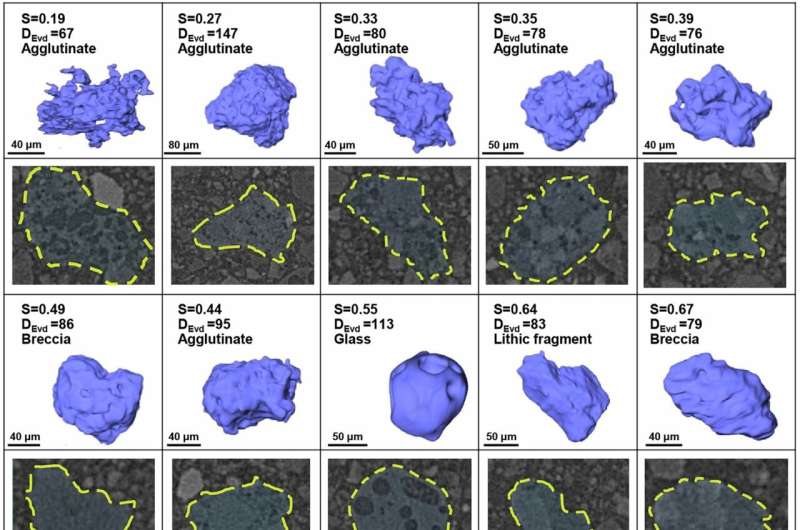
The recent analysis of lunar soil samples returned by China’s Chang’e-6 mission has revealed unexpected characteristics that could reshape our understanding of the Moon’s geology. On June 25, 2024, the mission successfully brought back 1,935.3 grams of lunar soil from the South Pole–Aitken Basin, the largest impact structure on the Moon’s far side. This mission marks a pivotal moment in lunar research, as prior sample-return missions focused exclusively on the near side.
Unique Properties of Far-Side Lunar Samples
The analysis conducted by a team led by Prof. Qi Shengwen at the Institute of Geology and Geophysics of the Chinese Academy of Sciences has shown that the samples from Chang’e-6 exhibit a “slightly more viscous and somewhat clumpier” texture compared to the finer soils collected during the Chang’e-5 mission. To quantify these observations, researchers performed experiments to measure the angle of repose, a key indicator of how granular materials flow.
Published in Nature Astronomy, the findings indicate that the lunar soil from the far side has a significantly higher angle of repose than its near-side counterparts, demonstrating flow behavior typical of cohesive soils. This is a crucial insight, as it suggests a distinct geological history for the far side, which has been less studied due to the absence of sample returns.
Understanding Cohesion Through Particle Mechanics
The research team ruled out the influence of magnetic and cementation effects, noting that the samples contained minimal magnetic minerals and no clay minerals. Instead, the increased cohesion in the lunar soil is attributed to three interparticle forces: friction, van der Waals forces, and electrostatic forces. The study identifies a critical particle size threshold of approximately 100 micrometers, below which fine non-clay mineral particles begin to exhibit cohesive behavior.
Utilizing high-resolution CT imaging, the researchers determined that the Chang’e-6 samples have a D 60 measurement of only 48.4 micrometers, indicating that they are considerably finer and irregular in shape compared to near-side soils. Prof. Qi remarked, “Finer particles are typically more spherical. Despite being fine-grained, Chang’e-6 soil displays more complex particle morphologies.”
This unique morphology may result from two factors: a higher feldspar content of approximately 32.6%, which is prone to fragmentation, and the more intense space weathering processes on the far side of the Moon. These characteristics enhance interparticle forces, leading to the high cohesion observed in the samples.
The implications of this study extend beyond academic interest. Understanding the cohesive properties of lunar soil is vital for future exploration and potential resource utilization. As researchers continue to analyze the data from the Chang’e-6 mission, the findings could provide essential insights into the Moon’s geological history and its potential for supporting human activities in space.
This comprehensive examination of the cohesive behavior of lunar soil advances our knowledge of far-side regolith, marking a significant contribution to planetary science. As we continue to explore the Moon, the unique characteristics uncovered by Chang’e-6 may pave the way for future missions and lunar endeavors.

South Korea Strengthens FX Oversight in Urgent Market Stabilization

U.S. Climate Stance Sparks Global Call for Action and Tariffs

Cyber Monday Mattress Deals: Save Up to 59% Today Only!

Razorbacks Suffer Defeat Against Duke, Eye Louisville Showdown

Swiss Residents Reject 50% Inheritance Tax on Wealthy Citizens

Texas Oil Firm Fights California to Restart Offshore Platforms

Alexander Skarsgård Celebrates British Cinema at BIFA 2025

GOP Faces Urgent Deadline to Decide on Affordable Care Act Funding

Stay Organized This Holiday Season with the Midea Air Fryer

Urgent Update: Tom Aspinall’s Vision Deteriorates After UFC 321

MIT Scientists Uncover Surprising Genomic Loops During Cell Division

University of Hawaiʻi Joins $25.6M AI Project to Enhance Disaster Monitoring

AI Disruption: AWS Faces Threat as Startups Shift Cloud Focus

Time Crystals Revolutionize Quantum Computing Potential

Honeywell Forecasts Record Business Jet Deliveries Over Next Decade

Discover the Full Map of Pokémon Legends: Z-A’s Lumiose City

Parenthood Set to Depart Hulu: What Fans Need to Know

GOP Faces Backlash as Protests Surge Against Trump Policies
-
 Top Stories1 month ago
Urgent Update: Tom Aspinall’s Vision Deteriorates After UFC 321
-
 Health1 month ago
MIT Scientists Uncover Surprising Genomic Loops During Cell Division
-
Science4 weeks ago
University of Hawaiʻi Joins $25.6M AI Project to Enhance Disaster Monitoring
-
 Top Stories1 month ago
AI Disruption: AWS Faces Threat as Startups Shift Cloud Focus
-
 Science2 months ago
Time Crystals Revolutionize Quantum Computing Potential
-
 World2 months ago
Honeywell Forecasts Record Business Jet Deliveries Over Next Decade
-
 Entertainment1 month ago
Discover the Full Map of Pokémon Legends: Z-A’s Lumiose City
-
 Entertainment2 months ago
Parenthood Set to Depart Hulu: What Fans Need to Know
-
 Top Stories1 month ago
GOP Faces Backlash as Protests Surge Against Trump Policies
-

 Politics2 months ago
Judge Signals Dismissal of Chelsea Housing Case Citing AI Flaws
-

 Sports2 months ago
Yoshinobu Yamamoto Shines in Game 2, Leading Dodgers to Victory
-

 Health2 months ago
Maine Insurers Cut Medicare Advantage Plans Amid Cost Pressures