
Science
Michigan Farmers Harness Kestrels to Boost Cherry Safety and Profits

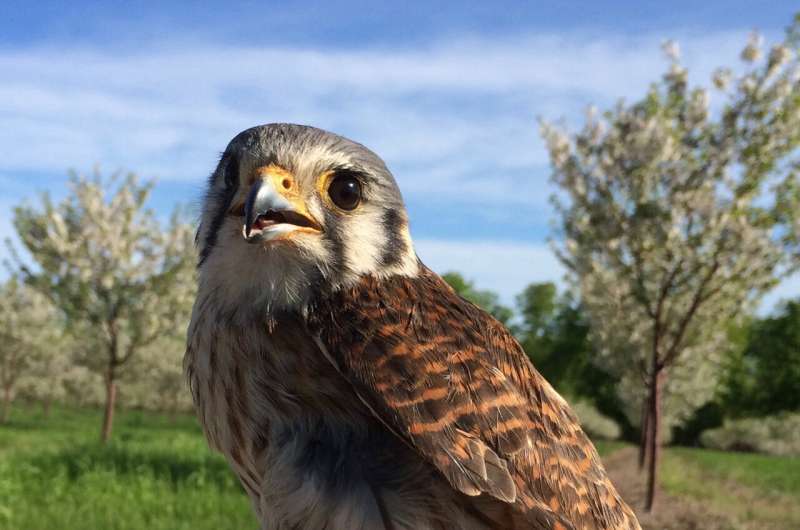
In an innovative approach to agriculture, cherry farmers in northern Michigan are turning to the American kestrel, the smallest falcon in the United States, to enhance food safety and boost crop yields. According to a study from Michigan State University (MSU) published on November 27, 2025, in the Journal of Applied Ecology, these birds of prey not only deter smaller birds from feasting on cherries but also help reduce potential contamination from droppings.
The research led by Olivia Smith, an assistant professor of horticulture at MSU, discovered that kestrels, known for their remarkable hovering ability as they hunt, could serve as natural pest control in orchards. By establishing nest boxes in eight cherry orchards, the team observed a significant decrease in the presence of fruit-eating birds such as robins and starlings when kestrels were nesting nearby. This avian partnership could be a game-changer for cherry growers, who typically lose between 5% to 30% of their crop annually to bird damage.
Benefits of Kestrels for Cherry Growers
The study highlights the dual benefits of employing kestrels in agricultural settings. Not only do these falcons help prevent cherry damage by scaring off would-be pests, but they also minimize the risk of contamination from bird droppings. Smith noted, “It’s hard to keep birds out of crops,” referencing traditional methods like nets and scarecrows, which can be ineffective and costly.
The presence of kestrels resulted in a more than tenfold reduction in cherry damage. Furthermore, the researchers found that these predators contributed to a three-fold decrease in the likelihood of droppings on cherry trees. While kestrels do produce waste, the overall impact of their predation on other birds is beneficial, according to Catherine Lindell, senior author and professor emerita at MSU.
Implications for Food Safety
The implications of this research extend beyond crop damage. The study noted that 10% of droppings found in the orchards contained Campylobacter, a bacterium linked to foodborne illnesses. While no outbreaks of illness related to cherries have been recorded, the findings suggest that kestrels could play a crucial role in enhancing food safety in various crops, particularly those traditionally associated with contamination issues, such as leafy greens.
Smith emphasized that while this method does not solve all bird-related challenges, it presents a low-cost, low-maintenance solution for growers. The researchers acknowledged that kestrels may not thrive in all agricultural regions, but their presence offers a promising alternative to conventional bird management strategies.
The study’s findings highlight an evolving understanding of the intricate relationships between wildlife and agriculture. As farmers seek innovative ways to protect their crops, the partnership with kestrels may pave the way for safer and more profitable harvests in the future.
For more information, see the article “Falcons Reduce Pre-Harvest Food Safety Risks and Crop Damage From Wild Birds” in the Journal of Applied Ecology (2025).

Church Members Rally Together After Thanksgiving Fire Devastation

U.S. Investment in Canadian Energy Firms Surges Despite Low Oil Prices

Nick Jonas Unveils New Solo Album ‘Sunday Best’ Set for February Release

Researchers Urge Label Changes for Low-Alcohol Drinks to Aid Pregnant Women

Wedding Cookie Table Community Aims for World’s Largest Cookie Exchange

Mayor Appoints Alan Wong as New Supervisor for District 4

UK Report Reveals Growing Role of AI in University Research Assessments

Mayor Lurie Appoints Alan Wong as New District 4 Supervisor

South Korea Strengthens FX Oversight in Urgent Market Stabilization

Urgent Update: Tom Aspinall’s Vision Deteriorates After UFC 321

MIT Scientists Uncover Surprising Genomic Loops During Cell Division

University of Hawaiʻi Joins $25.6M AI Project to Enhance Disaster Monitoring

AI Disruption: AWS Faces Threat as Startups Shift Cloud Focus

Time Crystals Revolutionize Quantum Computing Potential

Honeywell Forecasts Record Business Jet Deliveries Over Next Decade

Discover the Full Map of Pokémon Legends: Z-A’s Lumiose City

GOP Faces Backlash as Protests Surge Against Trump Policies

Parenthood Set to Depart Hulu: What Fans Need to Know
-
 Top Stories1 month ago
Urgent Update: Tom Aspinall’s Vision Deteriorates After UFC 321
-
 Health1 month ago
MIT Scientists Uncover Surprising Genomic Loops During Cell Division
-
Science4 weeks ago
University of Hawaiʻi Joins $25.6M AI Project to Enhance Disaster Monitoring
-
 Top Stories1 month ago
AI Disruption: AWS Faces Threat as Startups Shift Cloud Focus
-
 Science2 months ago
Time Crystals Revolutionize Quantum Computing Potential
-
 World2 months ago
Honeywell Forecasts Record Business Jet Deliveries Over Next Decade
-
 Entertainment1 month ago
Discover the Full Map of Pokémon Legends: Z-A’s Lumiose City
-
 Top Stories2 months ago
GOP Faces Backlash as Protests Surge Against Trump Policies
-
 Entertainment2 months ago
Parenthood Set to Depart Hulu: What Fans Need to Know
-

 Politics2 months ago
Judge Signals Dismissal of Chelsea Housing Case Citing AI Flaws
-

 Sports2 months ago
Yoshinobu Yamamoto Shines in Game 2, Leading Dodgers to Victory
-

 Health2 months ago
Maine Insurers Cut Medicare Advantage Plans Amid Cost Pressures