
Science
Scientist Explores Effects of Small Black Holes on Human Body

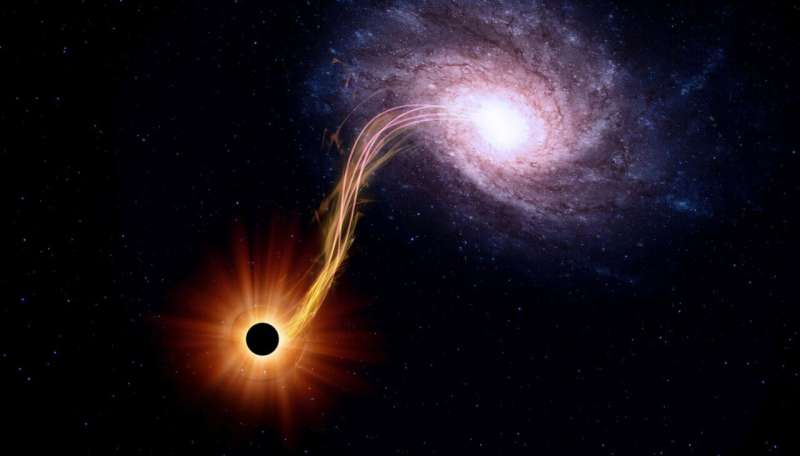
A recent study by Professor of Physics Robert Scherrer at Vanderbilt University investigates the hypothetical effects of a small primordial black hole passing through the human body. Published in the International Journal of Modern Physics D on November 21, 2025, Scherrer’s research aims to enhance understanding of dark matter by exploring the gravitational consequences of such an encounter.
Primordial black holes are theoretical entities believed to have formed shortly after the Big Bang, with masses that can vary dramatically—from less than a paperclip to more than the sun itself. Some scientists propose that these black holes could account for a significant portion of the universe’s dark matter. Scherrer’s inquiry focuses on determining the minimum size needed for a primordial black hole to inflict substantial injury on a human being.
Scherrer’s latest study builds on his prior work alongside colleagues Jagjit Singh Sidhu and Glenn Starkman from Case Western Reserve University, which examined large, hypothetical dark matter particles known as macroscopic dark matter (MACROs). Their research indicated that MACROs could cause severe damage to human tissue. Scherrer noted, “I knew that I could carry over some of those calculations to the study of primordial black holes.”
Understanding the Impact of a Black Hole Encounter
The study delves into two primary gravitational effects that a primordial black hole would exert on the human body: supersonic shock waves and tidal gravitational forces. A supersonic shock wave occurs when an object travels faster than the speed of sound, generating a disturbance in a conical shape. As a primordial black hole traverses the body, it would create these waves, leading to the destruction of human tissues akin to the impact of a bullet.
Additionally, tidal gravitational forces arise from differences in gravitational strength at various points, pulling and stretching materials. The tensile force resulting from this would likely tear human cells apart, with the brain’s cells being particularly vulnerable.
Scherrer emphasizes that while these findings contribute to our understanding of primordial black holes and their potential role in dark matter, the likelihood of such an event occurring is extremely low. “A sufficiently large primordial black hole, about the size of an asteroid or larger, would cause serious injury or death if it passed through you,” he explained. “A smaller primordial black hole could pass through you, and you wouldn’t even notice it. However, the density of these black holes is so low that such an encounter is essentially never going to happen.”
Implications for Dark Matter Research
The implications of Scherrer’s work extend beyond the fascinating intersection of theoretical physics and human biology. By determining the size and gravitational effects of primordial black holes, scientists can gather insights into the properties of dark matter. The ongoing interest in black holes, fueled by recent observations of gravitational waves from black hole mergers and new imaging techniques, makes this research timely and relevant.
As the quest to understand dark matter continues, Scherrer’s findings may help set parameters for the characteristics of primordial black holes, contributing to a broader comprehension of the universe’s mysterious components. His work not only highlights the intriguing possibilities within theoretical physics but also underscores the importance of continued research in this area.
For more information on this topic, refer to the study conducted by Robert J. Scherrer, titled “Gravitational effects of a small primordial black hole passing through the human body,” published in the International Journal of Modern Physics D in 2025.

U.S. Investment in Canadian Energy Firms Surges Despite Low Oil Prices

Nick Jonas Unveils New Solo Album ‘Sunday Best’ Set for February Release

Researchers Urge Label Changes for Low-Alcohol Drinks to Aid Pregnant Women

Wedding Cookie Table Community Aims for World’s Largest Cookie Exchange

Mayor Appoints Alan Wong as New Supervisor for District 4

UK Report Reveals Growing Role of AI in University Research Assessments

Mayor Lurie Appoints Alan Wong as New District 4 Supervisor

South Korea Strengthens FX Oversight in Urgent Market Stabilization

U.S. Climate Stance Sparks Global Call for Action and Tariffs

Urgent Update: Tom Aspinall’s Vision Deteriorates After UFC 321

MIT Scientists Uncover Surprising Genomic Loops During Cell Division

University of Hawaiʻi Joins $25.6M AI Project to Enhance Disaster Monitoring

AI Disruption: AWS Faces Threat as Startups Shift Cloud Focus

Time Crystals Revolutionize Quantum Computing Potential

Honeywell Forecasts Record Business Jet Deliveries Over Next Decade

Discover the Full Map of Pokémon Legends: Z-A’s Lumiose City

GOP Faces Backlash as Protests Surge Against Trump Policies

Parenthood Set to Depart Hulu: What Fans Need to Know
-
 Top Stories1 month ago
Urgent Update: Tom Aspinall’s Vision Deteriorates After UFC 321
-
 Health1 month ago
MIT Scientists Uncover Surprising Genomic Loops During Cell Division
-
Science4 weeks ago
University of Hawaiʻi Joins $25.6M AI Project to Enhance Disaster Monitoring
-
 Top Stories1 month ago
AI Disruption: AWS Faces Threat as Startups Shift Cloud Focus
-
 Science2 months ago
Time Crystals Revolutionize Quantum Computing Potential
-
 World2 months ago
Honeywell Forecasts Record Business Jet Deliveries Over Next Decade
-
 Entertainment1 month ago
Discover the Full Map of Pokémon Legends: Z-A’s Lumiose City
-
 Top Stories2 months ago
GOP Faces Backlash as Protests Surge Against Trump Policies
-
 Entertainment2 months ago
Parenthood Set to Depart Hulu: What Fans Need to Know
-

 Politics2 months ago
Judge Signals Dismissal of Chelsea Housing Case Citing AI Flaws
-

 Sports2 months ago
Yoshinobu Yamamoto Shines in Game 2, Leading Dodgers to Victory
-

 Health2 months ago
Maine Insurers Cut Medicare Advantage Plans Amid Cost Pressures