
Science
Indigenous-led Hunting Emerges as Key Solution for Deer Overabundance in B.C.

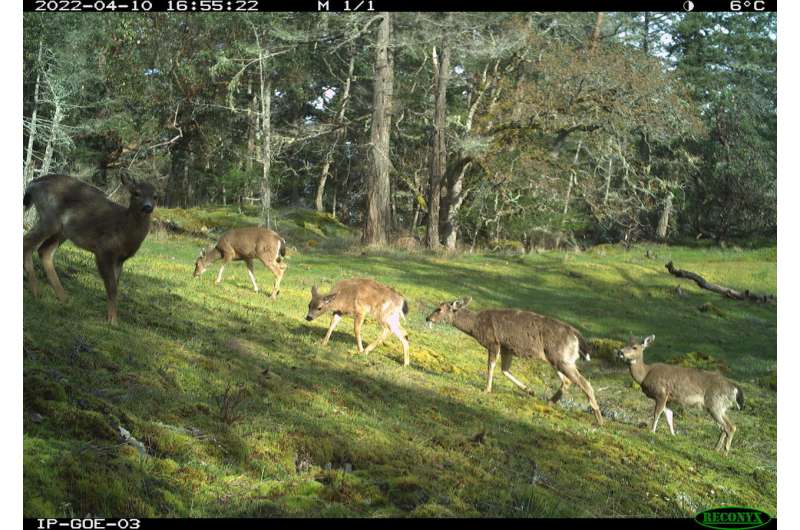
A recent study conducted by the University of British Columbia (UBC) has identified Indigenous-led hunting as the most effective method for managing the overabundance of black-tailed deer on the Southern Gulf Islands in British Columbia. The research, published in the journal People and Nature, highlights the ecological and cultural benefits of this approach, which integrates both Indigenous and Western knowledge systems.
Over the past two decades, populations of black-tailed deer in this region have surged to levels estimated to be up to ten times higher than a century ago. The dramatic increase is attributed to a combination of human-altered landscapes, restrictions on hunting, and a decline in natural predators. According to the study’s lead researcher, Dr. Tara Martin, these conditions have led to severe ecological degradation, affecting forest regeneration and biodiversity, and disrupting cultural ties to the land.
“As beautiful and natural as the islands may appear, they are significantly degraded,” Dr. Martin stated. “The change has been gradual, making it difficult for many to recognize the extent of the problem.”
The consequences of unchecked deer populations are profound. The Garry Oak meadow, one of British Columbia’s most endangered ecosystems, faces the risk of irreversible collapse due to overgrazing. Similar issues are emerging in regions around the world, including Haida Gwaii, Ontario, Australia, New Zealand, and New Caledonia.
Inclusive Strategies for Effective Deer Management
Developing management strategies that not only address deer overpopulation but also support the well-being of communities is complex. The study emphasizes the need for decision-making frameworks that balance ecological and cultural considerations. Lead author and doctoral student Sofie McComb remarked, “This study provides a roadmap to tackle complicated problems where multiple values and goals often lead to indecision.”
The research team collaborated with Coast Salish Nations and local land stewards to evaluate various deer management strategies. These included Indigenous-led hunting, enhancing predator populations, hiring deer reduction specialists, utilizing birth control, and increasing licensed hunting. Among these, Indigenous-led hunting emerged as the only strategy with a high likelihood of achieving both ecological and cultural benefits.
The findings suggest that Indigenous-led hunting could enhance human and ecological well-being by nearly 60% compared to current practices. In contrast, strategies such as increased licensed hunting, while cost-effective, were projected to yield long-term benefits of less than 30%.
The Cost of Inaction
Experts warn that maintaining the status quo will not remedy ecosystem dysfunctions and will contribute to ongoing decision-making paralysis, fueled by concerns over potential controversy. “Delaying action is the most detrimental choice,” stated McComb. “If we do not act soon, the ecosystems may become irrecoverable.”
The research proposes an inclusive framework for communities grappling with similar challenges posed by hyperabundant herbivores. By merging various knowledge systems and considering both feasibility and costs alongside ecological and cultural benefits, decision-makers can pursue strategies that promote recovery in a socially grounded manner.
Dr. Martin concluded, “Solutions to complex environmental issues can benefit both people and ecosystems. This work illustrates that restoring cultural sovereignty and ecological health can be achieved simultaneously.”
For further details, refer to the study by Sofie McComb et al., titled “Decision analysis rooted in Indigenous and Western scientific knowledge identifies cost-effective strategies for managing hyperabundant deer to restore keystone places,” published in People and Nature in November 2025.

Philadelphia Parks Launch Free Earth Month Events Starting April 1

Bradford’s Fish Fry Fridays Serve Community with Delicious Dinners

Trump Faces Growing Challenges Amid Rising Tensions with Iran

Scientists Probe the Universe’s Missing Topological Defects

Samsung Galaxy Watch 9 to Feature Larger 435mAh Battery

UConn Huskies Aim to Defend Title in 2026 NCAA Women’s Tournament

U.S. Littoral Combat Ships Dock in Malaysia Amid Regional Tensions

Healthy Choice Wellness Reports Quarterly Earnings, Shares Rise

Urgent News: Charles M. Payment Passes Away at 78 in Duluth

University of Hawaiʻi Joins $25.6M AI Project to Enhance Disaster Monitoring

Major Grant Enhances Cancer Care and Research in Hawaiʻi

Joleen Chaney, Beloved Journalist, Passes Leaving Lasting Legacy

San Francisco’s SFO to Welcome 16 Airlines with Nonstop Flights to Europe in 2026

Goldman Sachs Unveils 2026 Catalyst Playbook for Biotech Investors

Discover Top Business Smartphones for Professionals in 2026

Urgent Update: Tom Aspinall’s Vision Deteriorates After UFC 321

Texas Roadhouse Honors Veterans with Free Meal Vouchers

CD Projekt Red Confirms No Release for The Witcher 4 in 2026
-
Science9 months ago
University of Hawaiʻi Joins $25.6M AI Project to Enhance Disaster Monitoring
-
 Health8 months ago
Major Grant Enhances Cancer Care and Research in Hawaiʻi
-
 Top Stories9 months ago
Joleen Chaney, Beloved Journalist, Passes Leaving Lasting Legacy
-
 World7 months ago
San Francisco’s SFO to Welcome 16 Airlines with Nonstop Flights to Europe in 2026
-
 Business8 months ago
Goldman Sachs Unveils 2026 Catalyst Playbook for Biotech Investors
-
 Business7 months ago
Discover Top Business Smartphones for Professionals in 2026
-
 Top Stories9 months ago
Urgent Update: Tom Aspinall’s Vision Deteriorates After UFC 321
-
 Lifestyle9 months ago
Texas Roadhouse Honors Veterans with Free Meal Vouchers
-
 Entertainment8 months ago
CD Projekt Red Confirms No Release for The Witcher 4 in 2026
-

 Top Stories10 months ago
AI Disruption: AWS Faces Threat as Startups Shift Cloud Focus
-

 Health10 months ago
MIT Scientists Uncover Surprising Genomic Loops During Cell Division
-

 Entertainment10 months ago
Discover the Full Map of Pokémon Legends: Z-A’s Lumiose City