
Science
Swansea Physicists Achieve Major Antihydrogen Breakthrough at CERN

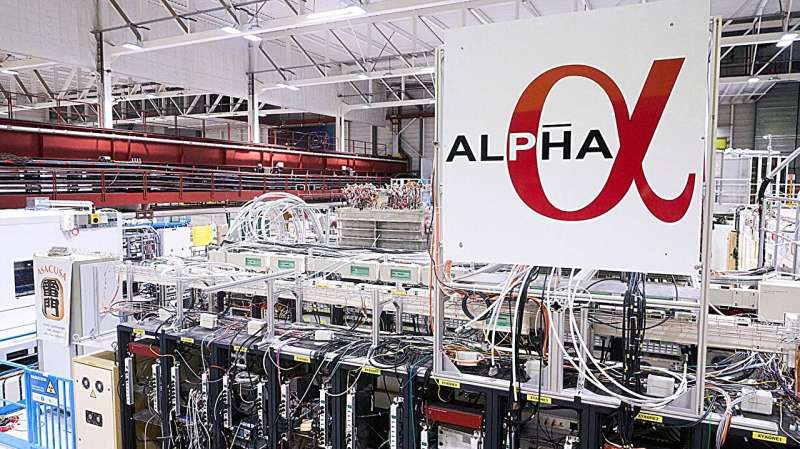
Physicists from Swansea University have made a significant advancement in antihydrogen research at CERN, increasing the trapping rate of antihydrogen by a factor of ten. This groundbreaking development, part of the international Antihydrogen Laser Physics Apparatus (ALPHA) collaboration, was published in Nature Communications on November 18, 2025. The findings aim to address a fundamental question in physics: why is there such a profound imbalance between matter and antimatter in the universe?
According to the Big Bang theory, equal amounts of matter and antimatter were created at the universe’s inception. Yet, the observable universe is predominantly composed of matter. Antihydrogen, the “mirror version” of hydrogen formed from an antiproton and a positron, serves as a critical tool for scientists investigating these mysteries. By trapping and studying antihydrogen, researchers can explore how antimatter behaves and whether it adheres to the same physical laws as matter.
The process of producing and trapping antihydrogen has been historically complex. Previous methods required up to 24 hours to trap merely 2,000 atoms, which severely limited experimental opportunities. The Swansea-led team has revolutionized this process. By utilizing laser-cooled beryllium ions, they successfully cooled positrons to below 10 Kelvin (approximately -263°C), notably lower than the previous threshold of around 15 Kelvin. This innovation led to a record achievement of trapping 15,000 atoms in less than seven hours.
New Era for Antihydrogen Research
This advancement marks a new era for the ALPHA collaboration, broadening the spectrum of possible experiments and enabling more precise investigations into fundamental physics. Key areas of focus include studying how antimatter responds to gravity and whether it follows the same symmetries as matter.
Professor Niels Madsen, the lead author of the study and Deputy Spokesperson for ALPHA, expressed his excitement about the breakthrough. “It’s more than a decade since I first realized that this was the way forward, so it’s incredibly gratifying to see the spectacular outcome that will lead to many new exciting measurements on antihydrogen,” he stated.
Ph.D. student Maria Gonçalves, a prominent contributor to the project, reflected on the culmination of years of effort. “The first successful attempt instantly improved the previous method by a factor of two, giving us 36 antihydrogen atoms—my new favorite number! It was a very exciting project to be a part of, and I’m looking forward to seeing what pioneering measurements this technique has made possible,” she noted.
Dr. Kurt Thompson, another key researcher on the project, highlighted the collaborative nature of the achievement. “This fantastic accomplishment was the result of the dedication and collaborative efforts of many Swansea graduate students, summer students, and researchers over the past decade,” he said. “It represents a major paradigm shift in the capabilities of antihydrogen research. Experiments that used to take months can now be performed in a single day.”
This breakthrough not only enhances the capabilities of antihydrogen research but also opens new avenues for understanding the universe’s fundamental properties. As physicists continue to unravel the mysteries of antimatter, the implications of this research could have far-reaching consequences for our understanding of the cosmos.
More information on this study can be found in the article by R. Akbari et al., titled “Be+ assisted, simultaneous confinement of more than 15,000 antihydrogen atoms,” published in Nature Communications (2025).

Church Members Rally Together After Thanksgiving Fire Devastation

U.S. Investment in Canadian Energy Firms Surges Despite Low Oil Prices

Nick Jonas Unveils New Solo Album ‘Sunday Best’ Set for February Release

Researchers Urge Label Changes for Low-Alcohol Drinks to Aid Pregnant Women

Wedding Cookie Table Community Aims for World’s Largest Cookie Exchange

Mayor Appoints Alan Wong as New Supervisor for District 4

UK Report Reveals Growing Role of AI in University Research Assessments

Mayor Lurie Appoints Alan Wong as New District 4 Supervisor

South Korea Strengthens FX Oversight in Urgent Market Stabilization

Urgent Update: Tom Aspinall’s Vision Deteriorates After UFC 321

MIT Scientists Uncover Surprising Genomic Loops During Cell Division

University of Hawaiʻi Joins $25.6M AI Project to Enhance Disaster Monitoring

AI Disruption: AWS Faces Threat as Startups Shift Cloud Focus

Time Crystals Revolutionize Quantum Computing Potential

Honeywell Forecasts Record Business Jet Deliveries Over Next Decade

Discover the Full Map of Pokémon Legends: Z-A’s Lumiose City

GOP Faces Backlash as Protests Surge Against Trump Policies

Parenthood Set to Depart Hulu: What Fans Need to Know
-
 Top Stories1 month ago
Urgent Update: Tom Aspinall’s Vision Deteriorates After UFC 321
-
 Health1 month ago
MIT Scientists Uncover Surprising Genomic Loops During Cell Division
-
Science4 weeks ago
University of Hawaiʻi Joins $25.6M AI Project to Enhance Disaster Monitoring
-
 Top Stories1 month ago
AI Disruption: AWS Faces Threat as Startups Shift Cloud Focus
-
 Science2 months ago
Time Crystals Revolutionize Quantum Computing Potential
-
 World2 months ago
Honeywell Forecasts Record Business Jet Deliveries Over Next Decade
-
 Entertainment1 month ago
Discover the Full Map of Pokémon Legends: Z-A’s Lumiose City
-
 Top Stories2 months ago
GOP Faces Backlash as Protests Surge Against Trump Policies
-
 Entertainment2 months ago
Parenthood Set to Depart Hulu: What Fans Need to Know
-

 Politics2 months ago
Judge Signals Dismissal of Chelsea Housing Case Citing AI Flaws
-

 Sports2 months ago
Yoshinobu Yamamoto Shines in Game 2, Leading Dodgers to Victory
-

 Health2 months ago
Maine Insurers Cut Medicare Advantage Plans Amid Cost Pressures