
Science
LIGO-Virgo-KAGRA Collaboration Marks Record Gravitational Wave Observations

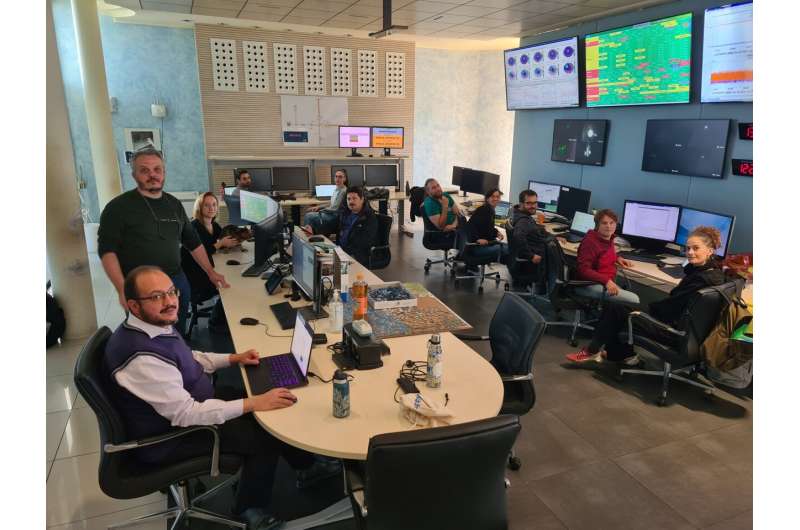
The international LIGO-Virgo-KAGRA Collaboration has successfully concluded its fourth observation campaign, known as O4, marking a significant achievement in the field of gravitational wave astronomy. Launched in May 2023, this campaign lasted over two years and resulted in the detection of approximately 250 new gravitational wave signals, which represent more than two-thirds of the total signals identified by the collaboration to date.
Advancements in detector technology have played a crucial role in the increased sensitivity of the gravitational wave detectors, leading to a record number of observed events. The findings from this latest observational run have already begun to enhance our understanding of compact binary systems and various fundamental physical processes in the universe.
Significant Findings from O4
Gianluca Gemme, spokesperson for the Virgo Collaboration and researcher at the Italian National Institute for Nuclear Physics (INFN), highlighted the importance of this milestone, stating, “The completion of O4 marks a historic milestone: the longest observing run ever conducted by the global gravitational-wave network.” He emphasized Virgo’s essential contributions to the detection and characterization of numerous signals.
Among the notable discoveries is the event known as GW250114, which provided unprecedented observational evidence of two black holes merging. This finding supports a theorem proposed by renowned physicist Stephen Hawking in 1971, asserting that the total surface area of black holes cannot decrease. Specifically, the initial black holes had a combined surface area of 240,000 square kilometers, which increased to about 400,000 square kilometers post-merger.
Another remarkable outcome from the O4 campaign was the detection of “second generation” black holes, identified as GW241011 and GW241110. These events exhibit unique characteristics regarding the size and spin orientation of the black holes, suggesting they are the product of previous mergers in dense cosmic environments, such as star clusters.
Additionally, the event GW231123 marked the observation of the most massive black hole merger recorded to date, resulting in a final black hole exceeding 225 times the mass of the Sun. This observation poses challenges to current models of stellar evolution and black hole formation.
Future Endeavors and Upcoming Upgrades
The ongoing analysis of the hundreds of events collected during the O4 campaign continues to yield significant findings, which will be compiled in a comprehensive gravitational signal catalog set for publication in the coming months.
Looking ahead, the LIGO, Virgo, and KAGRA interferometers are preparing for a new phase of technological upgrades and testing. These enhancements will be rolled out in stages, interspersed with periods of data collection. A new observation campaign is anticipated to commence in late summer or early autumn of 2026, lasting approximately six months.
The successful completion of O4 showcases the power of international collaboration and the dedication of research teams striving to expand the boundaries of gravitational wave detection. As these advancements progress, the scientific impact promises to deepen our understanding of the universe.

Philadelphia Parks Launch Free Earth Month Events Starting April 1

Bradford’s Fish Fry Fridays Serve Community with Delicious Dinners

Trump Faces Growing Challenges Amid Rising Tensions with Iran

Scientists Probe the Universe’s Missing Topological Defects

Samsung Galaxy Watch 9 to Feature Larger 435mAh Battery

UConn Huskies Aim to Defend Title in 2026 NCAA Women’s Tournament

U.S. Littoral Combat Ships Dock in Malaysia Amid Regional Tensions

Healthy Choice Wellness Reports Quarterly Earnings, Shares Rise

Urgent News: Charles M. Payment Passes Away at 78 in Duluth

University of Hawaiʻi Joins $25.6M AI Project to Enhance Disaster Monitoring

Major Grant Enhances Cancer Care and Research in Hawaiʻi

Joleen Chaney, Beloved Journalist, Passes Leaving Lasting Legacy

San Francisco’s SFO to Welcome 16 Airlines with Nonstop Flights to Europe in 2026

Goldman Sachs Unveils 2026 Catalyst Playbook for Biotech Investors

Discover Top Business Smartphones for Professionals in 2026

Urgent Update: Tom Aspinall’s Vision Deteriorates After UFC 321

Texas Roadhouse Honors Veterans with Free Meal Vouchers

CD Projekt Red Confirms No Release for The Witcher 4 in 2026
-
Science9 months ago
University of Hawaiʻi Joins $25.6M AI Project to Enhance Disaster Monitoring
-
 Health8 months ago
Major Grant Enhances Cancer Care and Research in Hawaiʻi
-
 Top Stories9 months ago
Joleen Chaney, Beloved Journalist, Passes Leaving Lasting Legacy
-
 World7 months ago
San Francisco’s SFO to Welcome 16 Airlines with Nonstop Flights to Europe in 2026
-
 Business8 months ago
Goldman Sachs Unveils 2026 Catalyst Playbook for Biotech Investors
-
 Business7 months ago
Discover Top Business Smartphones for Professionals in 2026
-
 Top Stories9 months ago
Urgent Update: Tom Aspinall’s Vision Deteriorates After UFC 321
-
 Lifestyle9 months ago
Texas Roadhouse Honors Veterans with Free Meal Vouchers
-
 Entertainment8 months ago
CD Projekt Red Confirms No Release for The Witcher 4 in 2026
-

 Top Stories10 months ago
AI Disruption: AWS Faces Threat as Startups Shift Cloud Focus
-

 Health10 months ago
MIT Scientists Uncover Surprising Genomic Loops During Cell Division
-

 Entertainment10 months ago
Discover the Full Map of Pokémon Legends: Z-A’s Lumiose City