
Science
Thelma Escobar Unveils Key Discoveries in Stem Cell Research

On September 25, 2025, Dr. Thelma Escobar, an assistant professor of biochemistry at the University of Washington, delivered a compelling presentation during the Hopkins Department of Biology’s Seminar Series. Her talk focused on significant advances made by her laboratory regarding chromatin modifications in hematopoietic stem cells (HSCs) and their implications for cancer, particularly acute myeloid leukemia (AML).
Hematopoietic stem cells, located in bone marrow, play a vital role in maintaining blood and immune cell production. This process of self-renewal and differentiation is tightly regulated, with epigenetic factors such as histone modifications being crucial. Within the cell nucleus, DNA, which carries a negative charge, is wrapped around positively charged histones, influencing gene expression. Escobar highlighted that less tightly-bound regions, known as euchromatin, allow for increased gene expression, while tightly-bound heterochromatin regions inhibit transcription due to distinct histone modifications.
Escobar explained the complexity of histone dynamics during cell division. “[This process involves] a very complex orchestration of destruction [of] parental histones and recycling of histones, as well as de novo deposition, all occurring during DNA replication,” she noted. Histone chaperones, proteins that assist in positioning histones on DNA, are essential for this process.
Her research focuses particularly on the histone chaperone protein Nucleophosmin 1 (NPM1), which is encoded by the NPM1 gene. This protein has been linked to AML, a serious blood cancer originating in the bone marrow. Escobar stated that “NPM1 mutations… are shown… to be present in 30 to 35% of all AMLs,” and emphasized the urgent need for targeted therapies for this mutation, which currently do not exist.
In her investigation, Escobar’s laboratory seeks to understand how NPM1 mutations contribute to AML. A prevailing hypothesis suggests that mutated NPM1 enhances the activity of HOX genes, which could lead to excessive cell proliferation and hinder the differentiation of hematopoietic stem cells. To explore these mechanisms, the Escobar lab differentiates induced pluripotent stem cells (iPSCs) into HSCs, generating sufficient quantities for experimental analysis.
A recent focus of their research involves comparing the interactions between normal NPM1 and its mutated variant. One notable finding indicated that NPM1 interacts with another protein frequently mutated in AML precursors. This discovery is currently under further investigation by Escobar’s team. Additionally, they found a novel NPM1 protein fragment within the nuclei of HSCs in both in vitro and in vivo settings. This observation had not been reported in other cell types.
To pinpoint the cleavage site of this fragment, the lab experimented with mutating various NPM1 protein sites. They observed that mutating specific amino acids yielded distinct fragment patterns, revealing a potential site of cleavage. Escobar plans to further characterize the implications of this protein fragment on cellular function and physiology.
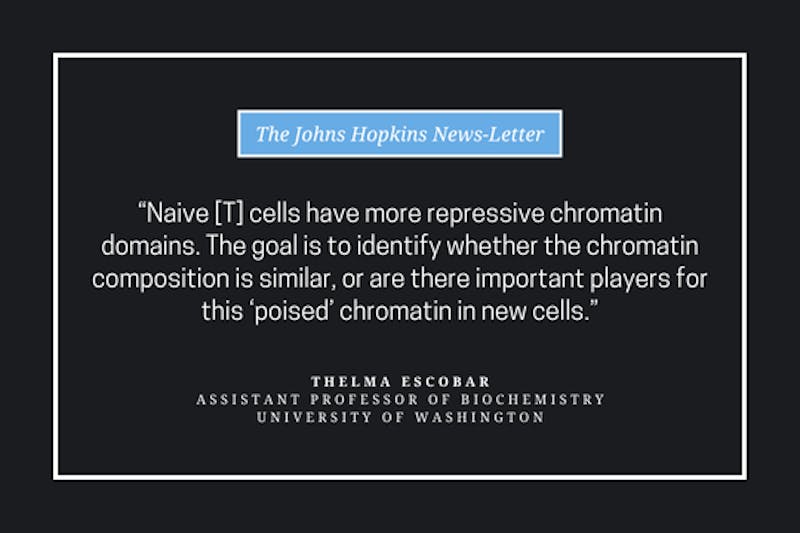
The presentation also touched upon another area of Escobar’s research focusing on chromatin modifications in T cells, central to the adaptive immune system. While many studies have emphasized the proliferation of B and T cells during immune responses, Escobar’s work aims to delve deeper into the role of epigenetics in these processes. She remarked, “Naive [T] cells have more repressive chromatin domains,” and sought to determine the significance of chromatin composition in the context of immune response activation.
Escobar suggested that immune cells with poised chromatin states—characterized by both activating and repressive histone modifications—could respond more rapidly to reinfection. This aspect of her research may redefine how scientists understand immune cell readiness and response.
In closing, Dr. Escobar expressed her enthusiasm for the ongoing projects in her lab, inviting attendees to stay connected for future updates. “Stay tuned, because we’re mixing biochemistry and hematopoietic stem cell differentiation. Hopefully, we can have this story published in the near future,” she said, underscoring the potential impact of her findings in the field of cancer research and beyond.

Shark Teeth Study Reveals Urgent Clues to Prevent Extinction

Church Members Rally Together After Thanksgiving Fire Devastation

U.S. Investment in Canadian Energy Firms Surges Despite Low Oil Prices

Nick Jonas Unveils New Solo Album ‘Sunday Best’ Set for February Release

Researchers Urge Label Changes for Low-Alcohol Drinks to Aid Pregnant Women

Wedding Cookie Table Community Aims for World’s Largest Cookie Exchange

Mayor Appoints Alan Wong as New Supervisor for District 4

UK Report Reveals Growing Role of AI in University Research Assessments

Mayor Lurie Appoints Alan Wong as New District 4 Supervisor

Urgent Update: Tom Aspinall’s Vision Deteriorates After UFC 321

MIT Scientists Uncover Surprising Genomic Loops During Cell Division

University of Hawaiʻi Joins $25.6M AI Project to Enhance Disaster Monitoring

AI Disruption: AWS Faces Threat as Startups Shift Cloud Focus

Time Crystals Revolutionize Quantum Computing Potential

Honeywell Forecasts Record Business Jet Deliveries Over Next Decade

Discover the Full Map of Pokémon Legends: Z-A’s Lumiose City

GOP Faces Backlash as Protests Surge Against Trump Policies

Parenthood Set to Depart Hulu: What Fans Need to Know
-
 Top Stories1 month ago
Urgent Update: Tom Aspinall’s Vision Deteriorates After UFC 321
-
 Health1 month ago
MIT Scientists Uncover Surprising Genomic Loops During Cell Division
-
Science4 weeks ago
University of Hawaiʻi Joins $25.6M AI Project to Enhance Disaster Monitoring
-
 Top Stories1 month ago
AI Disruption: AWS Faces Threat as Startups Shift Cloud Focus
-
 Science2 months ago
Time Crystals Revolutionize Quantum Computing Potential
-
 World2 months ago
Honeywell Forecasts Record Business Jet Deliveries Over Next Decade
-
 Entertainment1 month ago
Discover the Full Map of Pokémon Legends: Z-A’s Lumiose City
-
 Top Stories2 months ago
GOP Faces Backlash as Protests Surge Against Trump Policies
-
 Entertainment2 months ago
Parenthood Set to Depart Hulu: What Fans Need to Know
-

 Politics2 months ago
Judge Signals Dismissal of Chelsea Housing Case Citing AI Flaws
-

 Sports2 months ago
Yoshinobu Yamamoto Shines in Game 2, Leading Dodgers to Victory
-

 Health2 months ago
Maine Insurers Cut Medicare Advantage Plans Amid Cost Pressures