
Science
Webb Identifies Oldest Supernova, Tracing Cosmic History

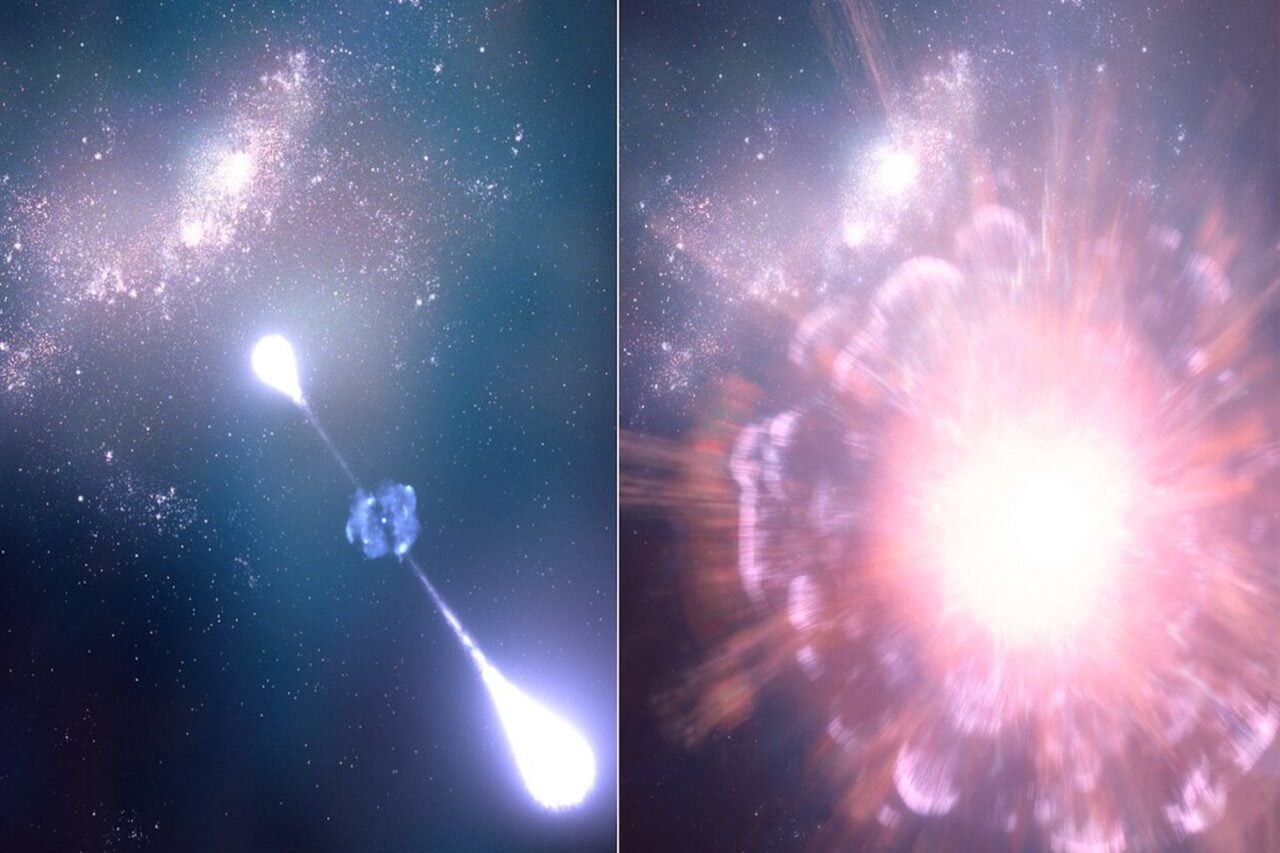
A powerful gamma-ray burst, detected earlier this year, has led astronomers to identify the oldest supernova ever observed. The event, which originated from the early universe just a few hundred million years after the Big Bang, has provided insights into stellar evolution and cosmic history. The findings were made possible through observations by the James Webb Space Telescope, which pinpointed the aftermath of a star’s explosive death when the universe was only 730 million years old.
This discovery sets a new record for the oldest stellar explosion detected, surpassing Webb’s previous record of a supernova that occurred 1.8 billion years after the Big Bang. The data collected from Webb confirmed the source of a highly energetic flash of light known as a gamma-ray burst, corroborating information gathered by a network of telescopes worldwide.
Key Observations from the Early Universe
On March 14, 2023, the SVOM mission (Space-based multi-band astronomical Variable Objects Monitor) first detected the gamma-ray burst from a distant source. Within hours, its location was pinpointed by three other telescopes, allowing astronomers to estimate its timing in the cosmic timeline. “There are only a handful of gamma-ray bursts in the last 50 years that have been detected in the first billion years of the universe,” stated Andrew Levan, an astrophysics professor at Radboud University and lead author of a paper published in Astronomy and Astrophysics Letters. “This particular event is very rare and very exciting.”
Gamma-ray bursts typically last only a few seconds and can result from collisions between neutron stars or between a neutron star and a black hole. The recent burst, however, lasted for ten seconds, indicating it was likely caused by the explosive death of a massive star. The observations from Webb occurred on July 1, 2023, roughly three months after the initial detection. This timeframe allowed the supernova’s brightness to increase, making it easier for the telescope to capture the event.
Comparative Analysis of Supernovae
The light from this ancient supernova was stretched due to the expansion of the universe, which altered its visibility and timing. Once astronomers focused on the early supernova, they compared it to more recent explosions closer to Earth. Surprisingly, they found that the characteristics of the ancient supernova closely resembled those of modern supernovae.
Stars in the early universe were composed of fewer heavy elements compared to their contemporary counterparts. They were also larger and had shorter life spans. Given these differences, Nial Tanvir, a professor at the University of Leicester and co-author of the study, remarked, “We went in with open minds, and lo and behold, Webb showed that this supernova looks exactly like modern supernovae.”
The team behind this groundbreaking research plans to use Webb to observe the afterglow of other distant gamma-ray bursts. This ongoing work aims to enhance understanding of galaxy formation and evolution over time. “That glow will help Webb see more and give us a ‘fingerprint’ of the galaxy,” Levan added, emphasizing the potential of future discoveries.
The identification of this ancient supernova not only enriches our understanding of stellar life cycles but also deepens our appreciation of the universe’s formative years, highlighting the invaluable contributions of modern astronomical technology.

Philadelphia Parks Launch Free Earth Month Events Starting April 1

Bradford’s Fish Fry Fridays Serve Community with Delicious Dinners

Trump Faces Growing Challenges Amid Rising Tensions with Iran

Scientists Probe the Universe’s Missing Topological Defects

Samsung Galaxy Watch 9 to Feature Larger 435mAh Battery

UConn Huskies Aim to Defend Title in 2026 NCAA Women’s Tournament

U.S. Littoral Combat Ships Dock in Malaysia Amid Regional Tensions

Healthy Choice Wellness Reports Quarterly Earnings, Shares Rise

Urgent News: Charles M. Payment Passes Away at 78 in Duluth

University of Hawaiʻi Joins $25.6M AI Project to Enhance Disaster Monitoring

Major Grant Enhances Cancer Care and Research in Hawaiʻi

Joleen Chaney, Beloved Journalist, Passes Leaving Lasting Legacy

San Francisco’s SFO to Welcome 16 Airlines with Nonstop Flights to Europe in 2026

Goldman Sachs Unveils 2026 Catalyst Playbook for Biotech Investors

Discover Top Business Smartphones for Professionals in 2026

Urgent Update: Tom Aspinall’s Vision Deteriorates After UFC 321

Texas Roadhouse Honors Veterans with Free Meal Vouchers

CD Projekt Red Confirms No Release for The Witcher 4 in 2026
-
Science9 months ago
University of Hawaiʻi Joins $25.6M AI Project to Enhance Disaster Monitoring
-
 Health8 months ago
Major Grant Enhances Cancer Care and Research in Hawaiʻi
-
 Top Stories9 months ago
Joleen Chaney, Beloved Journalist, Passes Leaving Lasting Legacy
-
 World7 months ago
San Francisco’s SFO to Welcome 16 Airlines with Nonstop Flights to Europe in 2026
-
 Business8 months ago
Goldman Sachs Unveils 2026 Catalyst Playbook for Biotech Investors
-
 Business8 months ago
Discover Top Business Smartphones for Professionals in 2026
-
 Top Stories9 months ago
Urgent Update: Tom Aspinall’s Vision Deteriorates After UFC 321
-
 Lifestyle9 months ago
Texas Roadhouse Honors Veterans with Free Meal Vouchers
-
 Entertainment8 months ago
CD Projekt Red Confirms No Release for The Witcher 4 in 2026
-

 Top Stories10 months ago
AI Disruption: AWS Faces Threat as Startups Shift Cloud Focus
-

 Health10 months ago
MIT Scientists Uncover Surprising Genomic Loops During Cell Division
-

 Entertainment10 months ago
Discover the Full Map of Pokémon Legends: Z-A’s Lumiose City