
Science
Researchers Unveil Innovative Non-Precious Metal Catalyst for Hydrogen Production

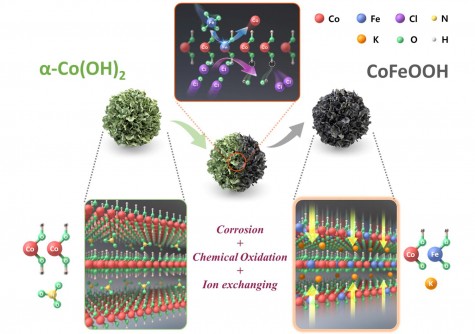
A research team led by Dr. Sung Mook Choi from the Korea Institute of Materials Science (KIMS) has made a significant breakthrough in hydrogen production technology. Collaborating with a team headed by Professor Seung-Hwa Lee at Changwon National University, they have developed a proprietary non-precious metal catalyst designed for oxygen evolution reactions (OER) that operates effectively in anion exchange membrane water electrolysis (AEMWE) environments.
This new catalyst showcases a layered structure that enhances both efficiency and durability while significantly reducing the dependence on costly precious metals. The AEMWE process, which functions under alkaline conditions, allows for the use of non-precious metal catalysts, presenting a more economical and safe alternative for hydrogen production. Despite the potential, previous attempts to fully replace precious metals were hindered by the lack of stable non-precious metal OER catalysts that could withstand long-term operation in alkaline settings.
Conventional catalysts, primarily based on transition metals, often suffer from durability issues. Prolonged use can lead to problems such as structural degradation, metal dissolution, and decreased catalytic activity. To overcome these challenges, the research team engineered a cobalt (Co) and iron (Fe)-based oxyhydroxide catalyst (CoFeOOH) with a carefully structured layered design. This innovative approach not only stabilizes the catalyst’s active surface but also optimizes the reaction pathways involved in the oxygen evolution process.
The introduction of iron into the CoFeOOH structure allows for effective modulation of the electronic properties of the cobalt centers. This adjustment lowers the energy barrier associated with the crucial adsorption and desorption steps of the reaction intermediates, enhancing the overall efficiency of the OER. As a result, the catalyst achieved high current densities even at low overpotentials, maintaining stable performance without significant structural degradation during extended operation.
To further address potential issues with catalyst corrosion and degradation during the iron doping process, the team developed a specialized technique involving controlled chemical oxidation of the catalyst surface. This method successfully established a robust catalyst surface structure optimized for the oxygen evolution reaction under alkaline conditions.
The new catalyst was tested in a unit cell of AEMWE, validating its performance and durability under practical conditions beyond the confines of laboratory settings. This achievement indicates that non-precious metal OER catalysts can be effectively integrated into AEMWE systems, paving the way for commercial applications. If successfully commercialized, this technology is poised to lead to the development of cost-effective, high-efficiency AEMWE systems that rely less on precious metals.
The implications of this research extend beyond mere cost savings; it is expected to bolster clean hydrogen production and enhance technological self-reliance in critical water electrolysis catalyst materials. Dr. Sung Mook Choi, who serves as the Principal Researcher at KIMS, emphasized the importance of this breakthrough, stating, “This research represents a case in which the limitations of non-precious metal-based catalysts were overcome through structural design.” He further expressed commitment to advancing green hydrogen production technologies, contributing to the vision of a hydrogen-based society.
The study, supported by the National Research Foundation of Korea (NRF) and published on December 1, 2025, in the journal ACS Nano, highlights the potential for a sustainable future in hydrogen energy. As the world moves toward greener energy solutions, this innovative catalyst may play a crucial role in the transition to cleaner energy sources.

Philadelphia Parks Launch Free Earth Month Events Starting April 1

Bradford’s Fish Fry Fridays Serve Community with Delicious Dinners

Trump Faces Growing Challenges Amid Rising Tensions with Iran

Scientists Probe the Universe’s Missing Topological Defects

Samsung Galaxy Watch 9 to Feature Larger 435mAh Battery

UConn Huskies Aim to Defend Title in 2026 NCAA Women’s Tournament

U.S. Littoral Combat Ships Dock in Malaysia Amid Regional Tensions

Healthy Choice Wellness Reports Quarterly Earnings, Shares Rise

Urgent News: Charles M. Payment Passes Away at 78 in Duluth

University of Hawaiʻi Joins $25.6M AI Project to Enhance Disaster Monitoring

Major Grant Enhances Cancer Care and Research in Hawaiʻi

Joleen Chaney, Beloved Journalist, Passes Leaving Lasting Legacy

San Francisco’s SFO to Welcome 16 Airlines with Nonstop Flights to Europe in 2026

Goldman Sachs Unveils 2026 Catalyst Playbook for Biotech Investors

Discover Top Business Smartphones for Professionals in 2026

Urgent Update: Tom Aspinall’s Vision Deteriorates After UFC 321

Texas Roadhouse Honors Veterans with Free Meal Vouchers

CD Projekt Red Confirms No Release for The Witcher 4 in 2026
-
Science9 months ago
University of Hawaiʻi Joins $25.6M AI Project to Enhance Disaster Monitoring
-
 Health8 months ago
Major Grant Enhances Cancer Care and Research in Hawaiʻi
-
 Top Stories9 months ago
Joleen Chaney, Beloved Journalist, Passes Leaving Lasting Legacy
-
 World7 months ago
San Francisco’s SFO to Welcome 16 Airlines with Nonstop Flights to Europe in 2026
-
 Business8 months ago
Goldman Sachs Unveils 2026 Catalyst Playbook for Biotech Investors
-
 Business7 months ago
Discover Top Business Smartphones for Professionals in 2026
-
 Top Stories9 months ago
Urgent Update: Tom Aspinall’s Vision Deteriorates After UFC 321
-
 Lifestyle9 months ago
Texas Roadhouse Honors Veterans with Free Meal Vouchers
-
 Entertainment8 months ago
CD Projekt Red Confirms No Release for The Witcher 4 in 2026
-

 Top Stories10 months ago
AI Disruption: AWS Faces Threat as Startups Shift Cloud Focus
-

 Health10 months ago
MIT Scientists Uncover Surprising Genomic Loops During Cell Division
-

 Entertainment10 months ago
Discover the Full Map of Pokémon Legends: Z-A’s Lumiose City