
Top Stories
Uber Eats Launches Autonomous Robot Delivery in Philadelphia NOW

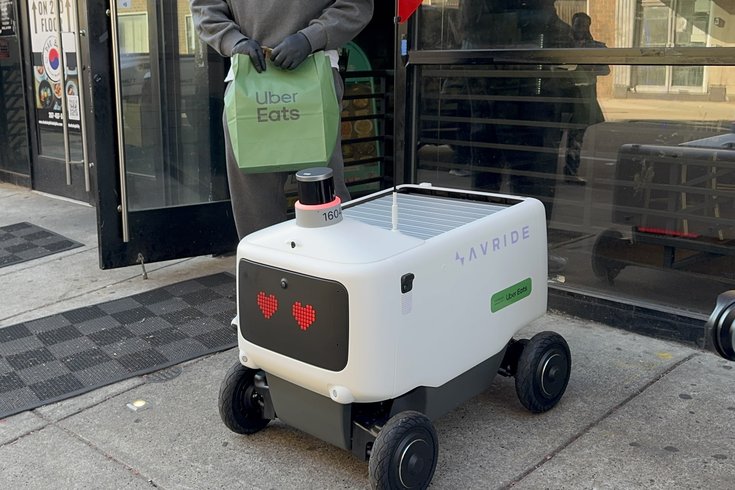
UPDATE: Pedestrians in Philadelphia will soon share sidewalks with autonomous delivery robots as Uber Eats just launched its new delivery service in Center City. The program, featuring **four-wheeled robots** developed by Avride, officially kicked off on Tuesday, marking a significant step in urban delivery innovation.
These robots, standing just under **3 feet tall** and equipped with cameras and a distinctive red flag, are designed to navigate the busy streets of Philadelphia. After nearly a year of testing, Uber Eats is rolling out this service with **dozens of local restaurants**, with plans for expansion to other neighborhoods in the near future.
“We look forward to introducing this cutting-edge technology to more Uber Eats customers over time in close collaboration with the Philadelphia community,” said **Aaron Emrich**, head of autonomous delivery at Uber.
The robots are available for delivery from **10 a.m. to 10 p.m.** and can carry up to **55 pounds** of cargo. Customers ordering through the Uber Eats app will be able to select autonomous delivery, allowing the app’s algorithm to recommend the fastest service option. The robots travel at speeds of up to **5 mph**, using advanced sensors, cameras, and radar to navigate their environment safely.
Avride emphasizes privacy, stating that their cameras automatically blur faces and license plates, ensuring that no personal data is collected. Once assigned to a delivery, customers can track their robot through the Uber Eats app and unlock its hatch upon arrival. The robots are programmed to wait **up to 10 minutes** for customers to retrieve their orders.
Megan Jensen, head of autonomous delivery operations at Uber, explained, “In dense urban centers with traffic and parking considerations, we found that robots can be really helpful in alleviating congestion.” This efficiency is particularly valuable as the robots can bypass traffic and parking challenges, providing a quicker alternative for customers, with the added benefit of not incurring delivery tips.
Uber Eats has been testing Avride’s robots throughout the city, mapping roadways and traffic patterns since last year. These robots are designed to operate in various weather conditions and have a battery life of about **12 hours**, recharging nightly at a Center City hub.
On Tuesday, representatives from Uber Eats and Avride demonstrated the robots outside **Carter’s Cheesesteaks** in Chinatown, showcasing their ability to yield to pedestrians and navigate obstacles on the sidewalks. The robots even feature animated screens that mimic expressions like blinking and “heart-eye” emojis, adding a unique touch to the delivery experience.
Philadelphia’s journey with autonomous technology has not been without controversy. The infamous **HitchBOT incident** in 2015, where a robot was vandalized in the city, looms large in public memory. To avoid a similar fate, these new delivery bots are equipped with safety features, including the ability to call for a remote supervisor from Avride if they encounter difficulties.
“This robot is a pretty sturdy piece of equipment,” Jensen noted. “Even without an order, it weighs almost **150 pounds**, making it difficult to pick up or tilt over.” With safety and functionality prioritized, these robots represent a significant evolution in urban delivery.
The launch of Uber Eats’ autonomous delivery service is part of a broader trend in Philadelphia, as various companies explore the potential of autonomous vehicles. Notably, **Waymo** is continuing its testing of robotaxis under the supervision of the **Pennsylvania Department of Transportation**.
As this innovative delivery service takes to the streets, expect to see more of these robots navigating the urban landscape, redefining how food is delivered in Philadelphia. Stay tuned for updates as this development unfolds.

Philadelphia Parks Launch Free Earth Month Events Starting April 1

Bradford’s Fish Fry Fridays Serve Community with Delicious Dinners

Trump Faces Growing Challenges Amid Rising Tensions with Iran

Scientists Probe the Universe’s Missing Topological Defects

Samsung Galaxy Watch 9 to Feature Larger 435mAh Battery

UConn Huskies Aim to Defend Title in 2026 NCAA Women’s Tournament

U.S. Littoral Combat Ships Dock in Malaysia Amid Regional Tensions

Healthy Choice Wellness Reports Quarterly Earnings, Shares Rise

Urgent News: Charles M. Payment Passes Away at 78 in Duluth

University of Hawaiʻi Joins $25.6M AI Project to Enhance Disaster Monitoring

Major Grant Enhances Cancer Care and Research in Hawaiʻi

Joleen Chaney, Beloved Journalist, Passes Leaving Lasting Legacy

San Francisco’s SFO to Welcome 16 Airlines with Nonstop Flights to Europe in 2026

Goldman Sachs Unveils 2026 Catalyst Playbook for Biotech Investors

Discover Top Business Smartphones for Professionals in 2026

Urgent Update: Tom Aspinall’s Vision Deteriorates After UFC 321

Texas Roadhouse Honors Veterans with Free Meal Vouchers

CD Projekt Red Confirms No Release for The Witcher 4 in 2026
-
Science9 months ago
University of Hawaiʻi Joins $25.6M AI Project to Enhance Disaster Monitoring
-
 Health8 months ago
Major Grant Enhances Cancer Care and Research in Hawaiʻi
-
 Top Stories9 months ago
Joleen Chaney, Beloved Journalist, Passes Leaving Lasting Legacy
-
 World7 months ago
San Francisco’s SFO to Welcome 16 Airlines with Nonstop Flights to Europe in 2026
-
 Business8 months ago
Goldman Sachs Unveils 2026 Catalyst Playbook for Biotech Investors
-
 Business7 months ago
Discover Top Business Smartphones for Professionals in 2026
-
 Top Stories9 months ago
Urgent Update: Tom Aspinall’s Vision Deteriorates After UFC 321
-
 Lifestyle9 months ago
Texas Roadhouse Honors Veterans with Free Meal Vouchers
-
 Entertainment8 months ago
CD Projekt Red Confirms No Release for The Witcher 4 in 2026
-

 Top Stories10 months ago
AI Disruption: AWS Faces Threat as Startups Shift Cloud Focus
-

 Health10 months ago
MIT Scientists Uncover Surprising Genomic Loops During Cell Division
-

 Entertainment10 months ago
Discover the Full Map of Pokémon Legends: Z-A’s Lumiose City