
Business
Global Ferrovanadium Market Set to Reach USD 8 Billion by 2034

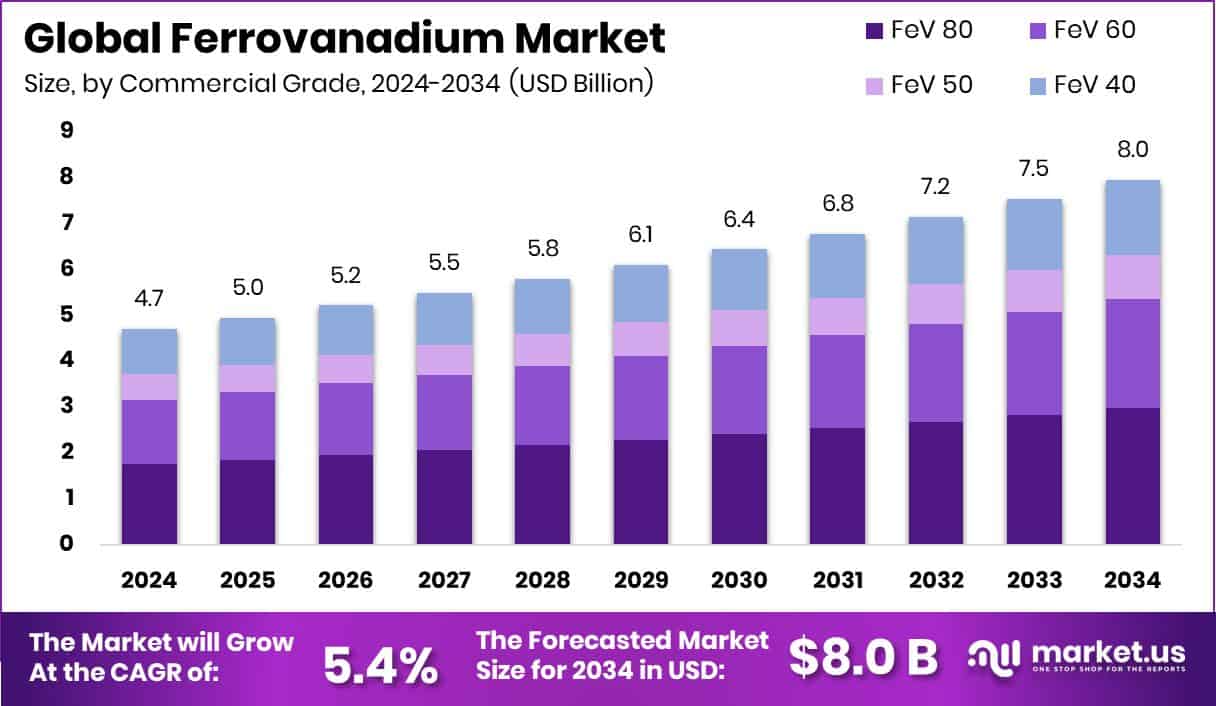
The global ferrovanadium market, valued at USD 4.7 billion in 2024, is anticipated to expand significantly, reaching USD 8 billion by 2034. This growth reflects a compound annual growth rate (CAGR) of 5.4% over the next decade. The Asia-Pacific region stands out as the leading contributor, holding a substantial 43.20% market share and generating USD 2.0 billion in revenue.
Ferrovanadium, an alloy of iron and vanadium, plays a vital role in enhancing the strength of steel used across various industries, including construction, machinery, and transportation. As urbanization accelerates and economies develop, the demand for high-performance, lightweight, and durable steel continues to grow. This trend underscores the importance of ferrovanadium in global manufacturing processes. Technological advancements in steel production and a rising interest in high-performance materials further support market momentum.
Key Market Insights
The ferrovanadium market is projected to grow robustly, with commercial-grade FeV 80 dominating demand, holding a 37.4% global market share. Production processes are led by aluminothermic reduction, which accounts for 67.2% of the market. The primary end-use segments include construction and rebar steel, capturing 34.60% of the market share.
The dominance of FeV 80 stems from its balanced vanadium content and reliability in steel manufacturing. Steel producers favor this grade for its consistent alloying behavior, which supports the production of high-quality carbon and microalloyed steels. Its stable chemical properties help meet stringent standards while minimizing melting losses, making it a practical choice for both developing and established steel markets.
In terms of production methods, aluminothermic reduction leads due to its efficiency and ability to yield high-purity ferrovanadium. This method offers superior control over chemical composition and vanadium recovery, making it particularly suitable for applications requiring consistent quality. It is also favored by smaller producers as it is less dependent on electricity, thus proving cost-effective in regions with high energy costs.
Regional Analysis and Use Cases
The Asia-Pacific region commands the ferrovanadium market, with its significant steel production capacity and strong demand for rebar and alloy steels driven by rapid urbanization and infrastructure projects. North America follows closely, benefiting from the replacement of aging steel structures and a focus on high-quality microalloyed steels. Europe maintains a steady demand due to advanced steelmaking technologies, while the Middle East and Africa experience gradual growth fueled by ongoing construction and industrial development.
Ferrovanadium serves multiple applications, including enhancing the strength of steel used in buildings and bridges, making tools and machinery parts more durable, and improving the performance of automotive components. Its lightweight properties are crucial in aerospace applications, while in the oil and gas sector, ferrovanadium-enhanced steel is essential for safe and durable pipelines and pressure equipment.
Recent developments in the industry highlight a commitment to sustainability and innovation. In March 2024, Treibacher Industrie AG announced a new recycling plant in Austria, investing nearly €120 million. This facility aims to recycle spent metal-containing catalysts, including vanadium, and will utilize waste heat to generate a portion of its electricity. Meanwhile, in February 2024, AMG Vanadium acquired processing technologies from Transformation Technologies Inc., enhancing its capacity to recycle spent refinery catalysts while minimizing carbon emissions.
The ferrovanadium market continues to gain strength as industries increasingly rely on high-performance steels that offer durability and efficiency. With rising standards for construction, automotive, and industrial applications, along with a focus on cleaner production methods and sustainable recycling, the market is well-positioned for ongoing growth in the years ahead. The interplay of technological advancements and infrastructure expansion will ensure that ferrovanadium remains a critical component in the production of reliable, high-quality steel.

Philadelphia Parks Launch Free Earth Month Events Starting April 1

Bradford’s Fish Fry Fridays Serve Community with Delicious Dinners

Trump Faces Growing Challenges Amid Rising Tensions with Iran

Scientists Probe the Universe’s Missing Topological Defects

Samsung Galaxy Watch 9 to Feature Larger 435mAh Battery

UConn Huskies Aim to Defend Title in 2026 NCAA Women’s Tournament

U.S. Littoral Combat Ships Dock in Malaysia Amid Regional Tensions

Healthy Choice Wellness Reports Quarterly Earnings, Shares Rise

Urgent News: Charles M. Payment Passes Away at 78 in Duluth

University of Hawaiʻi Joins $25.6M AI Project to Enhance Disaster Monitoring

Major Grant Enhances Cancer Care and Research in Hawaiʻi

Joleen Chaney, Beloved Journalist, Passes Leaving Lasting Legacy

San Francisco’s SFO to Welcome 16 Airlines with Nonstop Flights to Europe in 2026

Goldman Sachs Unveils 2026 Catalyst Playbook for Biotech Investors

Discover Top Business Smartphones for Professionals in 2026

Urgent Update: Tom Aspinall’s Vision Deteriorates After UFC 321

Texas Roadhouse Honors Veterans with Free Meal Vouchers

CD Projekt Red Confirms No Release for The Witcher 4 in 2026
-
Science9 months ago
University of Hawaiʻi Joins $25.6M AI Project to Enhance Disaster Monitoring
-
 Health8 months ago
Major Grant Enhances Cancer Care and Research in Hawaiʻi
-
 Top Stories9 months ago
Joleen Chaney, Beloved Journalist, Passes Leaving Lasting Legacy
-
 World7 months ago
San Francisco’s SFO to Welcome 16 Airlines with Nonstop Flights to Europe in 2026
-
 Business8 months ago
Goldman Sachs Unveils 2026 Catalyst Playbook for Biotech Investors
-
 Business7 months ago
Discover Top Business Smartphones for Professionals in 2026
-
 Top Stories9 months ago
Urgent Update: Tom Aspinall’s Vision Deteriorates After UFC 321
-
 Lifestyle9 months ago
Texas Roadhouse Honors Veterans with Free Meal Vouchers
-
 Entertainment8 months ago
CD Projekt Red Confirms No Release for The Witcher 4 in 2026
-

 Top Stories10 months ago
AI Disruption: AWS Faces Threat as Startups Shift Cloud Focus
-

 Health10 months ago
MIT Scientists Uncover Surprising Genomic Loops During Cell Division
-

 Entertainment10 months ago
Discover the Full Map of Pokémon Legends: Z-A’s Lumiose City